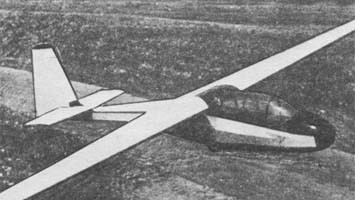
The glider was designed in response to a request from the DOSAAF Central Committee as a development of the PAI-6 glider, but project manager Alexei Ivanovich Pietsuj proposed an entirely new construction.
The MAI-56 (Russian: МАИ-56) was designed in 1956 as a two-seater training glider and was developed by the collective of the aircraft construction and projection chair at the Moscow Aviation Institute (MAI). The group of designers was made up of IV Kachanov, Ye. S. Voit, AA Liebiedinski and VA Manucharov under the direction of AI Pietsuj. An important group of students also joined this work.
The engineer AA Liebiedinski was assigned to the construction and all the calculations and plans were developed by students.
The MAI-56 featured a high cantilever wing structure and two-seater capacity, but unlike previous models, the fuselage was designed around a skeletal structure built with welded steel tubes with little lateral section covered with fabric.
The landing was made on a central wheel in the lower fuselage, which had a wooden skid at the front.
Stabilization straps were located under the wings.
The wing and tail were constructed entirely of wood with the use of steel fasteners. The wing was equipped with airbrakes.
The wing structure was designed with a single spar: the wings had a trapezoidal shape in the plane with some negative sagging. The wingtips were covered with plywood and worked by twisting. The louvered three-point ailerons featured aerodynamic and weight compensation.
The stabilizer and keel were covered with plywood. All surfaces had cable control.
The cockpit with two-seater capacity in tandem was closed by means of a transparent cover in line with the fuselage, with lateral opening towards the right. The bow fairing was attached to the cockpit deck, facilitating access to the cockpit for the pilot. The second crew member was located above the center of gravity of the model. In order to improve visibility from this second position, the wing leading edge, at the junction point with the fuselage, was made of transparent acrylic.
To improve the operation of the MAI-56, a trailer truck for transport was designed, which could be installed on a light car. The MAI-56 was generally superior to gliders of its Czechoslovakian “Pioner” type or its national “Primoriets” version, which was mass produced in the USSR. The Czechoslovakian glider had an aerodynamic quality of 17.5 against the 21 of the MAI-56, obtained thanks to the absence of wing braces and cleaner aerodynamic shapes.
The construction of the prototype was carried out in the UPM workshops of the MAI.
The first flight of the MAI-56 took place in August 1958 with the main constructor AI Pietsuj at the controls. The test program was carried out between May and September 12, starting the manufacturing tests, which took place at the airfield of the airfield the DOSAAF of Yegorievk having as pilot Pietsuj.
The pilots who participated in the tests gave a very positive evaluation of the model and recommended its series production. The test report was approved by the chairman and aeronautical constructor AS Yakovlev.
In addition to the drag tests from a Yakovlev Yak-52, four flights were made during the tests using drag from a motorcycle and six from a car. The MAI-56 glider passed the tests without difficulty. The piloting technique was considered simple and suitable for athletes of all categories, but the expected series production would never come to fruition.
Many MAI students completed their course and diploma work on topics related to the projection and development of the MAI-56. The consultations with the students were made by Professors Ye. S. Voit, IV Kachanov and AA Liebiadinski.
MAI-56
Wingspan: 15.60 m
Wing area: 18.10 m²
Aspect ratio: 13.1
Length: 7.61 m
Empty weight: 237 kg
Maximum weight: 273 kg
Wing loading: 21.9 kg / m²
Glide ratio: 21
Accommodation: 2
 All Aero