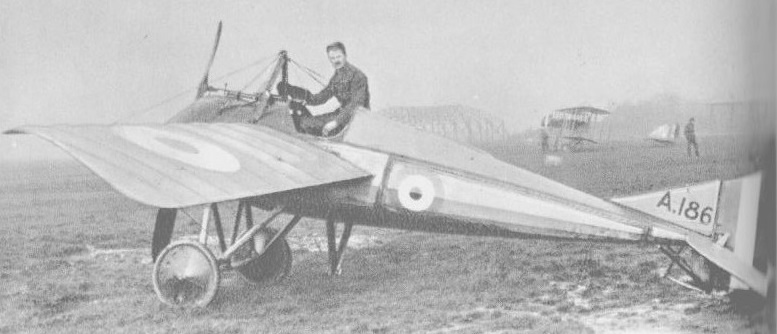
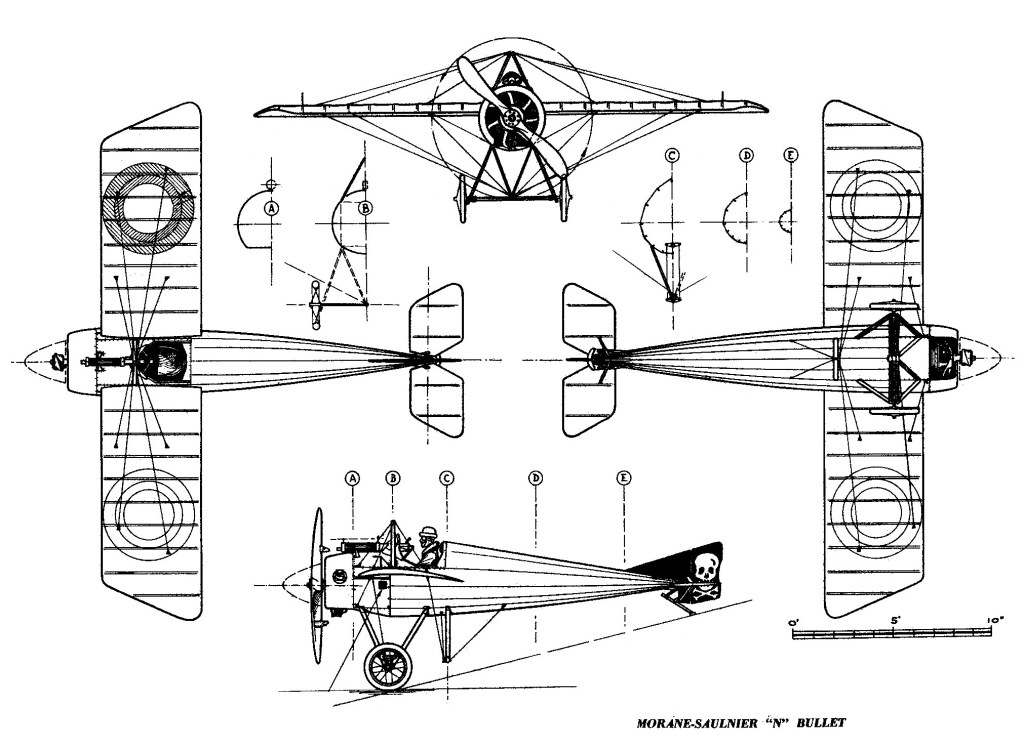
The Type N was a streamlined version of the L and thus obtained the nickname of “Bullet” from the RFC. Its lines were accentuated by the large airscrew spinner, dubbed “casserole” by the French. The Type N or Monocoque Morane was a mid wing fighter powered by either the 80 h.p. Gnome or 110 h.p. Le Rhone engine. Fabric covered, the two-spar wooden wings used wing warping. The fabric covered wooden fuselage has ring stringers to give a circular section. The tail surfaces were fin, rudder and elevators.
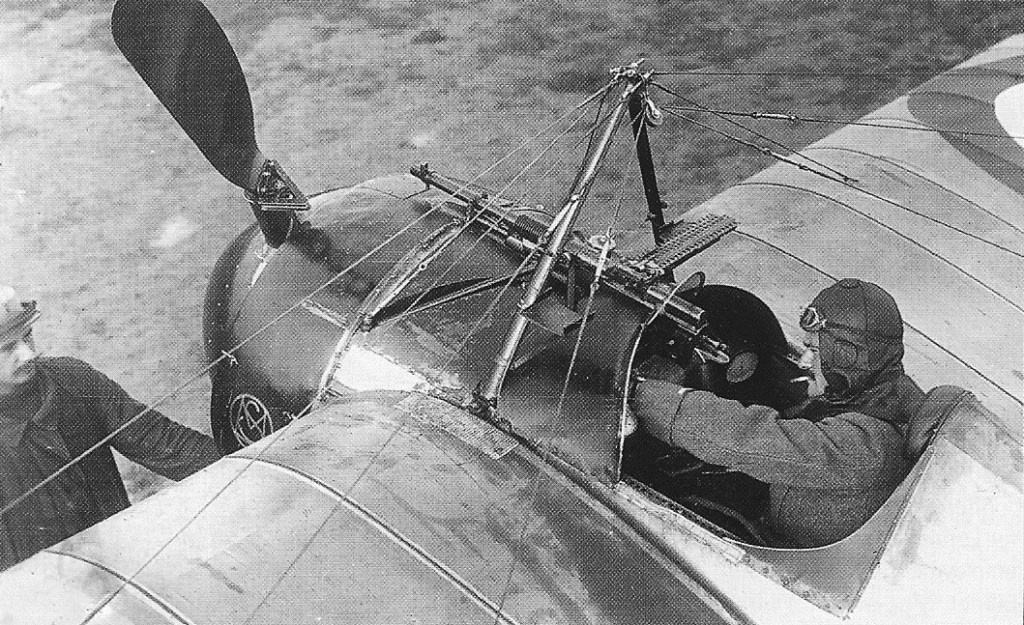
Armament varied; earlier versions flown by the French were armed with the Hotchkiss or more often with the St. Etienne machine gun fitted above the fuselage immediately behind the propeller blades. Later the Vickers gun, with a crude form of interrupter gear, became standard. British versions were fitted with the Lewis gun.
During the period May August 1916 the N served with No. 60 Squadron RFC. It was during this time that an official order was issued to the effect that all “Bullets” must have their spinners and other external metallic parts doped red, to avoid confusion with the similar shape of the Fokker monoplanes.
Effectively the earliest single-seat fighters were the Morane-Saulnier Type N and its German contemporary, the Fokker E I, although the Type N had not been conceived with a military application in mind. Both types were flown in May 1914, the Type N being demonstrated in the following month at Aspern, Vienna. Retaining the wing warping lateral control of earlier Morane-Saulnier shoulder-wing monoplanes, but embodying noteworthy aerodynamic refinements, the Type N was powered by an 80 hp Le Rhône 9C rotary engine, and its operational use was pioneered by Eugene Gilbert who flew an early example fitted with a forward-firing 8-mm Hotchkiss machine gun with propeller-mounted steel bullet dcflectors and dubbed Le Vengeur, this armament being similar to that of the Type L flown by Roland Garros. The performance of Le Vengeur prompted an official order for a small series of aircraft for use by the Aviation Militaire and these entered service in the summer of 1915. In January 1916, 24 Type N aircraft were ordered for the Royal Flying Corps, these being delivered between March and June 1916, and becoming known unofficially to the service as “Morane Bullets”. A few were delivered to the Russian Military Air Fleet, but most had been withdrawn from French operational service before the end of 1915, and those delivered to the RFC were phased out in the following summer. As supplied to the RFC, the Type N was fitted with either the Lewis or Vickers machine gun, both of 7,7-mm calibre.
Only 49 were built, designated MS.5C.1 in French service. The Morane-Saulnier Type N was followed into service by two larger, more powerful and better-armed variants, the Type LA and Type P.
The Old Rhinebeck Morane Saulnier N was constructed from an original Morane Saulnier A.I fuselage, obtained by Cole Palen in 1981, and new wings were fabricated to complete the reproduction. It is finished in the colors of Alexander Kazakov’s aircraft.
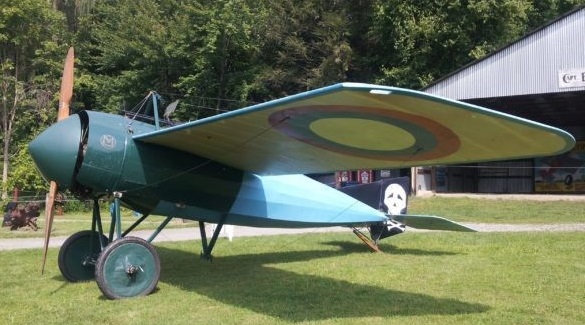
Replica:
Circa Reproductions Morane Saulnier N / Bullet
Bianchi / Personal Plane Services Morane N
Engine: 1 x 110hp Le Rhone 9J rotary engine
Max take-off weight: 510 kg / 1124 lb
Span, 26 ft 8 5/8 in (8,15 m)
Length, 19 ft 1½ in (5,83 m)
Height, 7 ft 4½ in (2,25 m)
Wing area, 118.4 sq ft (l1,00 sq.m).
Max. speed: 165 km/h / 103 mph at 6,500ft
Service ceiling: 4000 m / 13100 ft
Armament: 1 x 7.7mm machine-gun
Endurance: 1¾ hrs
Time to 3,280 ft (1 000 m), 4.0 min
Engine: 1 x 110hp Le Rhone 9J rotary engine
Span: 27 ft 3 in
Length: 22 ft
Height: 8 ft 3 in
Empty weight: 735 lb
Max take-off weight: 1122 lb
Max. speed: 103 mph at 6,000ft
Service ceiling: 13,000 ft
Endurance: 1 hr 30 min
Armament: 1 x Hotchkiss, Vickers, or Lewis machine-gun
 All Aero