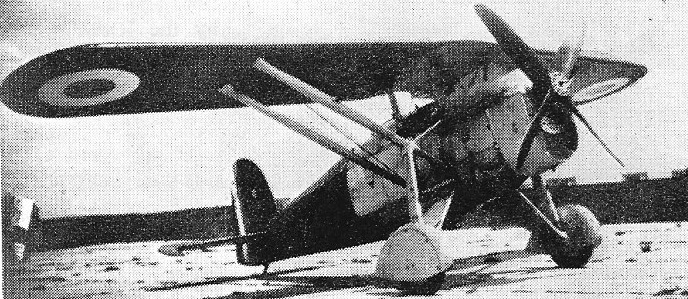
The Morane-Saulnier M.S.225 was a French fighter aircraft of the 1930s. It was produced in limited quantities to be used as a transitional aircraft between the last of the biplanes and the first monoplane fighters.
The M.S.225 was a parasol monoplane, with a wide fixed landing gear, and powered by a Gnome-Rhône 9Krsd radial engine, and having a circular fuselage.
The Morane-Saulnier M.S.225 was first shown in the form of a model at the Paris Air Show of 1932. After successful flight tests of the prototype in 1932, series production started at once.
Classified in the category C.1 (single-seat fighter), 75 aircraft were produced. A total of 53 aircraft were delivered to the Air Force in November 1933. The M.S.225s of the Armée de l’Air served in the 7e Escadre de Chasse (7th Fighter Wing) at Dijon, and in two escadrilles of the 42e Escadre (42nd Wing), based at Rheims. They were withdrawn from front-line service between 1936 and 1937.
The Aéronavale received the first of the 16 aircraft it had ordered in February 1934. The aircraft also flew with the Aéronavale l’Escadrille 3C1, established in Marignane, this formation later transferring to the Air Force at the beginning of 1936, where it became Le Groupe de Chasse II/8.
Three were also sold to China.
The Air Force Aerobatic Squadron based at Étampes used five modified M.S.225s, with a larger vertical stabilizer, while the last unit of the Air Force to operate this aircraft was the flying school based at Salon-de-Provence.

In 1932, Morane-Saulnier initiated study of a dedicated shipboard version of the M.S.225 fighter. Designated M.S.226 and powered by a similar Gnome-Rhone 9Kdrs to that of the shore-based fighter, the shipboard aircraft differed initially in having some structural strengthening, an arrester hook and naval equipment. Three prototypes were ordered in 1933, the first two being completed as M.S.226s and the third as the M.S.226bis which differed in having aft-folding wings. No series production of the M.S.226 was undertaken as the Marine Nationale considered the type to be conceptually obsolescent.
A variant used as test bench for the 515 kW (690 hp) Hispano-Suiza 12Xcrs engine, with a four-bladed propeller was designated M.S.227.
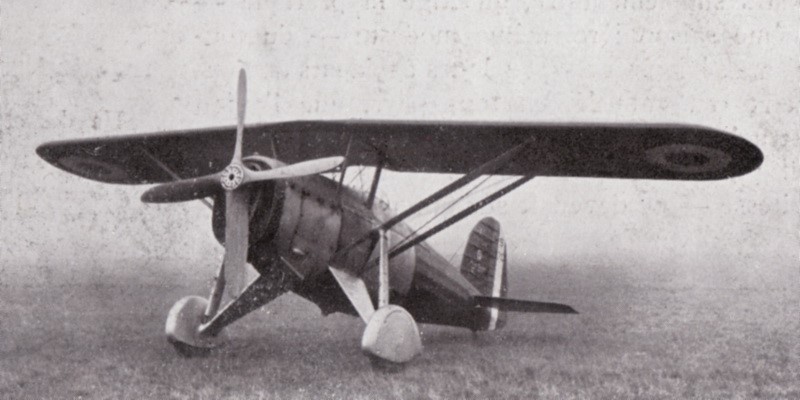
At the outbreak of World War II, only 20 M.S.225s were still in flying condition, the majority of them being scrapped in mid-1940.
Variants:
M.S.225
Production variant
Engine: Gnome-Rhone 9Kdrs, 373 kW (500 hp)
Propeller: 2-bladed fixed-pitch wooden
Wingspan: 10.56 m (34 ft 8 in)
Wing area: 17.2 m2 (185 sq ft)
Length: 7.25 m (23 ft 9 in)
Height: 3.26 m (10 ft 8 in)
Empty weight: 1,154 kg (2,544 lb)
Gross weight: 1,590 kg (3,505 lb)
Maximum speed: 334 km/h (208 mph, 180 kn) at 3,850 m (12,631 ft)
Range: 700 km (430 mi, 380 nmi)
Service ceiling: 10,000 m (33,000 ft)
Rate of climb: 6.12 m/s (1,205 ft/min)
Time to altitude: 3,000 m (9,843 ft) in 5 minutes 42 seconds
Armament: 2 × 7.7 mm (.303 in) Vickers machine guns
75 built
Crew: 1
M.S.226
1933
arrestor hook
Engine: Gnome & Rhône 9Kdr
Wingspan: 10.56 m / 34 ft 8 in
Wing area: 17.20 sq.m / 185.14 sq ft
Length: 7.25 m / 23 ft 9 in
Height: 3.26 m / 10 ft 8 in
Max take-off weight: 1640 kg
Max. speed: 277 km/h / 172 mph
Ceiling: 7500 m / 24600 ft
M.S.226bis
1934
226 with folding wings
M.S.227
test bench for the 515 kW (690 hp) Hispano-Suiza 12Xcrs engine
four-bladed propeller.
M.S.278
Conversion of the M.S.225
Engine: 388 kW (520 hp) Clerget 14Fcs diesel
 All Aero