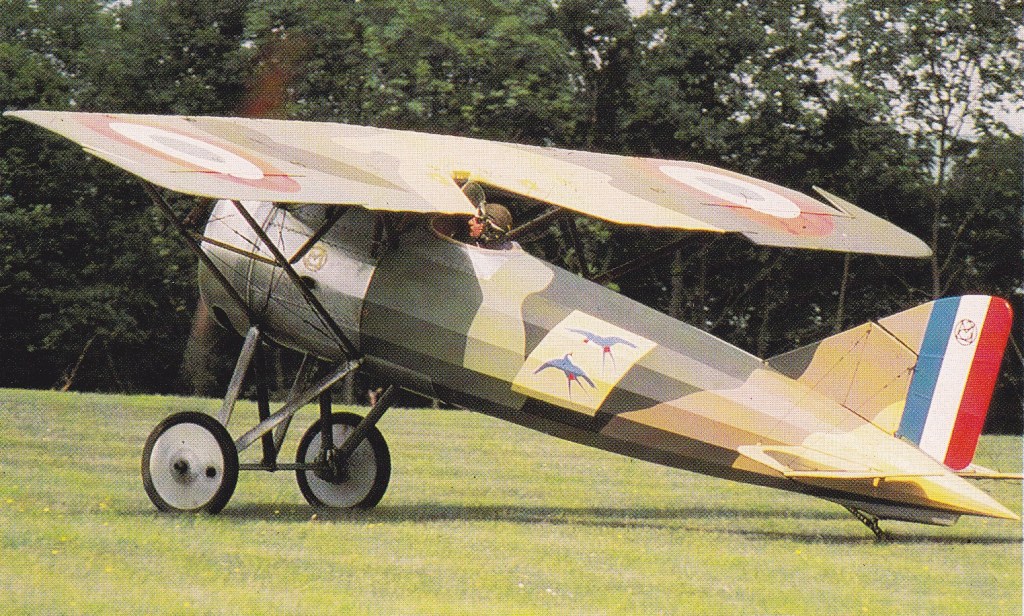
The type AI was a parasol monoplane with the wing on cabane struts and braced by parallel struts running from the outer wings to the landing gear attachment points on the lower fuselage.
The first flight was made in the summer of 1917, entering service at the beginning of 1918. Arrmament was one or two machine guns synchronised to fire through the propeller disc.
In May 1918 the type was withdrawn from front-line service after a number of structural failures and engine problems.
Morane-Sualnier tried to revive the fighter with a modified structure and a 150 hp / 112 kW Gnome rotary but further production was concentrated on two advanced trainer models without armament.
Total production exceeded 1200 and the AI was exported to Belgium, Great Britain, Japan, Switzerland, USA, and USSR.
A single-seat advanced trainer was flown by French pilot Alfred Fronval from 1921 through 1928. In August 1927 at the Zurich Meet, Fronval won over Germany’s Gerhard Fieseler in a Raab-Katzenstein with 110 hp Siemens, and Marcel Doret in his 300 hp Hispano-powered Dewoitine D-27.

In February 1928 Fronval looped an AI 1,111 consecutive times in 4 hours 56 minutes over Villacoublay.
Alfred Fronval’s A1 was donated to the Musee d L’Air by Robert Morane.
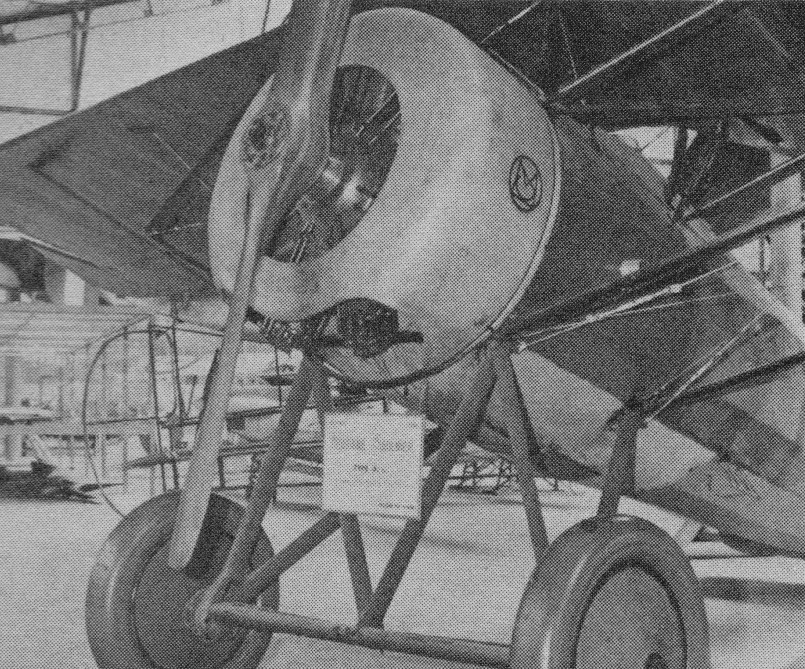

Variants:
MoS.27
Fighter
Engine: Gnome Monosoupape 9N, 150 hp / 112 kW
Wingspan: 27 ft 11 in / 8.51 m
Length: 18 ft 6.5 in / 5.65 m
Height: 7 ft 10.5 in / 2.40 m
Wing area: 144.13 sq.ft / 13.39 sq.m
Empty weight: 928 lb / 421 kg
MTOW: 1431 lb / 649 kg
Max speed: 141 mph / 225 kph at SL
Climb to 13,125 ft / 4000m: 11 min 15 sec
Service ceiling: 22,965 ft / 7000m
Endurance: 1 hr 45 min
Armament: 1 x .303 / 7.7mm mg
Seats: 1
A-1
Engine: Clerget 9B-A, 120 hp
Wingspan: 27.91 ft
Length: 18.53 ft
MoS.29
Fighter
Armament: 2 mg
MoS.30
Trainer
Engine: Le Rhone 9Jb, 120hp/89 kW or Le Rhone 9Jby, 135hp/101 kW
MoS.30bis
Trainer
Engine: Le Rhone 9Jby, 90hp/67 kW
 All Aero