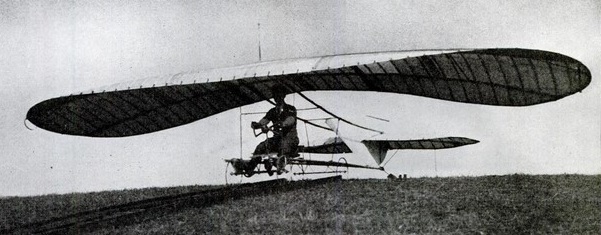
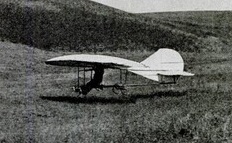
John J Montgomery, a science teacher at Santa Clara College, in California, experimented with gliders as early as 1883. Montgomery’s 1883 glider had a short, 23 foot wing span with a moveable horizontal tail. A keel-like bar (longeron) was suspended three feet below the wing longerons. The pilot ran to launch the ship by holding the upper bars, and once in flight he straddled the centre bar. He could then swing his body from side to side for lateral control and manipulate the horizontal elevator plane for lift. The craft is reported to have flown consistently well.
The first glider proved the value of the cured wing which he copied from a seagull and with it he flew 600 ft.
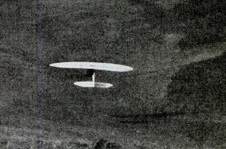
His second hang glider used flat wing surfaces, and proved to be totally useless. In 1905, Montgomery added a second, tandem wing to his basic design, and Daniel Maloney, a parachute jumper, made numerous exhibition flights with his plane, performing sharp turns and even barrel rolls.
His third hang glider incorporated wing warping for lateral control.
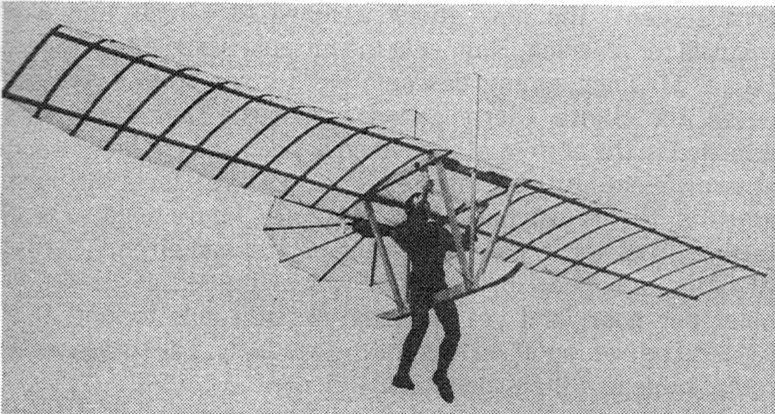
Montgomery’s first models were tested from aa cable suspended between two hill tops in California, and the gliders were dropped from them. He was able to give them such stability that they could even even themselves after being launched upside down, and glider smoothly to the ground.
Montgomery made a number of flights himself but stopped when he put his foot in a squirrel hole on one landing and hurt his leg.
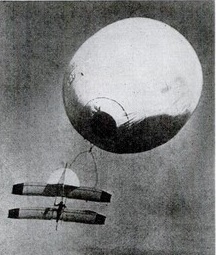
He also dropped from a balloon at 4000 feet and glided gently back to a stand-up landing at his take-off point.
In 1905 Montgomery returned with an improved hang glider with two main wings: one placed behind the other in a tandem arrangement.
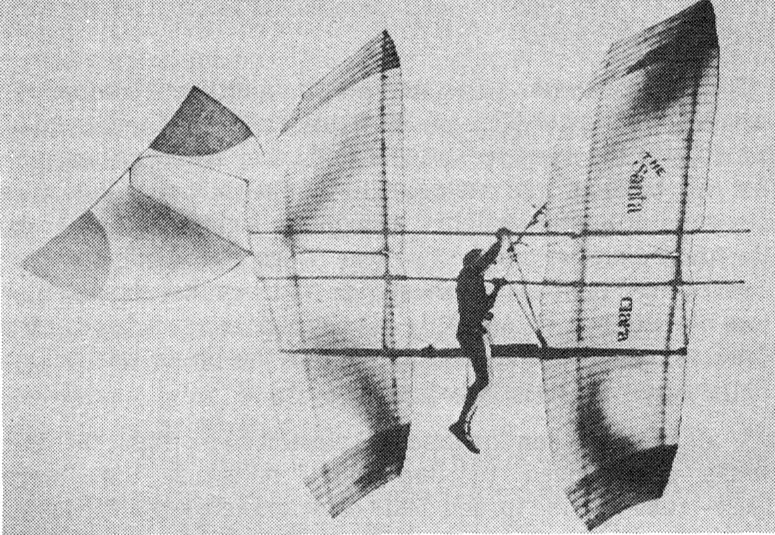
His new glider weighed 45 lb and had controls for steering. Engaging parachute jumper Daniel Maloney, many descents were made from 4000 ft above the Santa Clara college grounds. The glider was attached to the bottom of a manned balloon cut loose when at sufficient altitude. Montgomery was able to perform figure eights, dives and stalls, spiral and circling turns. At times the speed of the glider was estimated at almost 70 mph, and yet Montgomery was still able to land at a predetermined spot on his own two feet.
Montgomery also employed two other glider pilots, Wilkie and Defolco. Maloney was killed in an accident and the act was discontinued. Montgomery describes the fatal accident as follows;
“The ascension was given to entertain a military company in which were many of Maloney’s friends, and he told them he would give the most sensational flight they had ever heard of. As the balloon was rising with the aeroplane, a guy-rope dropping switched around the right wing and broke the tower that braced the rear wings and which also gave control over the tail. We shouted to Maloney that the machine was broken, but he probably did not hear us, as at the time he was saying ‘Harrah airship’ and as the break was behind him, he may not have detected it. When the machine started on its flight, the rear wings commenced to flap – indicating they were loose – the machine turned on its back and settled faster than a parachute. When we reached Maloney he was unconscious and lived only 30 minutes. The only mark of any kind on him was a scratch from a wire on the side of his neck, the six attending physicians were puzzled at the cause of his death”.
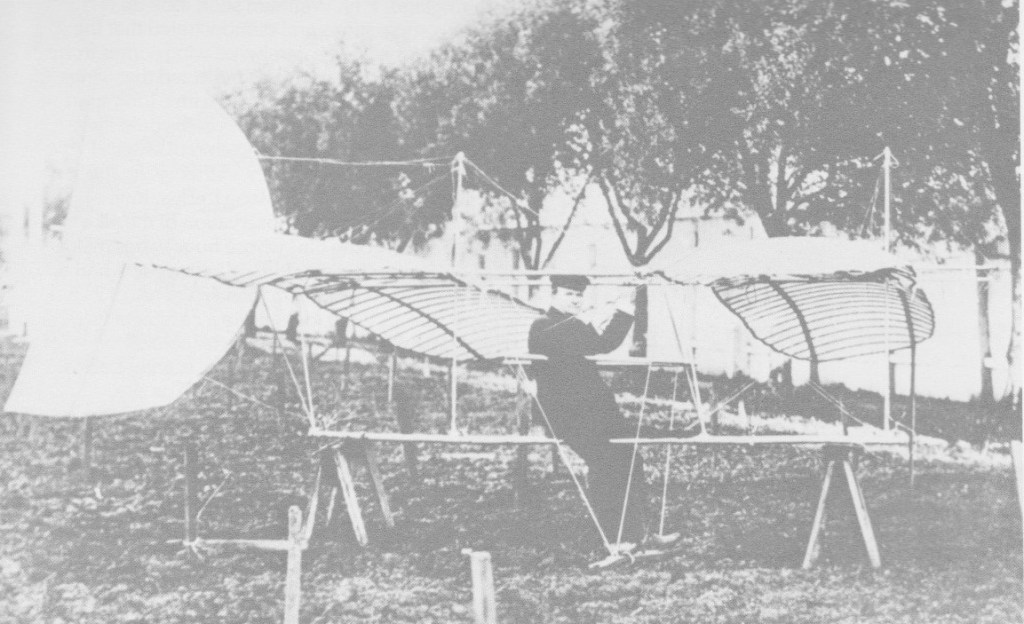
Montgomery did quite a bit of research in the use of curved lifting surfaces and the movement of air around them. He had intended to carry out more experimentation, but the great San Francisco Earthquake prevented it. It wasn’t until 1911 that he again started gliding, but unfortunately h was soon killed in a fall in one of his gliders. In October, while in the air, he was struck by an unexpectedly violent gust of wind which sent his glider crashing to the ground. He hit fairly hard and injured his head and hip. At the time he did not think he was severely hurt, but later on complained of severe pains. These continued to get worse, and stayed with him until death.
 All Aero