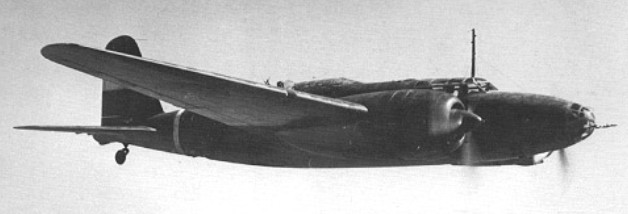
The Mitsubishi Ki-21 (Army Type 97 Heavy Bomber) was produced by engineers Nakata and Ozawa in response to an operational specification issued by the Air Headquarters (Daihonei) of the JAAF on 15 February 1936. The original specification, issued in February 1936, had required an aircraft with an endurance of over five hours at an average cruising speed of 300 km/h (186 mph), able to climb to 3000 m (9840 ft) in eight minutes and reach a maximum 400 km/h (248 mph) at that height. Normal crew was to be four, with provision for two more gunners on missions where extensive air opposition was anticipated. Maximum bombload for short range missions was to be 1000 kg (2200 lb). Early production aircraft in fact met or exceeded all these criteria.
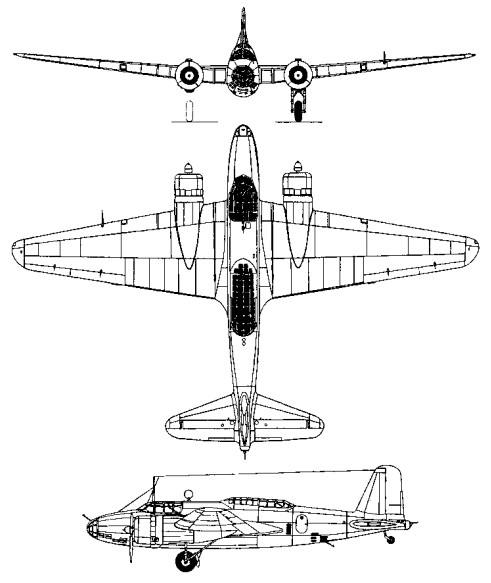
In its definitive form the Ki 21 was a midwing monoplane of all metal semi-monocoque construction, and the smoothly contoured fuselage was oval in section. It had a single fin and rudder, and the main under-carriage legs retracted forward into the two engine nacelles.
The first of eight prototypes and service trial aircraft flew on December 18, 1936. It had a square glassed in nose, dorsal gun turret and a ventral step for a lower defensive gun. Later prototypes adopted a long dorsal greenhouse accommodating the gunner’s position, a well contoured hemispherical glassed in nose and a smooth lower fuselage line which eliminated the ventral step. To improve directional stability the fin and rud¬der were redesigned and increased in area. The first prototype had two Mitsubishi Ha 6 825 hp radial engines, while the remaining prototypes and early production machines had 850 hp Nakajima Ha 5 Kais.
Before going into production the Ki 21 had survived a competition with its rival the Nakajima Ki 19. As a consolation a contract was awarded by the Koku Hombu (the army air headquarters) not only to Mitsubishi (432 Model Is built) but also to Nakajima (351 Model Is).
A year late in entering service, some of its technology, compared with that of contemporary foreign aircraft, was not as advanced as the designers Nakata and Ozawa had hoped. The gap left by the delay in delivery of Ki 21s had to be filled by importing Fiat B.R.20 bombers. The first production model being the Mitsubishi Ki-21-Ia (Army Type 97 Model 1A). Because of production bottlenecks it was not until the end of 1939 that Ki-21-la bombers equipped the first JAAF unit, the 60th Hikosentai (air regiment) based in China, the next unit to be equipped was the 61st Sentai.
Early lessons learned over China demonstrated lack of firepower and protection, and the Ki-21-Ib and Ki-21-Ic subvariants had extra armour, additional 7.7mm Type 89 machine-guns, more fuel and larger bomb-bays. The engines were 634kW Nakajima Ha-5 KAI radials.
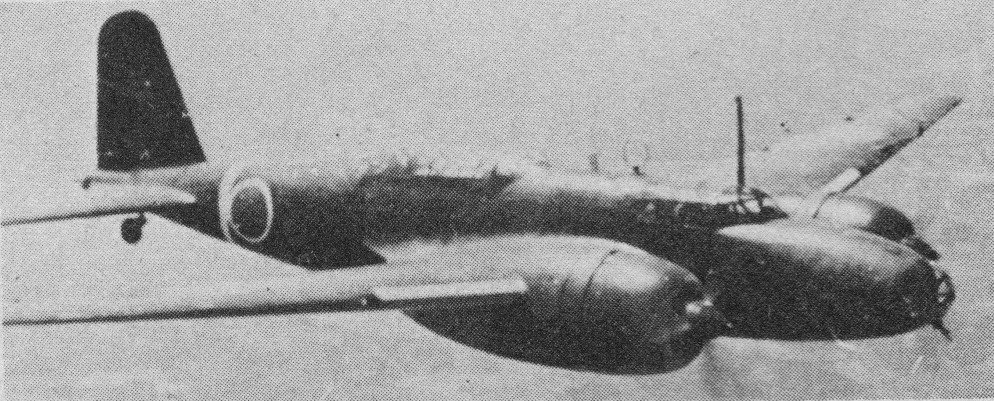
By the time of the outbreak of war in December 1941, the majority of the Mitsubishi Ki-21-Ia, Ki-21-Ib and Ki-21-Ic bombers had been relegated to second-line duties, or to service as operational bomber trainers. Most army front line bomber units were equipped with the Model 2 version of Ki 21, powered by two 1450 hp / 1119kW Mitsubishi Ha 101 14 cylinder radials driving constant speed three bladed metal propellers, unlike the Ha 5 Kai radials of the earlier version which had variable pitch propellers. The larger and more powerful Ha 101s required larger nacelles, and these completely enclosed the retracted landing wheels in the earlier machines, the wheels were left partly exposed.
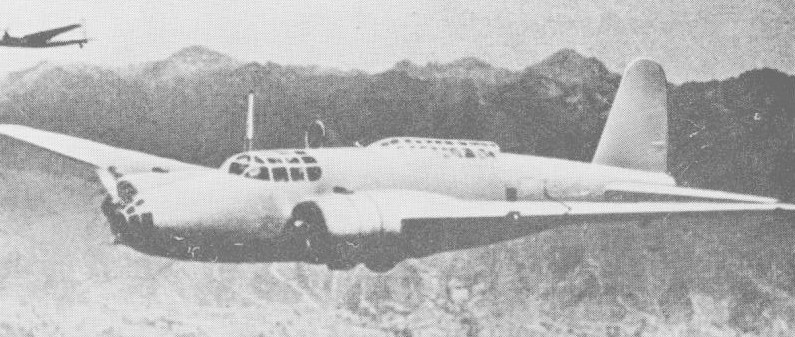
Production models in service in 1941 were the Ki-21-IIa (Army Type 97 Heavy Bomber Model 2A), and the Ki-21-IIb which had a pedal-operated dorsal turret with one 12.7mm Type 1 heavy machine gun. Three sentais remained in Japan, Korea and in Manchuria when the Japanese high command went to war in South East Asia. For operations over the Philippines the JAAF’s 5th Air Group, based in Formosa, mustered the 14th and 62nd Hikosentais; these went into action early on the morning of 8 December 1941 striking at Aparri, Tuguegarao, Vigan and other targets in Luzon. Mitsubishi Ki-21s of the 3rd Air Group, based in French Indo-China, were earmarked for bombing strikes against Siam (Thailand) and Malaya: units were the 12th, 60th and 98th Hikosentais. These smashed RAF and RAAF facilities at Alor Star, Sungei Patani and Butterworth, being escorted by Nakajima Ki-27 and Ki-43 fighters. Only over Rangoon over December 1941 and January 1942 did the Ki-21s, codenamed ‘Sally’, suffer heavy casualties.
At its peak the Ki 21 was supplied to 11 first line Sentais and played a considerable part in the Pacific air war. Towards the end of its career lack of Ki 49 and Ki 67 replacements forced the retention of the Ki¬-21 in the first line when it was obsolete and suffering heavy losses. It took part in a number of outstanding actions, perhaps the most notable of which was the suicide mission by nine Model 2s of the 3rd Dokuritsu Hikotai (independent air wing). These were to land on the US occupied airfield at Yontan on Okinawa in the summer of 1945 to launch commando style attacks on airfield installations and aircraft. Only one aircraft survived to deliver its troops, but considerable damage was inflicted before they were wiped out.
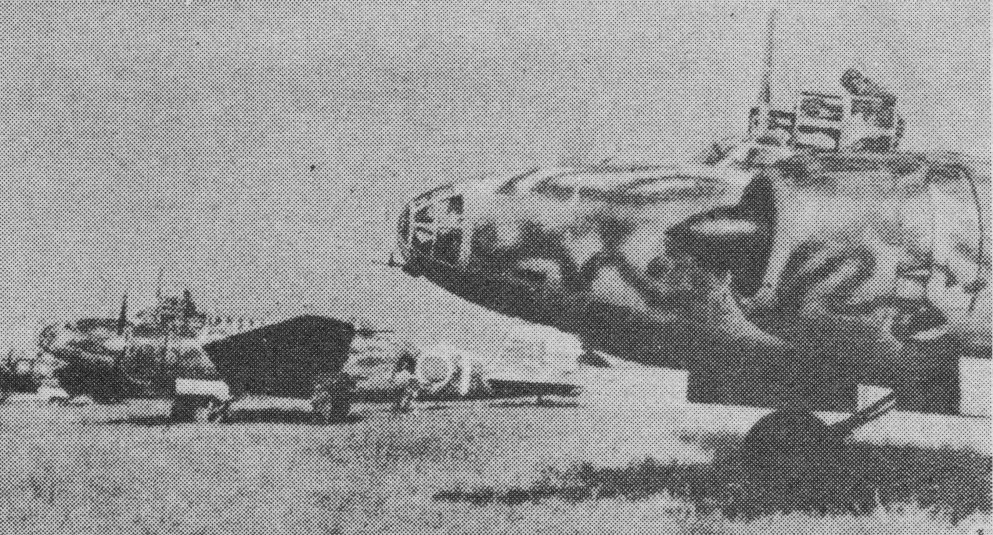
The original Ki 21 defensive armament of single flexibly mounted 7.7 mm (0.303 in) Type 89 machine guns mounted in nose, dorsal and ventral positions proved barely adequate even for operations against the poorly equipped Chinese air force, and the Ki 21 Ib had an additional gun in a remotely operated tail stinger position plus another which could be fired from lateral positions on either side of the fuselage. The Ki 21 Ic and IIa had two beam guns while the Ki 21 IIb (688 of which were built between 1942 1944) had a remotely controlled tail stinger position for a 7.7 mm (0.303 in) machine gun, and the dorsal greenhouse replaced by a large conical turret mounting a single 12.7 mm (0.54in) Type 1 machine gun. This latter change greatly altered the appearance of the Ki 21 IIb and for a period it was thought by the Allies to be a new bomber type and given a different codename, Gwen, which was soon dropped when the new version was properly identified.
The bombload of all Ki 21 versions remained the same: a normal load of 750 kg (1653 lb) and a maximum of 1000 kg (2205 lb). The maximum range was 2700 km (1680 miles).
Some Ki 21 Ia bombers were modified during 1940 and put into service as MC 21 freight transports. Formally they passed into civil use as they were operated by the Dai Nihon Koku KK (Greater Japan Airlines) on routes between Japan, China and Manchuria, but all these flights were in fact military contract work, carrying army supplies (or personnel). Although all armament and other equipment appropriate to the bombing role had been removed, the aircraft were externally identical to the bombers, until a number were modified by the fitting of a ‘solid’ nose.
The Ki.21 was coded ‘Jane’ after Gen. MacArthur’s wife but when this came to his attention at the General’s request the code was changed to ‘Sally’,
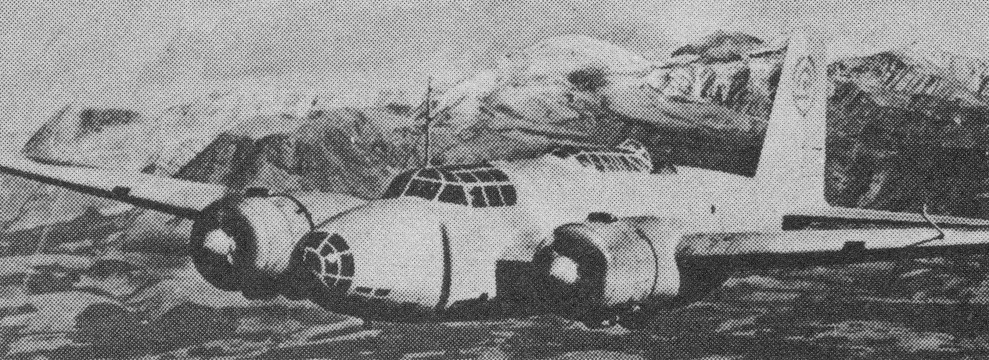
Code named Sally, a modified model with a smooth dorsal line and a gun turret in place of the ‘greenhouse’ led spotters to believe a new type was entering service. The name ‘Gwen’ was assigned, but soon dropped in favour of ‘Sally 3’ when it was identified as a model variation.
Production of the Ki 21 ceased in September 1944, with the 2064th aircraft.
Ki-21 (Army Type 97 Heavy Bomber) prototype
Engines: 2 x Mitsubishi Ha 6 825 hp radial or 850 hp Nakajima Ha 5 Kais.
Propellers: variable ¬pitch
Span: 22.5m (73ft l0in)
Length: 16m (52ft 6in)
Height: 4.35 m / 14 ft 3 in
Wing area: 69.6 sq.m / 749.17 sq ft
Ki-21-Ia (Army Type 97 Model 1A)
Engines: 2 x 850 hp Nakajima Ha 5 Kais.
Propellers: variable ¬pitch
Span: 22.5m (73ft l0in)
Length: 16m (52ft 6in)
Height: 4.35 m / 14 ft 3 in
Wing area: 69.6 sq.m / 749.17 sq ft
Gross weight: 7916 kg (17452 lb)
Empty weight: 4691 kg / 10342 lb
Maximum speed: 432 km/h (268 mph) at 4000 m (13,125 ft)
Ceiling: 8600 m / 28200 ft
Range w/max.fuel: 2700 km / 1678 miles
Range w/max.payload: 1500 km / 932 miles
Crew: 5
Armament: 3 x 7.7mm (0.303 in) Type 89 machine-guns
Bombload: 750 kg (1653 lb) – 1000 kg (2205 lb)
Ki-21-Ib
Engines: 2 x 634kW Nakajima Ha-5 KAI radials.
Propellers: variable ¬pitch
Span: 22.5m (73ft l0in)
Length: 16m (52ft 6in)
Height: 4.35 m / 14 ft 3 in
Wing area: 69.6 sq.m / 749.17 sq ft
Maximum range: 2700 km (1680 miles)
Armament: 4 x 7.7mm (0.303 in) Type 89 machine-guns
Bombload: 750 kg (1653 lb) – 1000 kg (2205 lb)
Ki-21-Ic
Engines: 2 x 634kW Nakajima Ha-5 KAI radials.
Propellers: variable ¬pitch
Span: 22.5m (73ft l0in)
Length: 16m (52ft 6in)
Height: 4.35 m / 14 ft 3 in
Wing area: 69.6 sq.m / 749.17 sq ft
Maximum range: 2700 km (1680 miles)
Armament: 4 x 7.7mm (0.303 in) Type 89 machine-guns
Bombload: 750 kg (1653 lb) – 1000 kg (2205 lb)
Ki 21-II
Engines: 2 x 1450 hp / 1119kW Mitsubishi Ha 101 14 cylinder radials
Props: constant speed three bladed metal
Span: 22.5m (73ft l0in)
Length: 16m (52ft 6in)
Height: 4.35 m / 14 ft 3 in
Wing area: 69.6 sq.m / 749.17 sq ft
Maximum range: 2700 km (1680 miles)
Armament: 4 x 7.7mm (0.303 in) Type 89 machine-guns
Bombload: 750 kg (1653 lb) – 1000 kg (2205 lb)
Ki-21-IIa (Army Type 97 Heavy Bomber Model 2A),
Engines: 2 x 1450 hp / 1119kW Mitsubishi Ha 101 14 cylinder radials
Props: constant speed three bladed metal
Span: 22.5m (73ft l0in)
Length: 16m (52ft 6in)
Height: 4.35 m / 14 ft 3 in
Wing area: 69.6 sq.m / 749.17 sq ft
Maximum range: 2700 km (1680 miles)
Armament: 4 x 7.7mm (0.303 in) Type 89 machine-guns
Bombload: 750 kg (1653 lb) – 1000 kg (2205 lb)
Ki-21-IIb
Engines: 2 x 1450 hp / 1119kW Mitsubishi Ha 101 14 cylinder radials
Props: constant speed three bladed metal
Span: 22.5m (73ft l0in)
Length: 16m (52ft 6in)
Height: 4.35 m / 14 ft 3 in
Wing area: 69.6 sq.m / 749.17 sq ft
Empty weight: 13,382 lb
Gross weight: 9710 kg (21407 lb)
Maximum speed: 486 km/h (302 mph) at 4720 m (15,485 ft).
Maximum range: 2700 km (1680 miles)
Armament: 4 x 7.7mm (0.303 in) Type 89 machine-guns, 1 x 12.7mm Type 1 heavy machine gun.
Bombload: 750 kg (1653 lb) – 1000 kg (2205 lb)
Crew: 7
MC 21
 All Aero