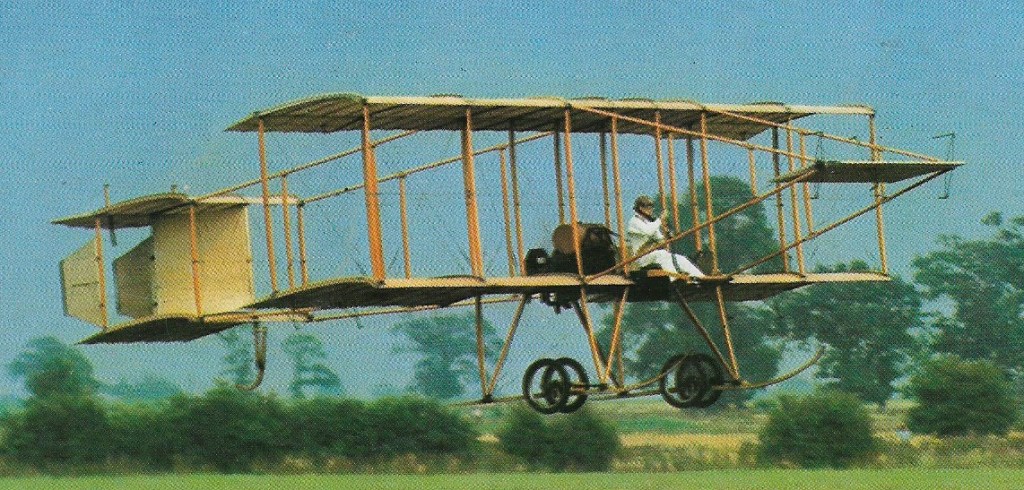
No original Bristol Boxkites aeroplanes survive today, although three authentic flyable reproductions were built by the F.G. Miles group for the film Those Magnificent Men in Their Flying Machines. Of 20 types built in 1964 at £5,000 pounds each, six could fly, flown by six stunt pilots and maintained by 14 mechanics.
The Phoenix Flyer Bristol Boxkite built by F.G. Miles Engineering Co. at Ford, Sussex, representing Curtiss biplane of 1910. Annakin had apparently expressed a desire to have a Wright Flyer in the film. The Bristol (a British derivative of the French 1909 Farman biplane) was chosen instead because it shared a common general layout with a Wright or Curtiss pusher biplane of the era, and had an excellent reputation for tractability. For the impersonation, the replica had “The Phoenix Flyer” painted on its outer rudder surfaces and was also called a “Gruber-Newton Flyer” adding the name of its primary backer to the nomenclature; although the American pilot character, Orvil Newton inaccurately describes his aircraft to Patricia Rawnsley as a “Curtiss with an Anzani engine.”
These were initially powered by a 65 hp (48 kW) Rolls-Royce Continental A65 air-cooled flat four, but this produced insufficient power, due to the shorter-stroke, higher-RPM mid-20th century engine, driving a small-diameter modern propeller, being inefficient at the low airspeed achieved by the Boxkite, which originally used the slower-revving Gnome Omega 50 hp seven-cylinder rotary engine.
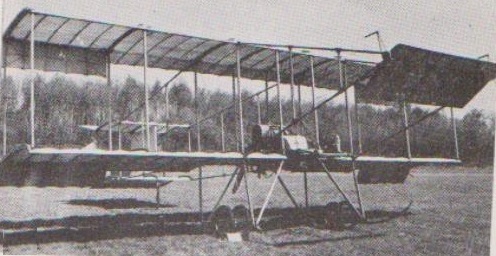
F G Miles, chiefly responsible for its design and manufacture, built the replica Bristol Boxkite with the original standard twin rudder installation and powered the replica with a 65 hp Rolls-Royce A65. In the course of testing, Air Commodore Wheeler had a third rudder inserted between the other two (as did some original Boxkites) to improve directional control, and replaced the first engine with a Rolls-Royce C90 that barely delivered the power of the original 50 hp Gnome rotary, and provided a 45 mph top speed. The Boxkite was tractable and the scene in the story when the aircraft loses a pair of main wheels just after takeoff but lands smoothly was repeated 20 times for the cameras. In the penultimate flying scene, a stuntman was carried in the Boxkite’s undercarriage and carried out a fall and roll (the stunt had to be repeated to match the principal actor’s roll and revival). Slapstick stunts on the ground and in the air were a major element and often the directors requested repeated stunts; the stuntmen were more than accommodating – it meant more pay.
This resulted in the replacement of the 65 hp flat-four by a 90 hp (67 kW) Continental O-200-B engine. These proved flyable enough to be used for cross-country flights between filming locations. Another tribute to the soundness of the design is that the calculations made for the purpose of granting the necessary Certificates of Airworthiness found that the stressing of the design was very close to modern requirements.
Box 1
c/n BM.7279 RR/Continental A65, first flown April 1964 at Ford Re-engined with a RR/Continental C90. Flew in the film ‘The Phoenix Flyer’. Refurbished and presented to the Shuttleworth Trust in Bedfordshire, where it is still flown during flying displays when the weather permits. Allocated BAPC.2.
Box 2
c/n BM.7280 A65 then C90. Donated to Museum of Australian Army Flying in Queensland after filming.
Box 3
c/n BM.7281 Retained A65 as it was only used for studio shots and crash scenes. Refurbished after the film and donated to Bristol City Museum and Art Gallery, allocated BAPC.40.
 All Aero