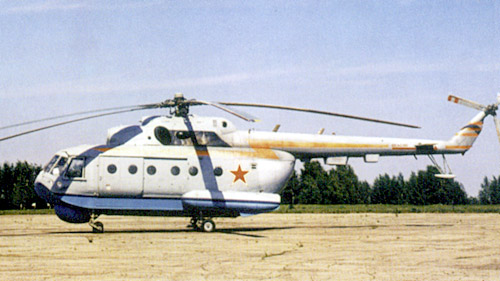
The Mi-14, allocated the NATO reporting name ‘Haze’, is an amphibious version of the Mi-8 intended to replace the Mi-4 in the ASW and mine counter-measure roles with the Soviet navy.
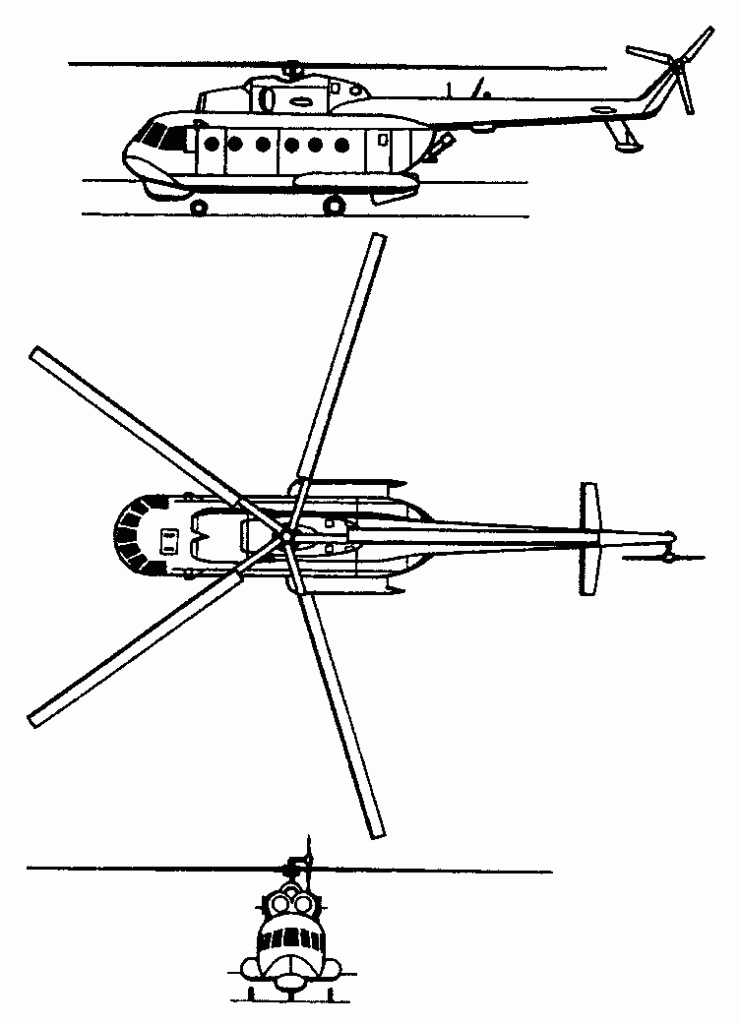
The prototype SSSR-11051, initially designated V-8G, then designated V-14, was first flown in September 1969 with a redesign watertight hull and sponsons containing fuel and a retractable undercarriage and with Mi-8 power plant. The sponson carry inflatable flotation bag each side at rear and small float the under tailboom. It has marine-type rudders on either side of the aft portion, into which the rear landing gear units retract. Two forward-retracting single-wheel nose units and two rearward-retracting twin-wheel main units. A fairing for the search radar is fitted under the nose, and a dipping sonar or magnetic anomaly detector beneath the root of the tail boom.
Production aircraft feature two 1,434kW Klimov TV3-117MT turboshafts, with a special anti-corrosion finish. Radar is the I-2M or I-2ME Initziativa undernose radar. Instrumentation includes RW3 radio altimeter, ARK-9 and ARK-U2 ADFs, DISS-15 Doppler, Chrom Nikiel IFF, AP34-B autopilot/autohover system and SAU-14 autocontrol system.
Using the twin powerplants and rotor system of the Mi-17, the ‘Haze’ went into service in 1977 and has become the basic shore-based helicopter with the Soviet navy for use in three distinct roles. Although amphibious, the Mi-14 is only intended for occasional operations from water. Initial deployment was with shore based antisubmarine units, although Haze was also expected to be oper¬ated from the Moskva Class helicopter car¬riers and the Kiev Class antisubmarine cruisers.
In the main cabin, which in transport versions can be equipped with 32 seats, a mission crew of three or four sit round a tactical display served by the radar, a towed MAD (magnetic anomaly detection) ‘bird’ and dipping sonar. Some ex¬amples have additional radio aerials and a few have a rescue hoist above the large sliding door on the left side. Fuel is housed in large tanks along the sides under the main floor, and poss-ibly also in the rear sponsons, leaving the central compartment free for use as a weapon bay, with belly doors.
Two versions have been identified: Haze A, the ASW variant with undernose search radar, towed MAD, and an internal weapons bay; and the Haze B mine countermeasures variant.
It was estimated in mid 1983 that there were 65 for the AV MF and 12 for Bulgaria. By 1991, about 230 had been delivered, with exports to Bulgaria, Cuba, East Germany, North Korea, Libya, Poland, Romania, Syria and Yugoslavia.
Versions:
Mi-14BT (buksir-tralschik) (‘Haze-B’)
Mine countermeasures version; fuselage strake, for hydraulic tubing, and air conditioning pod on starboard side of cabin; no MAD; container for searchlight, to observe MCM gear during deployment and retrieval, under tailboom forward of Doppler box.
Mi-14GP (gruzo-passazhirskyi)
Conversion by Konvers Avia of military variants for civil use as cargo/passenger combi aircraft; 24 seats or 5,000kg payload. Two 1,434kW TV3-117M turboshafts.
Mi-14P (passazhirskyi)
Conversion of military variants for civil use as passenger aircraft by Konvers Avia; 24 seats or 5,000kg payload. Two 1,434kW TV3-117M turboshafts.
Mi-14PL (protivo-lodoctinyi) (‘Haze-A’)
Basic ASW version; four crew; large undernose radome; OKA-2 retractable sonar in starboard rear of planing bottom, forward of two probable sonobuoy or signal flare chutes; APM-60 towed Magnetic Anomaly Detection (MAD) bird stowed against rear of fuselage pod (moved to lower position on some aircraft); weapons include one AT-1 ASW or APR-2 torpedo, one 1kT ‘Skat’ nuclear depth bomb or eight PLAB-250, PLAB-50-64 or PLAB-MK depth charges or OMAB-25-120 or OMAB-MK in enclosed bay in bottom of hull; VAS-5M-3 liferaft (in all versions).
Mi-14PL ‘Strike’
Subvariant with provision for Kh-23 (AS-7 Kerry) air-to-surface missiles. Tested from 1983.
Mi-14PW
Polish designation of Mi-14PL ‘Haze-A’
Mi-14PLM (protivo-lodochnyi mod) (‘Haze-A’)
As Mi-14PL, but with updated equipment including rescue basket.
Mi-14PS (poiskovo-spasatelnyi) (‘Haze-C’)
Search and rescue version, carrying 10 20-person liferafts; room for 10 survivors in cabin, including two on stretchers; provision for towing many more survivors in liferafts; fuselage strake and air conditioning pod as Mi-14BT; double-width sliding door at front of cabin on port side, with retractable rescue hoist able to lift up to three persons in basket; searchlight each side of nose and under tailboom; three crew.
Mi-14PX
Single Polish Mi-14PL converted for SAR training. With all portable ASW equipment removed, extra liferafts and sponson-mounted searchlights.
Mi-14PZh Eliminator III
Firefighting conversion.
Specifications:
Mi 14 ‘Haze’
Powerplant: two 2,200 shp (1641 kW) Isotov TV3 117A turboshafts
Empty weight approx 800,0 kg (17,650 lb)
Loaded weight approx 12000 kg (26,455 lb)
Length overall about 25.30 m (83 ft 0 in)
Height on ground 5. 65 m (18 ft 6½ in)
Main rotor disc area 355.0 sq.m (3,828.0 sq ft).
Mi-14
Engine: 2 x Klimov TW3-117MT turboshaft
Instant pwr: 1434 kW
Rotor dia: 21.6 m
Height: 6.93m
Empty weight: 11750kg
MTOW: 14,000 kg
Fuselage length: 59 ft 8 in (18.2m)
Max speed: 135 kts / 230km/h
Cruising speed: 215km/h
Service ceiling: 3500m
Max range: 1135 km
Service ceiling: 11,500 ft
Crew: 4
Mil Mi 14 PL
Engines: 2 x TW3-117M, 1923 shp
Length: 60.302 ft / 18.38 m
Height: 12.828 ft / 3.91 m
Rotor diameter: 71.982 ft / 21.94 m
Max take off weight: 30870.0 lb / 14000.0 kg
Max. speed: 124 kts / 230 km/h
Service ceiling: 13123 ft / 4000 m
Range: 613 nm / 1135 km
Crew: 4
 All Aero