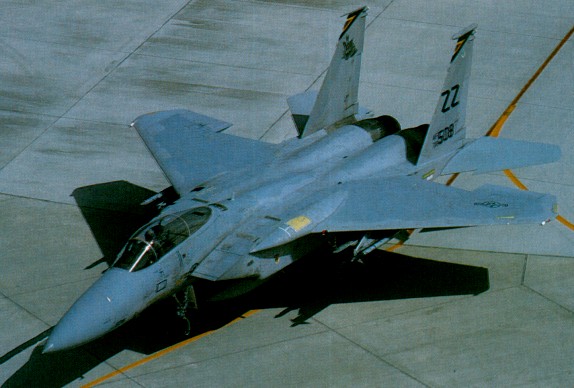
In September 1968, the USAF issued a request for proposals for a new FX fighter. The Air Force wanted a single air superiority fighter able to defeat the Mach 3 MiG 25 Foxbat, the MiG 21 Fishbed, and the MiG 23 Flogger. McDonnell was short listed and in late 1969 was selected to develop and produce the F-15 under the direction of Air Force Systems Command, full scale development being authorised in January 1970.
In February 1970, the Pratt & Whitney F100 turbofan was selected for development and a few months later the Hughes APG-63 radar was chosen for the F-15.
The initial contract called for 18 single-seat F-15As and two TF-15 trainers (re-designated F-15B in December 1977). The first F-15A was rolled out in June 1972, and made its maiden flight on 27 July 1972, to be joined by the first two-seater on 7 July 1973. Most of the major test hurdles had been successfully negotiated by late 1974, clearing the way for the Eagle to join TAC’s inventory.
The F-15 was the first USAF fighter to be developed under the DoD “Fly-Before-Buy” concept, but funding for long-lead items for the first wing of aircraft was released late in 1972, followed by full production funding in early 1973. The second wing was ordered late 1974. The first production aircraft was flown on 25 September 1974.
On 14 November 1974 President Gerald Ford formally accepted the first aircraft (actually a two-seat TF-15A designated F-15B) to be handed over to TAC at Luke AFB, Arizona. Initial operational capability was declared in July 1975, with delivery of the 24th aircraft, and the first wing was completely equipped by the end of 1976. From the outset the USAF planned a force of 729 production aircraft, of which 589 had been delivered by 1 May 1981.
McDonnell-Douglas F-15 Eagle Article
The first two models to enter service were the F-15A single-seater and TF-15A (later F-15B) combat-capable tandem two-seater. Both variants had the APG-63 radar and 10855kg Pratt & Whitney F100-P-100 afterburning turbofans, with AIM-7 Sparrow air-to-air missiles along the bottom of its large inlet ducts and 20mm cannon mounted in the right inboard wing. The two-seat F-15B combat trainer which first flew on 7 July 1973 is about 360kg heavier than the F-15A fighter, but retains most of its combat capability. The Eagle is equipped with Hughes APG-63 pulse-Doppler radar with computerised data-processing and the F-15 pioneered the HOTAS (hands on throttle and stick) concept.
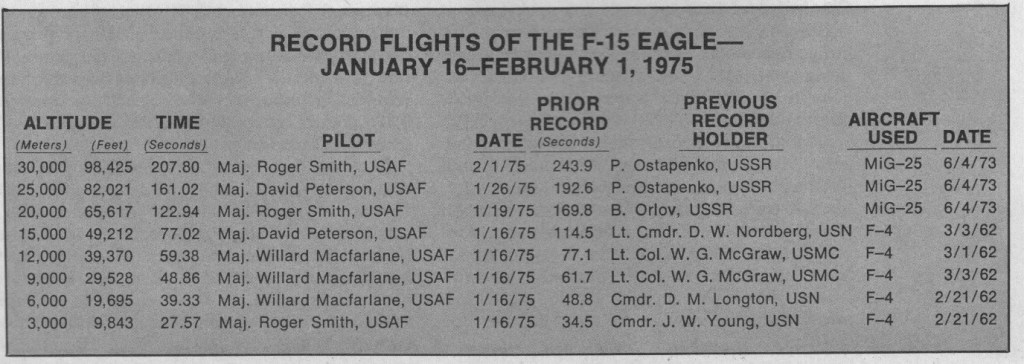
The 1st Tactical Fighter Wing at Langley AFB, Virginia, was the first USAF recipient of the F-15A, while the first operational aircraft in Europe were assigned to the 36th TFW at Bitburg AB, West Germany.
The production totalled 366 and 58 respectively for the US Air Force plus 19 and two respectively for the Israeli Air Force.
Israel, the first export country, ordered 40 F-15 under the ‘Peace Fox’ program. Delivery started in 1976 on an initial batch of 25 aircraft. At least one Syrian MiG-23 has been shot down in clashes with Israeli F-15s over Lebanon.
Japan’s programme to acquire the F-15 began in 1975. The first of the two single-seat F-15Js produced by the parent company was accepted on 29 July 1980, with the second following on 29 July, and after 39 test flights with ASDF pilots, were ferried to Japan landing at Kadena Air Base on 1 March 1981. Essentially similar to the USAF’s F-15C, the F-15J differs in having various avionics changes, the Tactical Electronic Warfare System – the TEWS pod being omitted from the tip of the port fin.
Continuing procurement of the F-15A variant enabled two more TAG wings and one more USAFE squadron to be equipped between 1977-9, production thereafter switching to the F-15C and the basically similar two-seat F-15D.
In June 1979 deliveries of the improved and more advanced F-15C single-seat (flown for the first time on 27 February 1979) and F-15D two-seat models began. Equipped with AGP-70 radar (with a programmable digital signal processor, synthetic-aperture ground mapping and track-while-scan air-to-air capability), an uprated powerplant, and provision for low-drag conformal packs carrying fuel and fitted with tangential attachments for weapons. The two variant were built for the USAF, Israel and Saudi Arabia and are still operated today. These variants were also built under licence in Japan by Mitsubishi and designated F-15J.
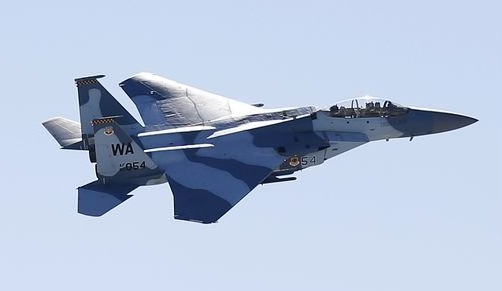
In addition, it is also compatible with the company-developed FAST (Fuel And Sensor Tactical) packs, whereby conformal fuel tanks and/or sensor packages can be attached to the outside of each air inlet. Extra fuel tanks conform to the sides of the fuselage and hold an additional 10,000 lb / 4536 kg of fuel to supplement the 11,600 lb / 5260 kg of internal fuel, or a variety of sensors (such as reconnaissance cameras, infra-red equipment, radar warning receivers, laser designators and low-light-level television cameras to be carried. Thus, overall capability the Eagle has been significantly enhanced. Operational deployment of the F-15C and F-15D began in 1979. The 18th TFW at Yridena, Okinawa, was the first unit to receive this version, re-equipment of this Wing’s three squadrons being effected between September 1979 and April 1980. Subsequent deliveries were made to existing Eagle units, most of which were progressively re-equipped during the early 1980s.
The first single-seat air superiority F-15C incorporating MSIP enhancements was rolled out in June 1985.
Renowned as an extremely capable interceptor, the F-15D Eagle was modified in 1980 to perform in the all-weather interdictor role whilst still retaining the ability to operate as an air superiority aircraft. This private venture, first known as the Strike Eagle, first flown on 8 July 1980, was redesignated McDonnell Douglas F-15E Enhanced Eagle when the USAF expressed interest in the concept and conducted an evaluation between November 1982 and April 1983. Together with the delta-winged General Dynamics F-16E, the Enhanced Eagle was competing for selection in the USAF’s Derivative Fighter Program as a supplement and eventual replacement for the General Dynamics F-111.
The dual-role F-15E Strike Eagle is basically a converted F-15B/D trainer for the ground-attack role. It has a total of 18 external hardpoints.
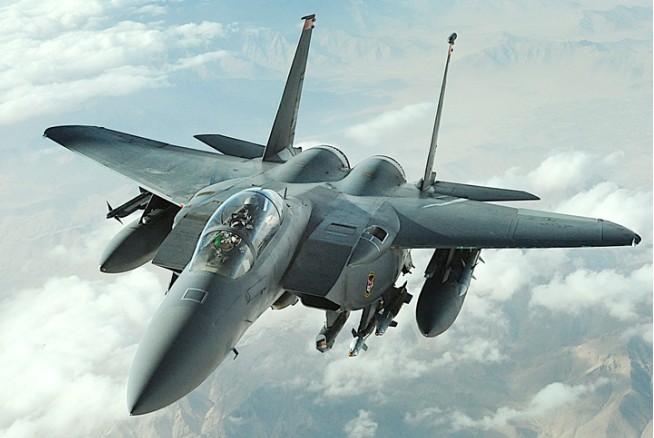
On 11 December 1986 the F-15E made its first flight and the US Air Force announced that it was to order 392 examples though this requirement was later reduced to 200 and deliveries began in 1988, initially to the 405th TTW for training and then the 4th TFW for operations, replacing the F-4E. The rear cockpit of the prototype (a converted F-15B trainer) has been fitted with four multi-purpose cathode ray tubes (CRTs) for information display to the systems operator and three more CRTs are to be installed for the pilot in production versions.
Beneath the nose-cone, high resolution radar provides long-range ground-mapping of remarkable clarity, whilst forward looking infra-red (FLIR) gives close range images of similar quality. In combination, these systems allow rapid target identification in all weathers and ensure accurate weapon delivery. Ordnance carriage has been improved by addition of bomb attachment points on the ‘conformal’ wing-root fuel and sensor packs, resulting in less drag and freeing wing pylons for additional fuel tanks. Called Tangential Carriage, the modification extends the Eagle’s endurance by 40 per cent in some cases. During proving trials, the F-15E demonstrated an ability to take off at a weight of 34020 kg (75,0001b), some 3175kg (7,0001b) above the previous maximum.
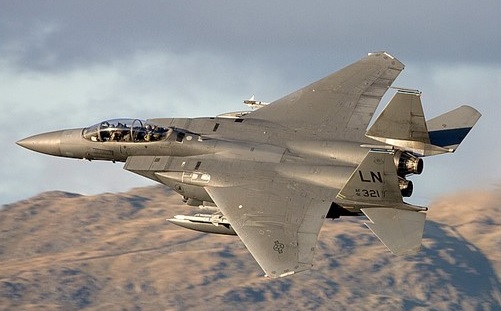
The type has an advanced nav/attack system with APG-70 main radar as well as several radar and infra-red navigation and targeting options displayed to the rear seat, leaving the pilot free to concentrate on tactical flying using his head-up display. Equipment installed in the F-15E includes the LANTIRN night nay/attack pod system, FLIR sensors, threat-warning displays, digital map displays, APG-70 radar, a wide-angle HUD an improved mission computer and provision for AIM-120 AMRAAM missiles and the integral M61 Vulcan cannon.
21 Strike Eagles were exported to Israel designated F-15I. The Israeli Defence Force/Air Force aircraft have been involved in several dogfights with Syrian MiG-21s and MiG-23s and are officially confirmed as having shot down at least one MiG-25. On 7 June 1981, Israeli F-15s escorted F-16s making the strike against Iraq’s Osirak nuclear powerplant, covering a radius of 966km.
On the 1st of November 1968, Japan signed a letter of agreement with Mc Donnell Douglas and it was also announced that it would become one of the few countries worldwide that was going to license-produce this aircraft. Over the following years, the Nihon Koku Jietai (Japan Air Self-Defence Force) received a total of 154 F-4EJ and RF-4Es. The F-4EJs (the export version for Japan) were mostly similar to the F-4Es, although the Japanese aircraft had their in-flight refuelling and ground-attack capabilities removed to align with Japan’s defensive posture, the F-4EJs were delivered without the AN/AJB-7 bombing computer system.
The first two F-4EJs (JASDF serials 17-8301 and 17-8302) were built by McDonnell Douglas in St Louis and first flew on January 14, 1971. The next 11 F-4EJs (JASDF serials 27-8303/8307, 37-8307/8310, and 47-8311/8313) were built by McDonnell Douglas in kit form and were assembled in Japan by Mitsubishi Heavy Industries, Ltd. The first Japanese-assembled aircraft (27-8303) flew on May 12, 1972. Seven more F-15Js single-seat version based on F-15C were to be assembled by August 1982, leading to manufacture by Mitsubishi against contracts placed for a total of 45 F-15Js and 12 two-seat F-15DJs (including two aircraft assembled in the USA by McDonnell Douglas). Funding of 43 more F-15Js in the FY82 budget brought total procurements to 100. Subsequently, Mitsubishi built all the rest 127 F-4EJ during the following nine years. The last example was delivered to the JASDF on May 20, 1981.
Mitsibishi produced 213 McDonnell Douglas F- 15J/DJ fighters for the JASDF by 1998.
Japan also acquired 14 RF-4Es built by McDonnell Douglas to serve in the reconnaissance role. These RF-4Es were delivered between November 1974 and June 1975. They were virtually identical to the USAF RF-4C, with the only differences being the deletion of certain equipment such as the radar homing and the warning suite which had not been released for export to Japan.
The F-4EJs entered service with the JASDF in August 1972 with a total of six squadrons operating the aircraft: the 301st, 302nd, 303rd, 304th, 305th and 306th squadrons. The RF-4Es equipped the 501st that had previously operated one of the less-well-known Sabre models, the RF-86F.
Korea ordered the Boeing F-15K to replace its F-4 Phantom II fleet. The F-15K is more advanced than the original F-15E, it has better radar and improved systems and a helmet-mounted cueing system.
Saudi Arabia ordered the F-15 variant and took delivery of 72 downgraded F-15Es, redesignated F-15S.
The F-15 Eagle has a perfect combat record of 101 victories and zero defeats. F-15s downed four Mig-29 fighters during the Balkan conflict and 33 of the 35 fixed-wing aircraft Iraq lost in air combat during Operation Desert Storm.
Singapore ordered the F-15SG (previously known as F-15T), another customized advanced derivative of the F-15E Strike Eagle, to replace the A-4 Skyhawk in the ground-attack role.
The McDonnell Douglas F-15S/MTD, AF71290, is the prototype F-15B modified under a $US117.8 million programme for the US Air Force Wright Aeronautical Laboratories to investigate short take-off and landing using vectored thrust jet nozzles and canards mounted on the engine intakes. The aircraft’s first flight was made on 7 September 1988 and after the fitment of the thrust vectoring reversing nozzles on the jet pipes these were flown for the first time on 10 May 1989. The aircraft was involved in a 13 month, 100 flight test schedule at Edwards. The aircraft’s controllable canard foreplanes are adapted tailplanes from the F/A-18 Hornet and can operate independently of each other for pitch and roll manoeuvres having a 20 degree dihedral.
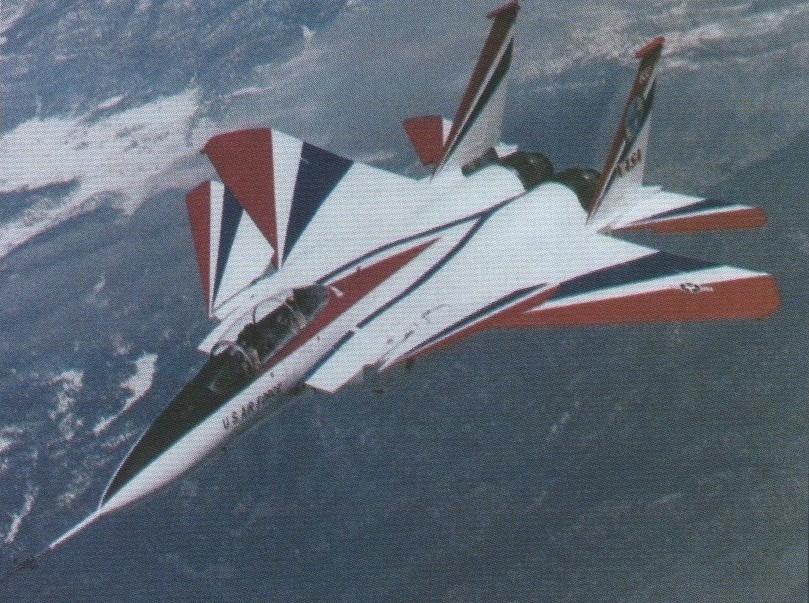
Samurra Air Battle – F-15 vs MiG-25
The US signed a US$29.4 billion deal to sell 84 new F-15 fighter jets to Saudi Arabia in December 2011. The sale includes the 84 advanced Boeing F-15SA fighters with Raytheon Co radar equipment and digital. electronic warfare systems. Also included are upgrades that wilI bring Saudi Arabia’s 70 older F-15s up to the new standard, as well as HARM, AGM-88 AntiRadiation Missfies; Laser JDAM and Enhanced Paveway munitions and related equipment and services. The first new F-15s’ were expected to be delivered to Saudi, Arabia in early 2015.
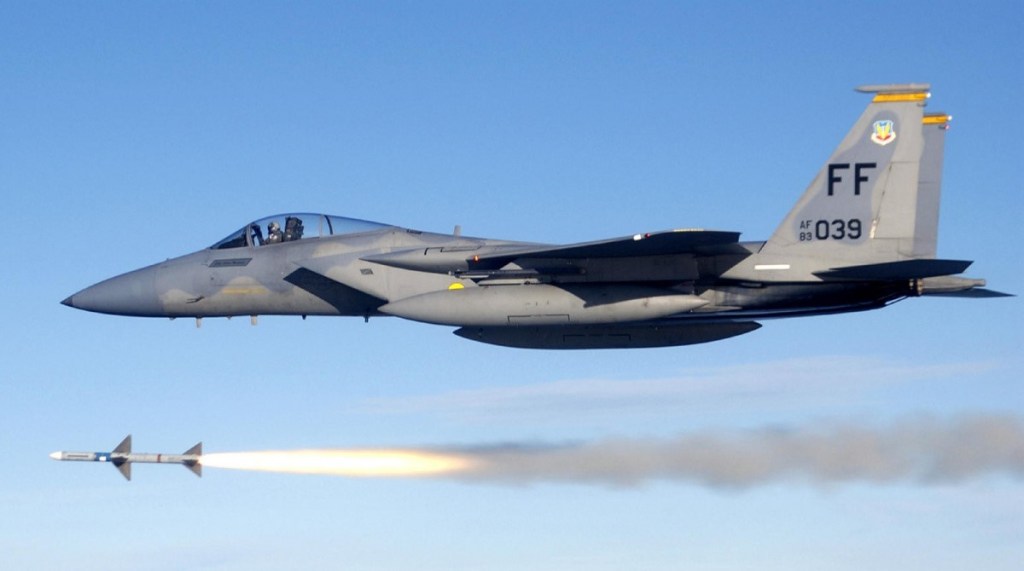
By 1990, since the development two-seat Strike Eagle was displayed in 1984, this all-weather interdictor/strike aircraft has entered service with the USAF’s 4th TFW and production of 200 was underway. Powered by 23,800 lb st (10 800 kgp) P& W F100-PW-220s, the F-15E The F-15E has a range of 2,400 nm (4,445 km).
The Boeing F-15EX Eagle II represents the ultimate evolution of the F-15, thoroughly modernised to remain relevant against emerging threats.
The F-15EX incorporates 21st-century technology, including an APG-82 AESA radar, advanced cockpit displays, digital fly-by-wire controls, and the Eagle Passive Active Warning Survivability System (EPAWSS), a sophisticated electronic warfare suite that drastically improves survivability against modern air defence systems.
Powered by twin Pratt & Whitney F100-PW-229 engines, each producing 29,000 pounds of thrust, the F-15EX reaches Mach 2.5 (approximately 3,100 km/h).
It can carry up to 22 air-to-air missiles or a mix of air-to-ground ordnance.
The US Air Force planned to acquire 144 F-15EX aircraft at $87 million each to replace aging F-15C/D models.
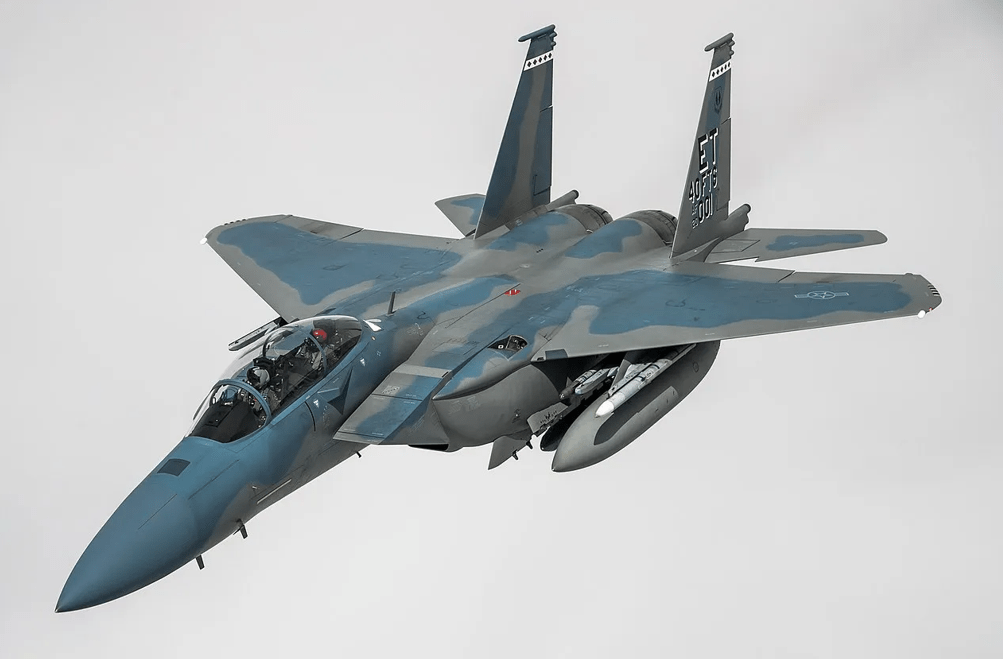
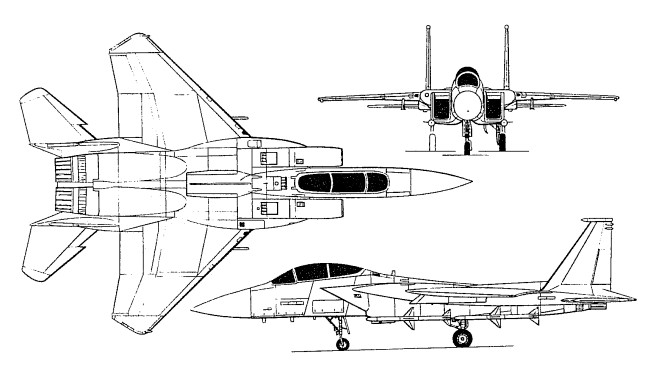
F-15A
Engines: 2 x Pratt & Whitney F-100-PW-100, 29,000 lb.
Wing span: 42 ft 9.75 in (13.05 m)
Length: 63 ft 9.75 in (19.45m)
Height: 18 ft 7.25 in (5.67m).
Wing area: 56.5 sq.m / 608.16 sq ft
Take-off weight: 18145-25000 kg / 40003 – 55116 lb
Empty weight: 12245 kg / 26996 lb
Max. speed: 2655 km/h / 1650 mph
Ceiling: 20400 m / 66950 ft
Range w/max.fuel: 8000 km / 4971 miles
Range w/max.payload: 4500 km / 2796 miles
Seats: 1
Internal fuel: 5278 kg (11,635 lb)
Armament: 1 x 20mm Vulcan, 6800kg ordnance
F-I5B / TF-15A
Engines: 2 x Pratt & Whitney, 29,000 lb.
Wing span: 42 ft 9.75 in (13.05 m)
Length: 63 ft 9.75 in (19.45m)
Height: 18 ft 7.25 in (5.67m).
Seats: 2
Weight: F-15A + approximately 363 kg (800 lb)
F-l5C
Engine: 2 x P&W F100-220, 105.73 kN (23,770 lb st)
Installed thrust (dry/reheat): 134 / 211 kN
Span: 13.05 m (42ft 9.75in)
Length: 19.43 m (63 ft 9in)
Height: 5.63m (18ft 5.5in)
Wing area: 56.48 sq.m (608 sq.ft)
Wheel base: 5.42m (17ft 9.5in)
Wheel tract: 2.75m (9ft .025in)
Empty wt: 12,247 kg (27,000 lb)
Take-off weight (clean): 20,244 kg (44,630 lb)
MTOW: 30,845 kg (68,000 lb)
Internal fuel: 6,103 kg (13,455 lb)
Conformal fuel tank capacity: 4536 kg (10,000 lb)
Max speed: 2.5+ Mach
Time to height: 1 min / 12,200 m
Service ceiling: 18,300 m
TO run: 274 m
Ldg run: 840 m
Fuel internal (external): 6100 kg (9820 kg)
Air refuel: Yes
Combat radius: 1062 nm.
Seats: 1
Hardpoints: 9
Armament: one 20mm M61A1 Vulcan six-barrel cannon with 940 rounds; 10,705 kg (23,600 lb) disposable stores
F-15D
MTOW: 68,000 lb
Fuel internal: 6100 kg
Fuel external: 9820 kg
Seats: 2
F-15E
Powerplant: two 10855-kg (23,930-lb) thrust Pratt & Whitney F100-PW-100 afterburning turbofans.
Span 13,05 m (42 ft 9¾ in)
Length 19.43 m (63 ft 9 in)
Height 5.63 m (18 ft 5½ in)
Wing area 56.5 sq.m (608 sq ft).
Maximum speed Mach 2.5 + at altitude
Maximum speed 1481 km/h (920 mph) at sea level
Ceiling 20000 m (65,610 ft)
Endurance 5 hours 15 min
Armament: one M61A1 Vulcan 20-mm gun (with 940 rounds)
External load: 24,000 lb / 10,885 kg
Hardpoints: 3 fuselage / 6 fuel pack
Seats: 2
F-15E Eagle
Engines: two 23,450-lb (10,637-kg) reheated thrust Pratt & Whitney F100-P-220 turbofans.
Maximum speed 1,650+ mph (2,655+ km/h) or Mach 2.5+ at 36,000 ft (10,975 m)
Climb to 39,370 ft (12,000 m): 1 minute 0 seconds
Service ceiling 60,000 ft (18,290 m)
Radius 1,150+ miles (1,851+ km)
Empty weight 31,700 lb (14,379 kg)
Maximum take-off 81,000 lb (36,742 kg)
Wing span 42 ft 9.75 in (13.05 m)
Length 63 ft 9 in (19.43 m)
Height 18 ft 5.5 in (5.63 m)
Wing area 608.0 sq ft (56.48 sq.m)
Armament: one 20-mm multi-barrel cannon, up to 24,250 lb (11,000 kg) disposable stores.
F-15E
Powerplant: two 129.45 kN (29,100 lb st) Pratt & Whitney F100-PW-229 turbofans
Length 19.43m (63 ft 9 in)
Height 5.63m (18 ft 6 in)
Wing span (over tip launchers) 13.05m (42ft 10 in)
Take-off weight (‘clean’) 14.515 kg (32,000 lb)
Max Take-Off Weight 36.741 kg (81,000 lb)
Wing loading: 133.25 lb/sq.ft / 650.0 kg/sq.m
Max level speed at high altitude (‘clean’) 2,655+ km/h (1,650+ mph)
Service ceiling: 60039 ft / 18300 m
Max rate of climb at sea level 15,240+ m (50,000+ ft)/min
Range int. fuel: 686 nm / 1270 km
Max range 4,455 km (2,762 miles)
Armament: one 20mm M61A1 Vulcan six-barrel cannon with 512 rounds; 11.000 kg (24,250 lb) ordnance
Hardpoints: 18
Crew: 2
F-15I
F-15J
F-15DJ
F-15K
F-15S
F-15SG
 All Aero