
In World War lithe USAAF made widespread and effective use of the attack bomber for battlefield tasks. For post¬war service the USAAF wanted a higher-speed successor, and the specification produced two types in the Douglas XB-43 and Martin Model 234 XB-51.
The Martin was designed originally to meet a US Army Air Force requirement for a close-support bomber, being allocated the designation XA-45. However, it was developed instead as a medium bomber with turbojet power-plant and two prototypes were ordered under the designation XB-51.
The XB-51 featured a tandem-unit landing gear arrangement, a thin variable ¬incidence wing whose leading edges were swept at 35 degrees, a swept T-tail. It was powered by three 2640kg thrust General Electric J47-GE-7 or -13 turbo-jets, one pylon-mounted low on each side of the forward fuselage and the third within the rear fuselage.
Other features included pressurised accommodation for the two-man crew, provisisions for JATO (jet-assisted take-off) units, and a braking parachute.
The first of two aircraft flew in October 1949, Martin’s Director of Flight O.E. (Pat) Tibbs making the first flight, taking off from Baltimore and lading at Naval Air Test Centre at Patuxent, in a flight of 35 minutes.
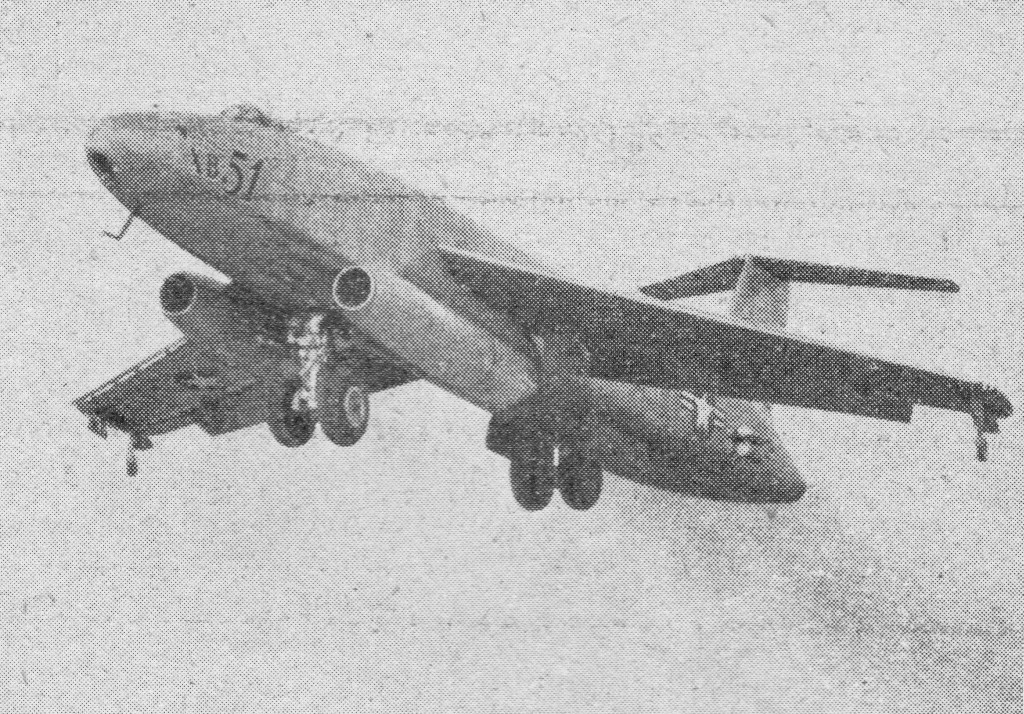
Although flight trials confirmed that the XB-51 had very good performance, they revealed that the type had poor handling qualities in the air. The XB-51 did not proceed past the prototype stage and the USAF opted instead for licence-production of the English Electric Canberra as the Martin B-57.

Engines: 3 x 2360kg General Electric J47-GE-13
Max take-off weight: 25393 kg / 55982 lb
Empty weight: 13431 kg / 29610 lb
Wingspan: 16.18 m / 53 ft 1 in
Length: 25.93 m / 85 ft 1 in
Height: 5.28 m / 17 ft 4 in
Wing area: 50.91 sq.m / 547.99 sq ft
Max. speed: 1038 km/h / 645 mph
Cruise speed: 857 km/h / 533 mph
Ceiling: 12344 m / 40500 ft
Range: 2576 km / 1601 miles

 All Aero