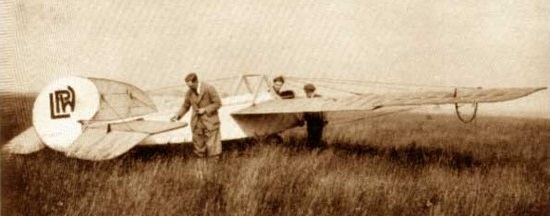
In 1922 John Leeming started to design his fifth glider, which became the LPW Glider, as the cheapest possible way to get airborne, but even the cost of materials worried him. He knew that Avro had made 8,340 Avro 504K trainers, and many were then stored but unwanted.
Leeming approached Avro to seek scrap materials, and met Clement Wood of the Sales staff, who turned out to be a kindred spirit. They raided the “scrap pile” and probably got major components needing minor repairs. The most costly items were two bicycle wheels that cost full price.
The LPW Glider was built by John Leeming, Tom Prince, and Clement Wood who later formed the Lancashire Aero Club.
The original was converted from an Avro 504K trainer.
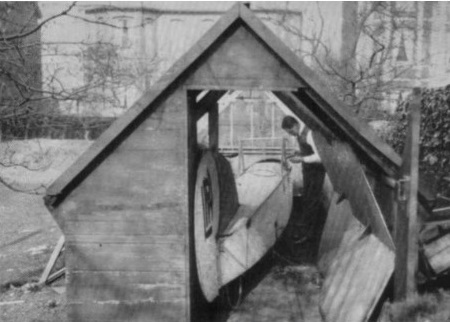
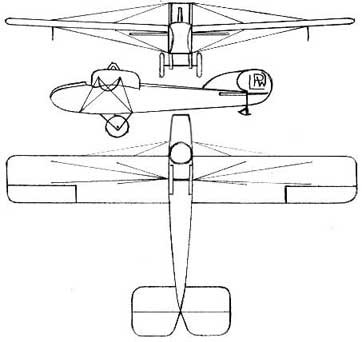
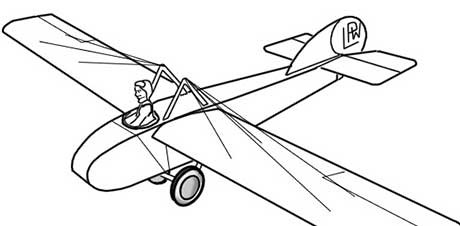
Leeming cut off the nose and front cockpit, and faired it in. Wing panels were fixed to the top fuselage longerons and braced from upper pylons and the bottom of the fuselage.
The thin wings had two spars, so the lift bracing wires also added torsional stiffness; a picture shows that the outer wings twisted nose-up.
The result was an enclosed body rather than the later open framework. But gliding performance wouldn’t be too good, with a large fuselage and so many bracing wires. The glider flew on 24 May 1924 from Alexandra Park Aerodrome in Manchester being towed into the air by a car. Based on simple assumptions, it probably stalled at 25 knots, had minimum sink of 3 knots at 30 knots, and maximum glide 12 to 1.
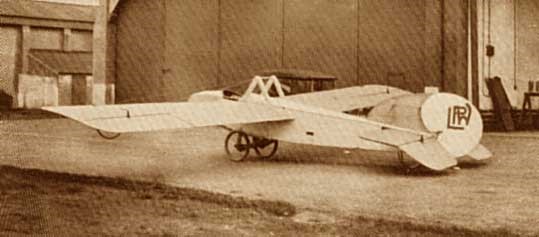
Flying took place at Alexandra Park aerodrome, in the middle of Manchester, starting 24 May 1924, car towing, having trouble with the long grass.
Rope length was quoted as 200 feet, so straight hops were all that was possible. Several pilots flew on many occasions. Leeming crashed the LPW in September 1924 when flying for press photographers on a windier day than usual. Struggling to fly level in the gusts, he didn’t notice how high he had reached so quickly.
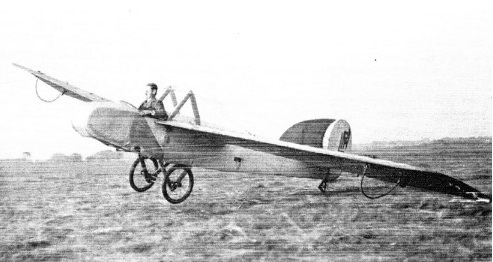
The driver looked back and saw the glider above, probably feared that the rope would fall on him, stopped the car and ran away. The glider stalled, and didn’t recover, probably through the wind gradient; Leeming wasn’t hurt, but the glider was badly smashed.
The wreck was rebuilt, fitted with an engine, and used for taxiing practice for new recruits, but it never flew. Leeming says that it was too heavy, probably too nose-heavy.
 All Aero