
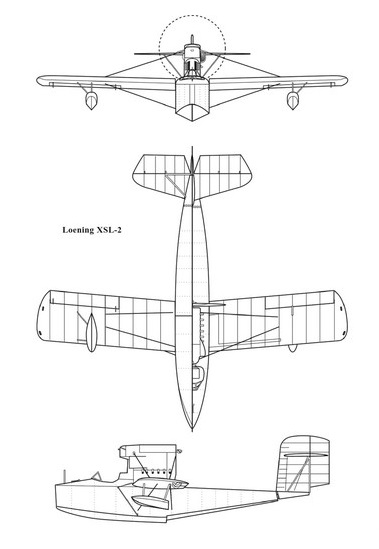
The Loening SL was the last type of airraft used in a series of Navy experiments, conducted intermittently from 1923 to 1933, to develop a small seaplane that could be deployed from a submarine. The aircraft had to be designed so that it could be easily dismantled and stowed in a watertight, eight foot diameter tube carried on the deck of the submarine. In 1930 BuAer decided to reinstate the idea with a small monoplane flying boat, and in June 1930, awarded Loening a contract to construct a single prototype as the XSL-1. The design emerged with a semi-cantilever monoplane wing which attached to the top of a single-step metal boat hull. The Warner engine, mounted on struts in a pusher configuration, featured a ring cowl and a small bullet-shaped nacelle. Stowage in the sub tube was accomplished by simply removing the wings and stabilising floats.
The prototype was delivered to NAS Anacostia for trials in February 1931. When testing revealed the XSL-1 to be underpowered with the Warner engine, it was returned to the factory for installation of a 160 hp Menasco B-6 and a more streamlined engine mount. The revised aircraft, re-designated XSL-2, resumed testing at Anacostia in early 1933 but these trials indicated only a nominal improvement in performance. Soon afterwards the Navy abandoned the entire program when the XSL-2 suffered serious damage during exercises with a submarine.
XSL-1
Engine: Warner Scarab, 110 hp
Prop: 2 blade fixed pitch metal
Wing span: 31 ft 0 in
Length: 27 ft 2 in
Wing area: 148 sq.ft
Empty weight: 1114 lb
Gross weight: 1512 lb
Max speed: 101 mh
Cruise: 88 mph
Ceiling: 13,000 ft
 All Aero