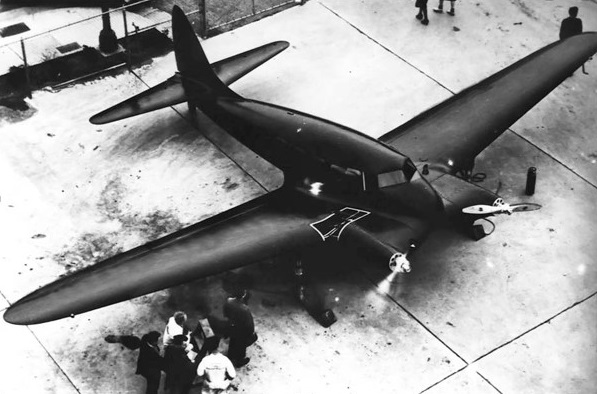
The Lockheed Brothers left the Company after the Detroit merger and set up the Airover Company, later called Alcor, to build the Uni-twin. With two Menasco engines side-by-side in the nose, driving two propellers. The name of the company was changed to Lockheed Vega when it became a subsidiary of the revived parent organization.
With Allan H. Lockheed as president, built a new version of his Duo twin-engined monoplane. Type was called Alcor Duo-6 and was distinctive in having two Menasco engines placed horizontally.
A demonstration flight was made in May 1934 at Mines Field with one propeller removed—it took off in 1200′, attained 130mph, and reportedly handled much like a single-engine plane.
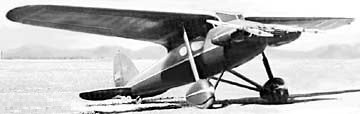
The Alcor Olympic Duo-4 of 1930 designed by Allan Loughead, featured two engines mounted side-by-side in a nose nacelle. Powered by two 160hp Menasco B-6 (reportedly first with 125hp C-5s), it was originally planned for one Wright J-6-7c in the nose. The unbraced cantilever wing had two full-length box spars.
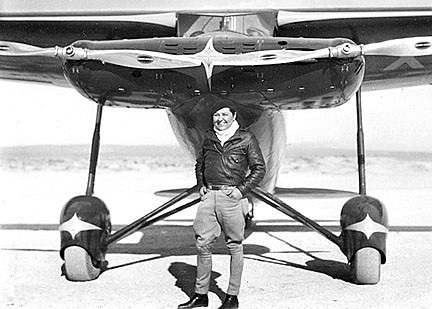
The one five-place Alcor Duo-4 built, NX962Y, nosed over in a wind gust during a landing on Mar 18, 1931; although damage was slight, nervous financial backers withdrew their support.
Though Alcor conformed with Lockheed “star names” system and development was pursued in 1930s, no production resulted. Alcor was not a Lockheed Aircraft Corporation product.
Olympic Duo-6
Engines: two 230hp Menasco B-6S
Wingspan: 42’0″
Length: 28’6″
Useful load: 2045 lb
Max speed: 183 mph
Cruise: 157 mph
Stall: 57 mph
Range: 700 mi
 All Aero