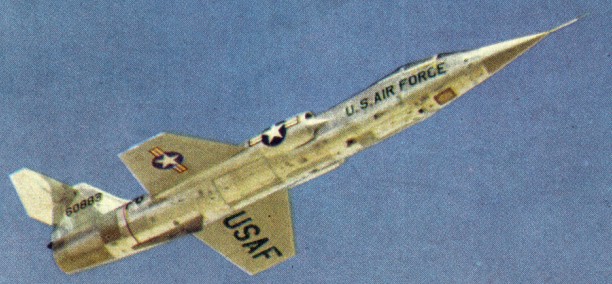
Lockheed were aware that USAF experience in Korea had shown the need for an air-superiority fighter able to operate from forward airfields and climb rapidly from the ground to engage in high-level combat. The Model 83 was designed to fulfil these roles, and in formulating his design “Kelly” Johnson attempted to keep it as cheap, small and readily maintainable as possible. Tendered to the USAF as an unsolicited proposal, it was necessary for competitive bids to be received and the USAF notified a formal requirement for such an aircraft in late 1952.
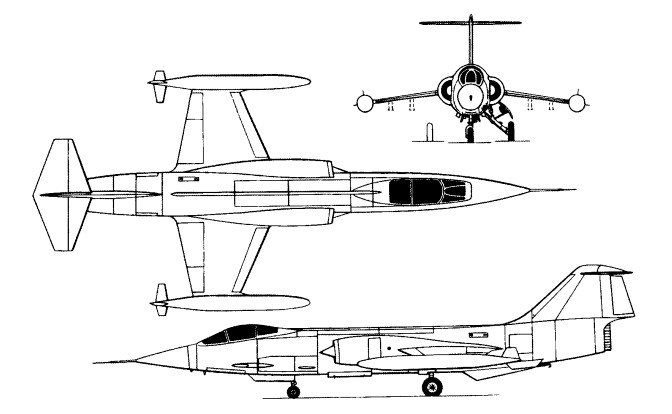
Submissions were received from North American and Republic; but as both of these companies were already heavily involved in fighter development and production, Lockheed’s proposal was selected cautiously: two XF-104 prototypes being ordered for development and testing. The long fuselage was tailored round the J79 engine, and the flying surfaces were small, unswept and very thin, with 10 degrees of anhedral. A token monoplane wing mid-set on the fuselage – this latter assembly wrapped tightly round a powerful turbojet engine – needle-nosed and T-tailed. All wheels, with a single wheel on each unit, retract forward into the fuselage. Able to demonstrate a level speed of around 2,250km/h and to climb to a height of 25km in about 4.5 minutes, the Press dubbed the Starfighter the “missile with a man in it”.
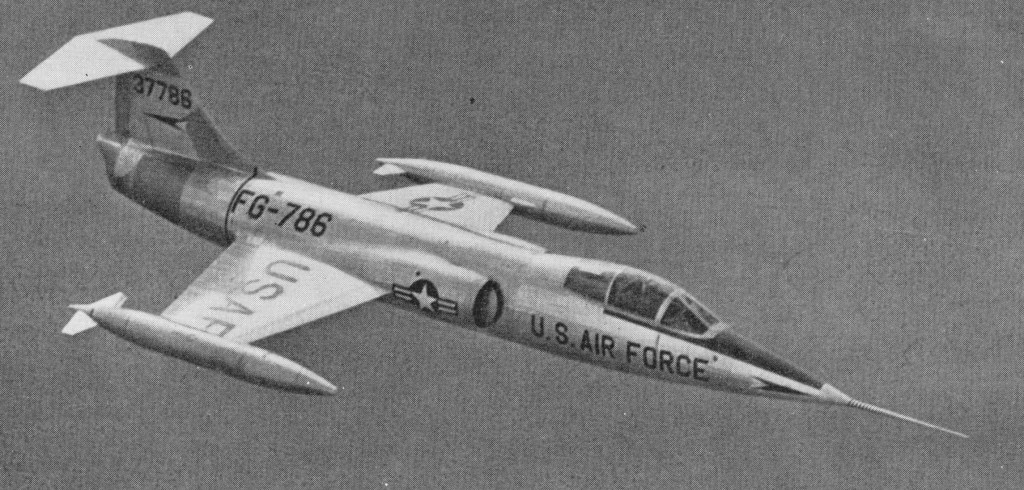
The XF-104 had a narrower and shorter rear fuselage compared to the production models. The two prototypes had a 10,500 lb Wright J65-W-6 turbojet but all subsequent aircraft had a J79 turbojet.
The first of these flew on 28 February 1954, followed by test and evaluation aircraft. It was not until 26 January 1958 that the first production F-104A began to enter service – as interceptors – with Air Defense Command’s 83rd Fighter Interceptor Squadron. The US Air Force had already lost interest in the type and took only 296 Starfighters.

Lockheed F-104A Starfighter Article
F-104A (170) and multi-mission F-104G (77) served with the USAF, as well as F-104B (26) and F-104D (21) two-seat operational-trainer counterparts of the A and C respectively.
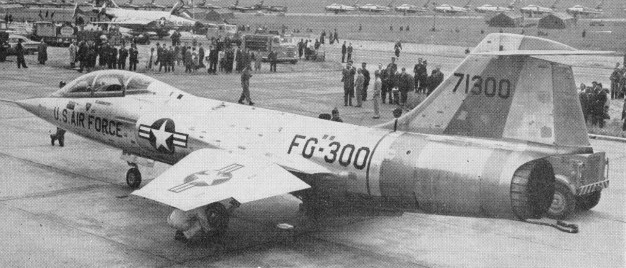
The type was then saved by the creation of the F-104G multi-role version for production by a multi-national European consor¬tium as well as for Japan.
Winner of a previous so-called ‘sale of the century’ and used by several NATO air arms for many years. During its heyday the Starfighter formed the backbone of the NATO alliance’s air power and a number of reconnaissance-configured aircraft were produced, sensor packages varying considerably according to the specialized requirements of the parent air arm.
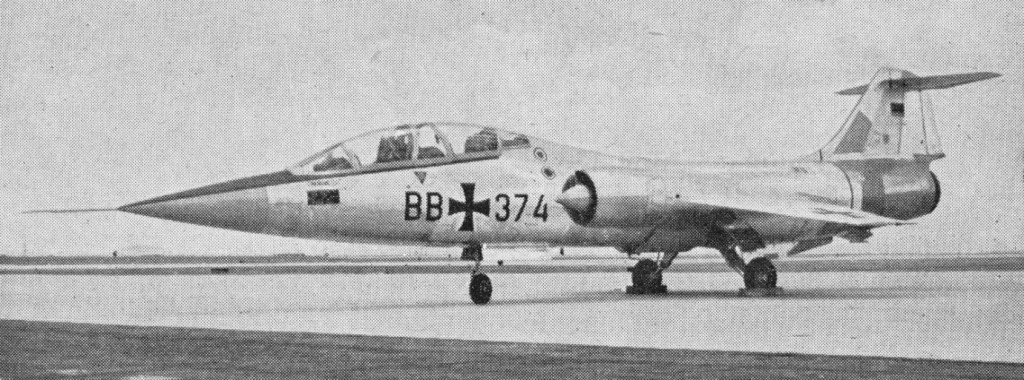
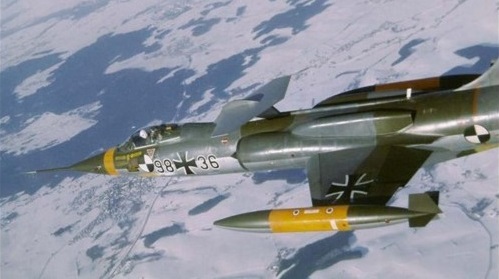
The German Luftwaffe, in their technological zeal, had insisted on overloading the F-104 with equipment which made it much heavier and more complex than the original model. The Starfighter programme began to go wrong after the first had been delivered in May 1961. The German pilots, even after extensive training in Arizona, were not fully experienced. The Starfighter, in the words of General Steinhoff, then inspector of the Luftwaffe, “was forever jealous of the pilot’s full attention. It rewarded discipline with deeds of airmanship; it could punish the dilatory of those who gave themselves to distractions. It was a marvel in capable hands, and merciless to the careless”.
Up to December 1968 ninety-one Starfighters crashed. With each series of Luftwaffe crashes the original choice of the Starfighter became more contentious, and by the time of the 1966 elections the Starfighter bribery scandal played a role in the fall of the Chancellor, Ludwig Erhard. Deliveries of 30 F-104F trainers to the Luftwaffe began in mid-1960.
The most widespread variant was the RF-104G, which featured a belly fairing containing cameras, installation of these necessitating the removal of the M61 Vulcan rotary cannon armament. West Germany, Italy and the Netherlands all operated this variant of the Starfighter for a time, although the Netherlands used the standard F-104G for reconnaissance tasks, using the Orpheus pod to accomplish this mission. The German Luftwaffe and Marineflieger used the RTF-104G two-seater.
Following development by Lockheed of the multi-mission F-104G, more than 1,000 came from production lines in Belgium, Germany, Holland and Italy to equip the air forces of those nations. Similar versions were built under licence in Canada and Japan. Lockheed also built 179 F-104G for export or for supply to friendly nations through the Military Assistance Program. These were essentially similar in appearance to their European counterparts and were fitted with three Hycon KS-67A cameras, examples being delivered to Norway and Taiwan, most of the Norwegian specimens being passed on to Turkey.
In 1964 West Germany cut down the intended size of its Luftwaffe because of shortages of funds and manpower. They will reduce the nine F-104G Starfighter squadrons to seven, and two Fiat G.91 reconnaissance squadrons instead of four. First line strength will be 380 F-104G’s and 170 G.91’s.

The Canadian built CF-104 Starfighter was one of the most successful jet fighter aircraft to serve with Canada’s Air Force. A total of 340 fighters were built under license by the Canadian government. The CF-104 was designed as a light-weight nuclear strike aircraft. The aircraft were retired from service in 1986 after being used for over 25 years until they were was replaced by the CF-18. Canada’s CF-104 (Canadian-built F-104G) was also originally engaged in reconnaissance duty, aircraft assigned to this task being fitted with a prominent belly-mounted pod containing a battery of Vinten cameras.
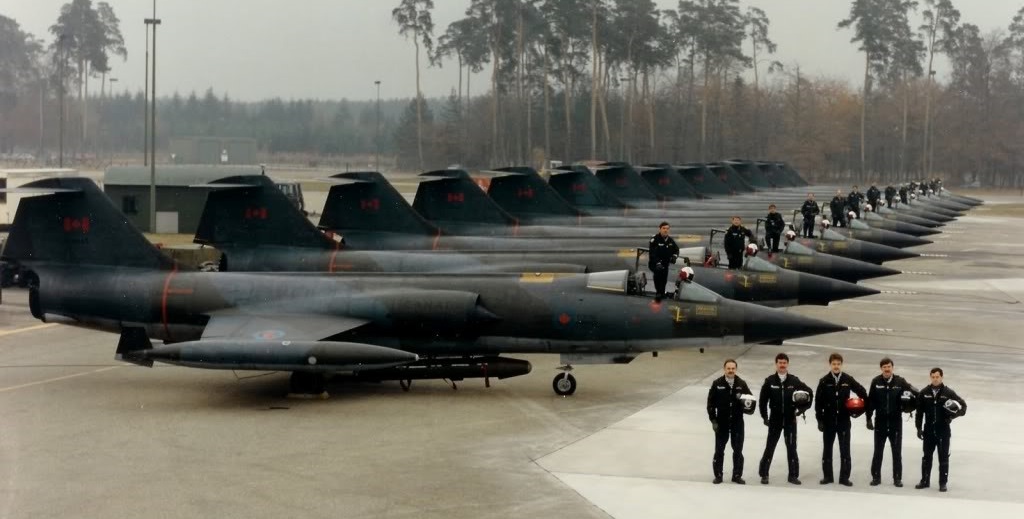
Thirty-nine CF-104D models built by Lockheed were purchased by the Canadian Air Force for training.
The CF-104 (single seat version) was built in Canada under license by Canadair in Cartierville, Quebec. The first aircraft produced by Canadair flew in May 1961, with 200 single seaters (CF-104) being produced for the RCAF. 22 Lockheed-built two seaters (CF-104D) were also used by the RCAF. The aircraft in later years provided a measure of unparalleled stability in the low-level, high speed environment until phased out in 1986. The majority of the Starfighters were transferred to the Turkish Air Force. After the RCAF production order was filled in June 1963, Canadair produced another 140 aircraft for other countries.
On 19 May 1964 Jacqueline Cochran set a world speed record of 1429.297 mph for women flying an F-104G over a 10 mile straightline course at Edwards Air Force Base, California. The Mach 2.2 flight broke her similar mark of 1273.109 mph.
Production ended in America, but in 1966 the first prototype of the Aeritalia built F 104S flew for the first time.
The Italian Air Force is receiving a total of 205 aircraft, and Turkey received 40 from 1974. Power is provided by one 17,900 lb thrust (with afterburning) General Electric J79 GE 19 turbojet engine. Armament in an air to air role consists of two Sparrow and two or four Sidewinder missiles, plus the 20 mm M 61 multi barrel cannon. In an attack role bombs, rockets, and other weapons up to a weight of 7,500 lb (3400 kg) can be carried on nine wing and fuselage stations.
Post-war Mitsubishi built Lockheed F-104J Starfighters with Kawasaki. Eventually Japan ordered 230 Starfighters – nearly all of them built under licence by Mitsubishi in Japan. Lockheed was estimated later to have paid bribes of about $1.5 million to Japanese officials, and a fee of $750,000 to Yoshio Kodama, one of the most powerful people in Japan.
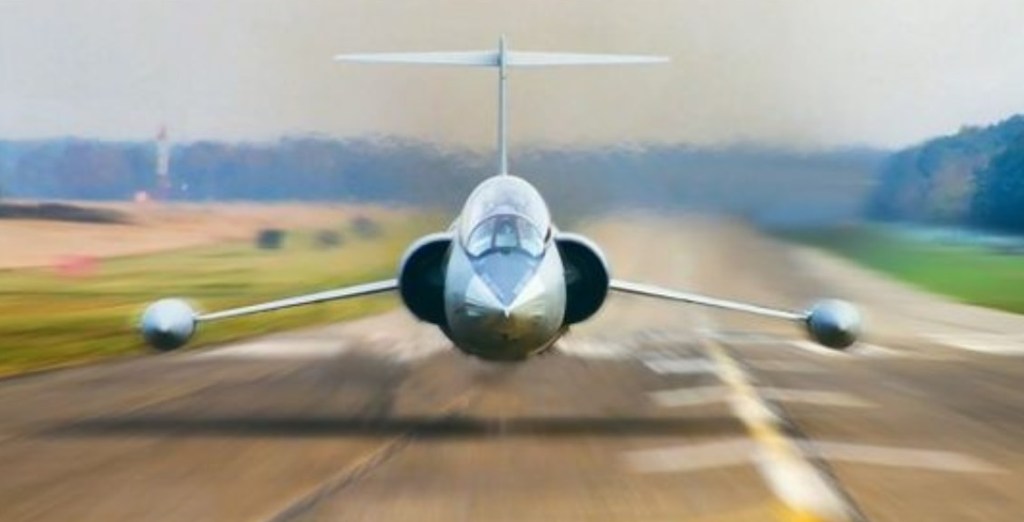
Total Starfighter pro¬duction was 2,282 units.
A Starfighter, built from non-serviceable ex-military aircraft components by American Darryl Greenmayer over a ten-year period, was the fastest and most complex “homebuilt” aircraft ever completed. With this aircraft, prepared by American Jet Industries in California and known as the Red Baron RB-104 Starfighter, he raised the world speed record over a 3km low-level course to 988.26 mph / 1,590.45 kph on 24 October 1977 at Tonopah, Nevada. The RB-104 was lost in an accident in 1978.
For training in the aerospace field, three early Starfighters have been modified to NF-104A standard by the addition of a 6,000 lb thrust (2722 kgp) Rocketdyne AR-2 booster and reaction jet controls for exploration missions up to heights of nearly twenty five miles. USAF pilots training for the X-20 Dyna-Soar roles use the NF-104A to learn atmosphere re-entry techniques.
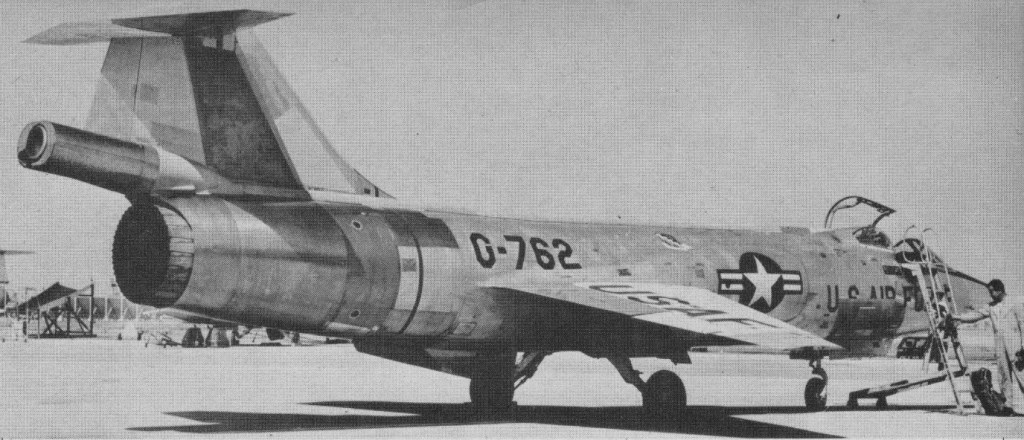
The NF-104A is designed to fly regularly to 25 miles altitude. The Rocketdyne engine is throttleable from 50 to 100% power. The NF-104A provides spaceflight experience at a fraction of X-15 operating costs.
The NF-104A was to zoom climb to over 90,000ft where atmospheric pressure was about 6 millibars. About 1% of the pressure at sea level. In the near vacuum the only way to control the plane at the top of its ballistic arc was with jets of hydrogen peroxide for pitch, yaw and roll control.
The jet engine would be shut down at about 70,000ft to prevent it from exceeding temperature limits. If not shut down, the engine would have introduced yaw motion challenging the ability to control the aircraft.
During the descent, at about Mach 1.8, enough air would pass through the intake ducts to allow a re-start or a dead-stick landing would be made.
On 10 December 1963, Chuck Yeager reached 108,700 ft (Yeager wanted to set a new world altitude record) when a pitch up caused the NF-104A to fall on its back and enter a flat spin. At 14,000 ft hr ejected.
Versions
F-104A (interceptor)
F-104B (two-seat trainer)
F-104C (tactical strike)
F-104D(two-seat trainer)
F-104G (definitive multi-role warplane with a strengthened structure, more power, and revised electronics)
TF-104G (F-104G trainer)
F-104J (F-104G ver¬sion for Japan)
F-104S (improved air defense version developed in Italy)
CF-104
CF-104D (CF-104 two-seat trainer).
NF 104A
RB-104
Specifications
F-l04A
Armament: 1 x six-barrel M-21 20mm Vulcan cannon & 2 x Sidewinder AAMs.
F-l04G
Engine: 1x 15,800-lb (7,167-kg) reheated thrust General Electric J79-GE-7 or llA turbojet or Turbo-Union J79-MTU-J1K.
Wing span 21 ft 11 in (6.68 m)
Wing area 196.1 sq ft (18.22 sq.m).
Length 54 ft 9 in (16.69 m)
Height 13 ft 6 in (4.11 m)
Empty weight 14,900 lb (6,758 kg)
Maximum take-off weight 28,779 lb (13,054 kg).
Fuel capacity: 847 Imp.Gal
External fuel: 2 x 162 Imp.Gal under wing, 2 x 142 Imp.Gal tip tanks
Maximum speed 1,450 mph (2,333 km/h) or Mach 2.2 at 36,000 ft (10,975 m)
Initial climb rate 55,000 ft (15,765 m) per minute
Service ceiling 58,000 ft (17,680 m)
Range 1,550 miles (2,495 km)
Range w/max.payload: 370 km / 230 miles
Armament: one 20-mm multi-barrel cannon
Bombload: 4,310 lb (1,955 kg) of disposable stores.
Crew: 1
Wheel tract: 8 ft 9 in
Wheelbase: 15 ft 1 in
TF-l04G
Seats: 2.
RF-104G
Engine: one General Electric J79GE- 1 IA turbojet, 7167-kg (15, 800-1b) afterburning thrust.
Maximum low level speed 1473 km/h (915 mph) or Mach 1.2
Maximum stabilized speed at 12190 m (40,000 ft) 2124 km/h (1,320 mph) or Mach 2.0
Tactical radius with external fuel 1110 km (690 miles)
Empty weight 6486 kg (14,300 lb)
Maximum take-off: 11352 kg (25, 027 lb).
Wing span 6.68 m (21 ft 11 in)
Length 16.69 m (54 ft 9 in)
Height 4.11 m (13 ft 6 in)
Wing area 18.22 sq.m (196.1 sq ft).
F 104S
Wing span: 21 ft 11 in (6.68 m).
Max speed: M2.2.
Lockheed CF-104D Mk.2
Engine: General Electric J79-19 turbojet 11,810 lbs. thrust, 17,900 lb. with afterburner
Maximum Speed: Mach 2
Loaded weight: 26,800 lb (12,156 kg)
Span: 21 ft 11 in (6.4 m)
Length: 58 ft 3 in (17.7 m)
Height: 13 ft 6 in (4.1 m)
Wing area: 196 sq ft (18.2 sq m)
Canadair CF-104 Mk.2
Engine: General Electric/Orenda J-79-OEL-7, 15,800 lb
Wing Span: 21ft 11in
Length: 54ft 8in (16.7m)
Height: 13ft 6in (4.1m)
Speed: 2,200 mph w/ drop tanks – Mach 2 + 1550mph + (2400km/h+) ASL
Armament: one 20mm Canon + 2 sidewinder missiles 4,000lbs (1,818kg) bombs, rockets & missiles
 All Aero