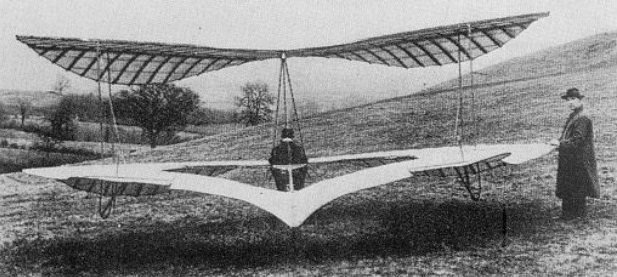
Englishman, G.J.A. Kitchen of Lancaster, patented a circular or annular wing and sold the rights to Cedric Lee, who built an annular winged biplane powered by a 50 hp Gnome rotary engine in 1911. This ‘Kitchen Doughnut’ was wrecked by a gale during tests. Lee and his engineer Tilghman Richards continued to experiment with gliders and with wind tunnel test models at the National Physical Laboratory and soon discovered that the circular wing had some very desirable properties. It continued to provide lift at extreme angles of incidence, and had a gentle stall. Furthermore, a round wing could have a span or diameter less than half that of a conventional surface of the same lifting area.
In 1912 the Lee-Richards annular wing was a circular planform with a hole diameter half span. The powered portotype was a biplane, and they tested it at Middleton Sands, Heysham in 1911. This was supposed to be a very stable configuration, and a later version flew for 128 hours, but the prototype had run into a gully, and then been destroyed when the hanger blew down in a gale. They had been changing the leading-edge camber shape, but were unable to decide which was best, so before rebuilding they tried two models, span 4.7 ft, flown indoors. Extra camber seemed to give a flatter glide angle, but the other person said that this was due to better launch technique. So they went full scale.
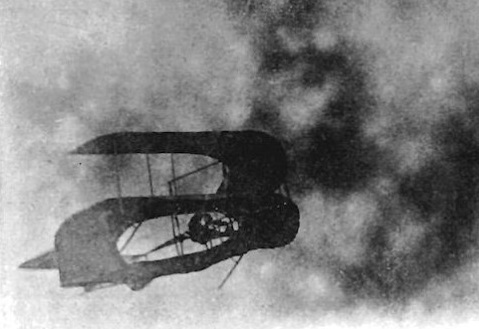
The glider was a biplane, but the upper wing was only the front half of the circle. Elevators behind the wing were also operated differentially for roll control and a fin and rudder were added later. The pilot’s seat was in the hole, and the breeze.
Launch was by catapult from a track, pulled by a rope tied to a dropping weight within a tall tripod. The site was Sellet Banks, an east-facing slope 117 feet above the River Lune near Kirby Lonsdale.
The glider made many successful glides. It was stable and controllable, was banked into turns, and even taken through the stall to 30 degrees nose up, when it pancaked steadily. They often flew in winds of 20 mph, and even 40 mph.
On the final day of flying at the end of trials in December 1912, Cedric Lee made a soaring flight in a strong wind. Cine film was taken, used in the opening clips of “Those Magnificent Men”, and stored in the Science Museum.
A non-flying replica of the powered version is at the Newark Museum.
Wingspan: 22 ft
Wing area: 400 sq.ft
Empty weight: 215 lb (later 390 lb)
Gross weight: 710 lb
Glide ratio: 1-8
 All Aero