
An invention of a French law student living in Chicago named C. Le Gaucier that once completed, was to have been christened “Napoleon”. Construction of this steam-powered flying boat was started at Cicero Aviation Field in the spring of 1913 with the long-range intent of crossing the Atlantic with it once tested and proven on Lake Michigan. The “Napoleon” was intended to be of a special construction of aluminium steel and be equipped with four 250 hp steam turbines, with four propellers – the span of its monoplane wing; 100 feet, with a 14-foot cord. The machine had an ingenious four wheel design along the sides of the hull whereas the wheels could be moved up or down, thus allowing for the capability to take off and touch down on land.
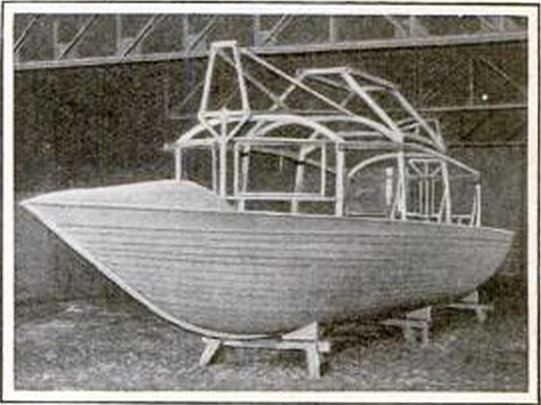
Note the changes to the design. The hull is the same, but now sponsons have been added. Above the gunnel, everything has been altered. The boat is fully faired from the bow on back, and there is a completely different superstructure.
For the first time, we get a view of the wings. The wing spars are most likely the tubular “aluminum steel”. The airfoils may well be one of Eiffel’s designs, not surprising given the cultural origins of the aircraft’s designer.
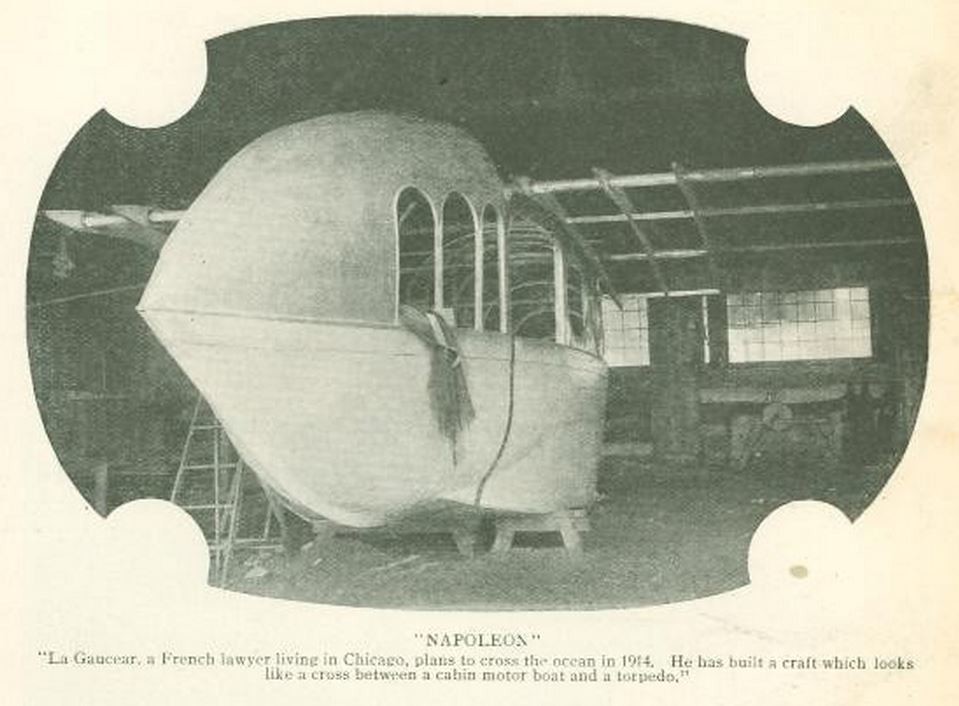
The image was lifted from Technical World Magazine, Feb 1914 issue, pg 843. Here’s a scan of the full page:
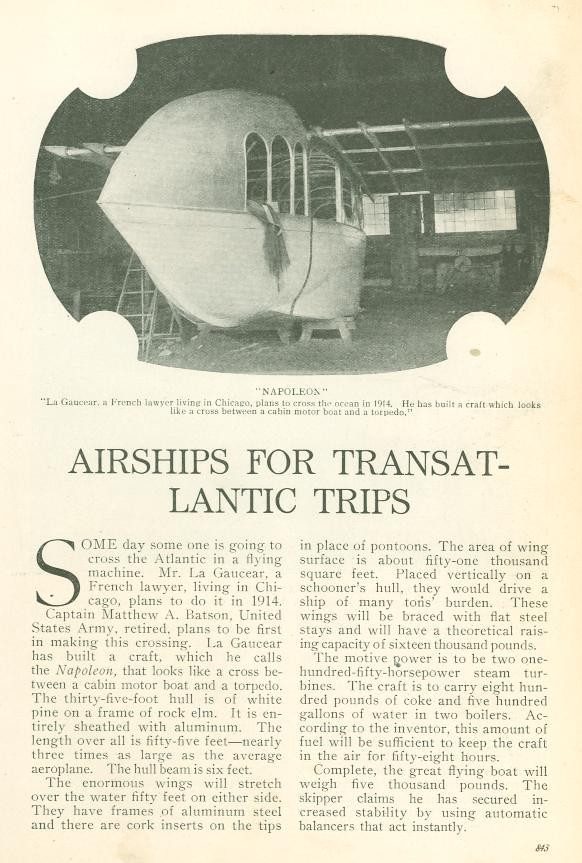
Most of the technical details supplied in the article match up with those in the Popular Mechanics’ piece, the exception being as to wing area, which Popular Mechanics says is 1,655 sq ft, but which Technical World states is 51,000 sq ft.
Jacques Le Gaucear founded the Le Gaucear-Rowe Engine Co. of Chicago, in 1915. It had capital of $8,400, and was incorporated by Charles A Rowe, Evanston, Ill., Jacques Le Gaucear and H.H. Armstrong.
And this is what the company worked on – the Rowe Le Gaucear Aeroplane Engine. This is from The Wisconsin Engineer, December 1916:
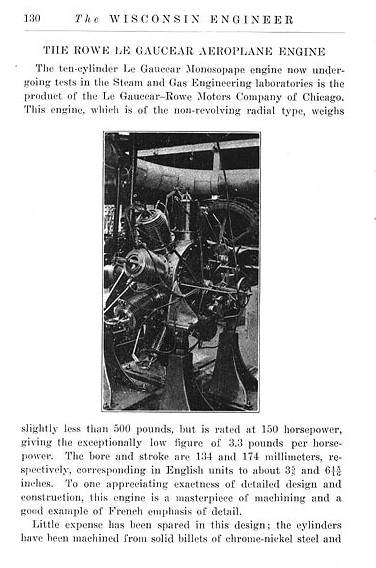

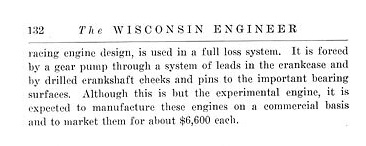
Note that it is not steam-powered, but a radial internal combustion engine. It’s no co-incidence that the engine is rated for 150hp, exactly the same as the steam powered engines that had been spec’ed for the Napoleon. The article makes specific mention of the “French emphasis of detail”. This seems to be the only time the engine ever garnered a mention in the press.
The Le Gaucear-Rowe Engine Co. lasted at least till 1917, as one of their employees – Charles Froesch – worked with them from 1915 to 1917. Froesch later rose to be Vice President-Engineering of Eastern Air Lines.
 All Aero