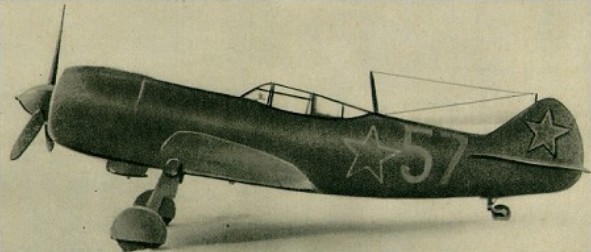
In late 1941 it was decided to improve the performance of the LaGG-3 by installing the more powerful 1600 hp Ash-82A radial engine. The basic LaGG-3 airframe was adapted for a 14- cylinder two-row radial Shvetsov M-82 engine without major redesign (examples converted from existing LaGG-3 airframes on the production line sometimes being referred to as LaG-5s). Despite its fractionally greater installed drag, 1%, it offered speed increase from 353 to 373 mph and improved all-round performance at height. The liquid-cooled fighter was cancelled in May 1942, all production switching to the new machine, designated LaGG-5. With in a few weeks this in turn was replaced om the assembly line by a further improvement, tested as a prototype early in 1942, with a new fuselage containing two 20mm guns and having a lower rear profile behind a canopy giving all-round vision. This was the La-5 which proved to be 28 mph faster than the Bf 109G-2 below 20,000 ft. But the German fighter could outclimb it and efforts were made to reduce weight.
The prototype conversion was first flown in March 1942 with an M-82 rated at 1700hp for take-off, and the La-5 was cleared for service testing in the following September with an armament of two 20mm cannon. Early machines retained the cockpit and rear fuselage construction of the earlier fighter.
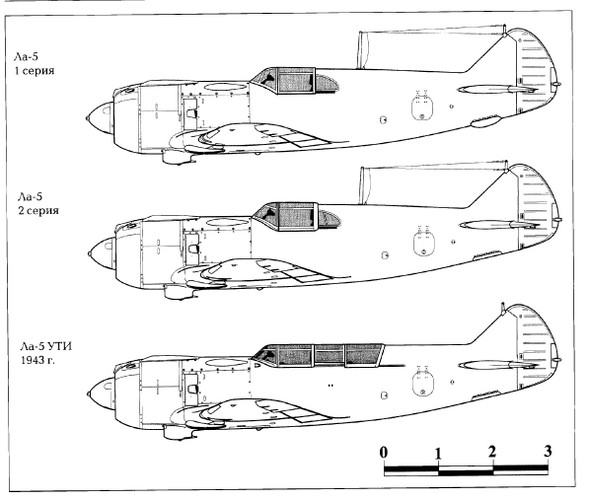
With completion of the conversion of existing LaGG-3 airframes, minor changes were introduced in new production aircraft, the principal of these being the cutting down of the aft fuselage decking and the introduction of a 360 degree vision canopy.
The designed earned Lavochkin the title of Hero of Socialist Labour, and the La-5 made its operational debut at the Battle of Stalingrad in October 1942.
A further development of the La-5AV became the La-7.
Late in 1942, the improved M-82F engine became available, producing 1650hp at 1650m, aircraft fitted with this engine being designated La-5F, and, from early 1943, fuel tankage was revised.
From late March 1943, the fuel injection M-82FN engine offering 1850hp for take-off replaced the carburettor-equipped M-82F, and with this power plant the fighter became the La-5FN. This version fought in the Battle of Kursk, and was produced in fairly substantial numbers.
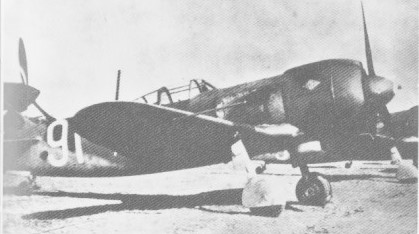
When the La-5 was withdrawn from production late in 1944, a total of 9,920 aircraft of this type (including La-5UTI two-seat trainers) had been built.
Prototype
Engine: Shvetsov M-82 14- cylinder two-row radial, 1700hp
La-5F
Engine: Shvetsov M-82F, 1650hp at 1650m
La-5FN
Engine: Shvetsov M-82FN, 1850hp
Max take-off weight: 3360 kg / 7408 lb
Empty weight: 2800 kg / 6173 lb
Wingspan: 9.8 m / 32 ft 2 in
Length: 8.60 m / 28 ft 3 in
Height: 2.54 m / 8 ft 4 in
Wing area: 17.50 sq.m / 188.37 sq ft
Max. speed: 648 km/h / 403 mph
Ceiling: 11000 m / 36100 ft
Range: 765 km / 475 miles
La-5FN
Engine: Shvetsov ASh-82FN, 1640hp
Wingspan: 9.8 m / 32 ft 2 in
Length: 27 ft 10 in
Height: 9 ft 3 in
Empty weight: 6085 lb
Loaded weight: 7406 lb
Max. speed: 402 mph at SL
Service ceiling: 11000 m / 36, 000 ft
Max range: 528 miles
Seats: 1
Armament: 2 x 20 mm ShVAK cannon
Bombload: 330 lb
La-5UTI
Seats: 2
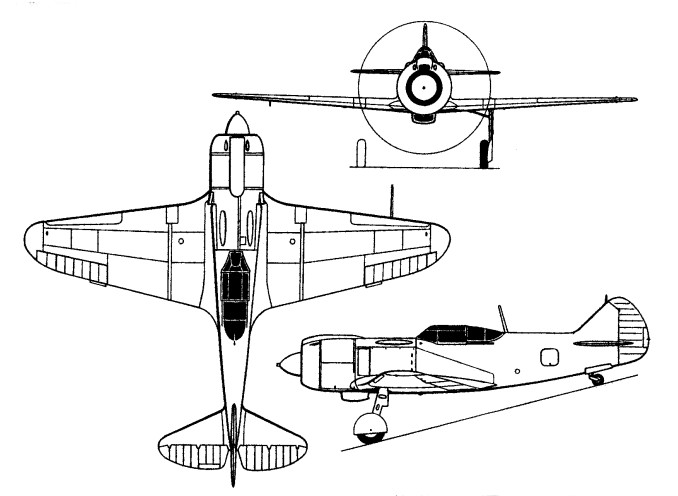
 All Aero