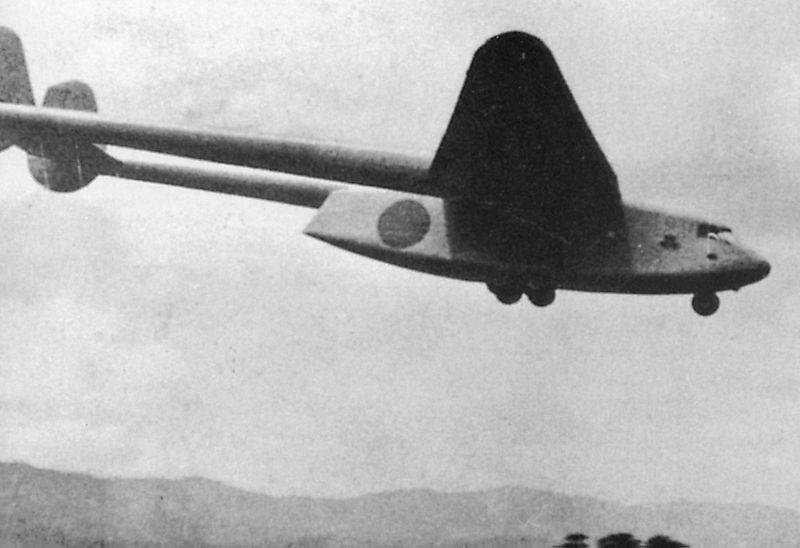
The Kokusai Ku-7 Manazuru (真鶴 “white-naped crane”; Allied code-name Buzzard) was a large experimental twin boom Japanese military glider.
An enlarged version of the earlier Maeda Ku-1 glider, it was developed during 1942. The use of a twin boom design allowed for a large square cargo door, which meant that the aircraft was capable of carrying either 32 soldiers, 7600 kg of cargo or even a light tank.
First flown on 15 August 1944, it required a powerful towing aircraft, either the Nakajima Ki-49 or the Mitsubishi Ki-67, which were in short supply. As a result, the aircraft were modified by fitting them with engines, which were designated the Ki-105 Otori (鳳 “Phoenix”). Ku-7-II was the original designation for the Ki-105.
Only two Ku-7 Manazuru were built.
Ku-7
Wingspan: 34.75 m (114 ft 0 in)
Wing area: 119.7 m2 (1,288 sq ft)
Aspect ratio: 10.8
Length: 19.5 m (64 ft 0 in)
Empty weight: 4,536 kg (10,000 lb)
Gross weight: 12,000 kg (26,455 lb)
Never exceed speed: 354 km/h (220 mph, 191 kn)
Maximum towing speed: 201 km/h (125 mph; 109 kn)
Crew: 2
Capacity: 32 troops, equipped / 8 short tons (7,300 kg) tank / 75 mm (3.0 in) howitzer with 4 short tons (3,600 kg) tractor / 7,464 kg (16,455 lb)
 All Aero