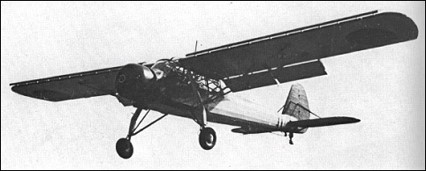
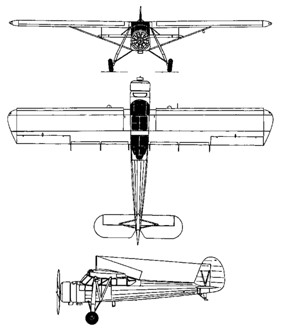
In 1940, the Imperial Japanese Army Air Force ordered the Nippon Kokusai Koku Kogyo to produce an artillery spotting and liaison aircraft. The resulting Ki-76, or Liaison Aircraft Type 3 (in Japanese: 三式指揮連絡機), was inspired by, and similar to, the German Fieseler Fi 156 “Storch”, although not a direct copy. A high-winged monoplane with a fixed tailwheel undercarriage, the Ki-76 used Fowler flaps, and was powered by Hitachi Ha-42 radial engine.
First flying in May 1941, the Ki-76 proved successful when evaluated against an example of the Fi-156, and was ordered into production as the Army Type 3 Command Liaison Plane in November 1942. 937 including a single prototype were built.
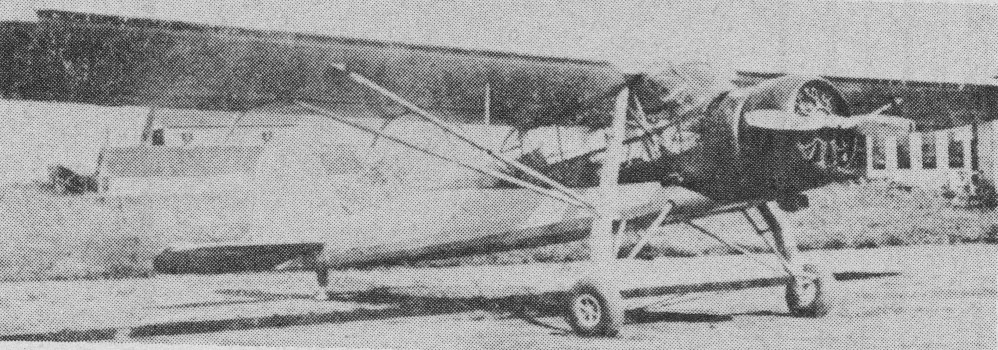
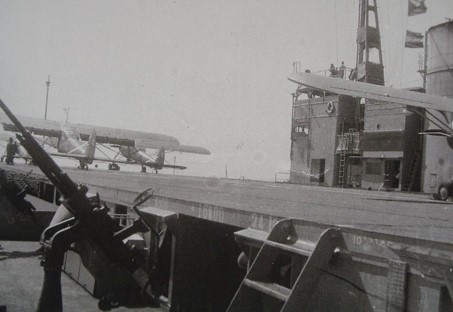
The Ki-76 remained in service as an artillery spotter and liaison aircraft until the end of the war. Ki-76s were also used as anti-submarine aircraft, operating from the Japanese Army’s escort carrier, the Akitsu Maru, being fitted with an arrestor hook and carrying two 60 kg (132 lb) depth charges.
The Allied reporting name was “Stella”.
Some were used by the Royal Thai Air Force.
Ki-76
Engine: 1 × Hitachi Ha42, 231 kW (310 hp)
Propeller: 2-bladed fixed-pitch
Wingspan: 15 m (49 ft 3 in)
Wing area: 29.4 m2 (316 sq ft)
Length: 9.65 m (31 ft 8 in)
Height: 2.9 m (9 ft 6 in)
Empty weight: 1,110 kg (2,447 lb)
Gross weight: 1,530 kg (3,373 lb)
Max takeoff weight: 1,623 kg (3,578 lb)
Maximum speed: 178 km/h (111 mph, 96 kn) at sea level
Range: 750 km (470 mi, 400 nmi)
Service ceiling: 5,630 m (18,470 ft)
Guns: 1× 7.7 mm (0.303 in) machine gun in rear cockpit
Bombs: 2× 60 kg (132 lb) depth charges (some variants)
Crew: 2
 All Aero