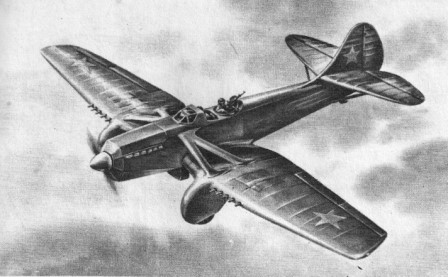
The Kochierigin/Gurievich TSh-3 (Russian: Кочеригин – Гуревич ТШ-3) attack aircraft was developed by S. A. Kochierigin and M. I. Gurievich between 1932 and 1934. It was also known as TsKB-4.
At the beginning of the 1930s, a line of aeronautical development was aimed at the creation of ground attack aircraft for the support of troops on the ground. It was considered that an essential component for this type of aircraft should be armor, capable of guaranteeing protection for the crew and the essential components and systems of the aircraft.
In 1932 a work group led by S. A. Kochierigin as head of the attack aircraft group of the TsKB and M. I. Gurievich, decided to work on the development of an armored attack aircraft, but starting from a monoplane conception with an M-34 750/750 engine of 830 horsepower.
The requirements of the VVS conceived a speed of 250 km/h and a ceiling of 4000 m. The aircraft was also to carry powerful weapons in different combinations.
By the end of 1933 the prototype could be ready. The name of the new model was TSh-3, an acronym for Heavy Attack Aircraft No.3 (ТШ-3 – Тяжелый Штурмовик – 3) and it corresponded to number 4 in the TsKB registry, which is why it is also known as TsKB -4.
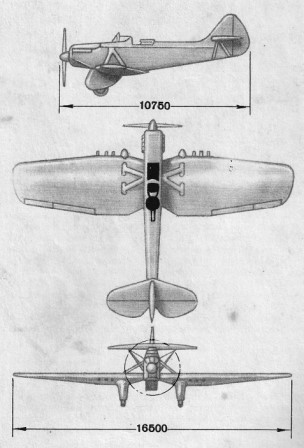
Structurally it was a large-area (45.04 m²) low-wing monoplane with strong inverted-V bracing with fixed landing gear covered with “trousers” that blended into the centerplane.
The entire forward portion of the fuselage, including the power plant, cockpit and gunner’s cabin, was formed in the form of an integral armored trunk that was fixed to the duralumin structure. The armor was made up of slats attached by 6 mm screws to the aluminum corners of the structure. The thickness of the armor in the front part reached 8 mm, in the bottom, walls and rear – 6 mm, the top 5 mm. The engine in its upper part did not present armor. The total weight of the armor reached 576 kg.
The radiator was movable and they also featured 6mm armor on the bottom. During the attack it was collected towards the interior of the lower fuselage to avoid being damaged by impacts. In that position the air intake was through an armored inlet located under the propeller. A part of the heat was absorbed by the 106 kg of water in the cooling system, so the radiator was designed oversized.
The lower part of the fuselage was made up of a structure of welded steel tubes and covered with fabric. The tail section added less than 10% to the total weight of the aircraft, weighing only 55 kg.
The wings were constructed of fabric-coated duralumin and featured two-section trailing-edge ailerons that could be used as flaps.
The TSh-3’s armament was made up of two batteries, each with 5 ShKAS machine guns, located in the wings on both sides of the fuselage. In addition, the aircraft had three 250 kg bomb bays located between the wing spars designed to carry small incendiary bombs. Some supports integrated into the wing structure also allowed the fixing of containers for chemical weapons or aviation bombs. The total bomb capacity reached 400 kg. The defensive armament was integrated by a machine gun in the defensive position of the gunner.
The landing gear was of the conventional, fixed type, with a single wheel on each of the main landing gear and tail skid. The main landers were faired by “pants”.
Tests of the prototype were developed in the spring of 1934 by the test pilot V. K. Kokkinaki. Despite the heavy takeoff weight of 3,557 kg, the TSh-3 managed to reach 247 km/h, climbing up to 5,800 meters. These results exceeded the requirements received in 1932, but by 1934, when the tests ended, this speed was already considered quite low. The angular profiles of the armor did not allow thinking about improving aerodynamics and the cooling system did not work effectively, so the TSh-3 was not built in series.
TSh-3 (TsKB-4)
Powerplant: One 750/830 hp M-34F
Wingspan: 16.50 m
Wing area: 45.04 m²
Length: 10.75 m
Empty weight: 2665 kg
Loaded weight: 3557 kg
Wing loading: 79.5 kg/m²
Power load: 4.7 kg/hp
Maximum speed at sea level: 247 km/h
Speed at 1000 m: 243 km/h
Landing speed: 95 km/h
Time to 3000 m: 10.7 min
Range: 470 km
Endurance: 2 h 30 min
Practical ceiling: 5800m
Armament: 11 ShKAS 7.62 mm machine guns
Bomb load: 400 kg
Accommodation: 2 crew
 All Aero