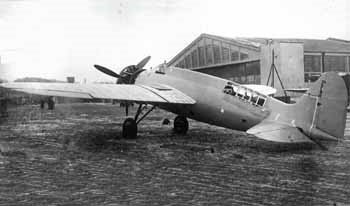
In the early 1930s both GUAP and the leadership of the VVS of the Red Army considered it necessary to replace the biplane reconnaissance aircraft in service with faster aircraft.
One of the first aircraft manufacturers to respond to the request was SA Kochierigin, who presented conceptual ideas for an experimental reconnaissance aircraft, which could be used as both a two-seater fighter and a light bomber.
The Kochierigin SR (TsKB-27) (Russian: Кочеригин СР (ЦКБ-27)) was assigned the 27th consecutive (TsKB-27) by the Central Construction Bureau and designated SR by the VVS, to highlight its role as a fast reconnaissance aircraft (СР – С коростной Р азведчик).
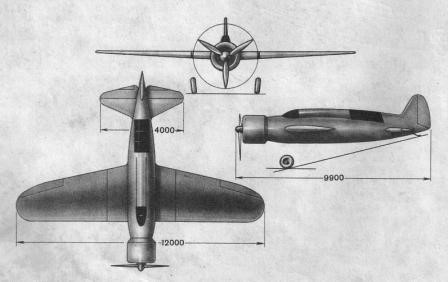
The new scout aircraft featured the classic monoplane layout of the time with a bomb bay between the spars of the centerplane. This distribution made it necessary to locate the gunner’s position well back in the fuselage.
The construction was of mixed construction, with a monocoque wooden fuselage and metal wings. The wings featured straight leading edge and trailing edge flaps for takeoff and landing operations. In order to ensure longitudinal balance, for the first time in the USSR uncontrolled stabilizers and trimmers were used on the elevators. Control surfaces were covered with tissue.
The landing gear, of the conventional type with a tailwheel, was retracted by means of a pneumatic retraction system.
The new model was designed around a 780 – 800 hp Gnome -Rhone Mistral Major 14Krsd air-cooled star engine, driving a three-blade, variable-pitch propeller, which had begun to be produced under license in the USSR by the Tumansky’s office under the designation M-85.
As armament the SR incorporated two 7.62 mm ShKAS machine guns without wing synchronization. The defensive armament consisted of a ShKAS machine gun mounted on a mobile mount. Normally the machine gun was in the cockpit and was only mounted on the mount if necessary. The internal hold had a capacity for 400 kg of bombs.
Compared to the Nieman JAI-VV (ХАИ-ВВ), the new SR presented an important advance from the aerodynamic, constructive and performance point of view. Another point of advantage was the use of the M-85 engine, which was lighter, more powerful and more reliable. The engine was covered by a much more aerodynamically effective NACA type hood than the Townend.
Three prototypes were built between 1935 and 1936.
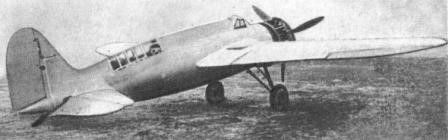
The first TsKB-27 prototype was delivered for testing at the NII VVS in the summer of 1935 and was noted for excellent speed results, reaching 460 km/h with gear up and 360 km/h with gear exposed. The ceiling reached 9000 meters.
Despite these results, the lack of completion and the complexity of the landing gear retraction system were reported. For the process of retraction and lowering, the pilot had to carry out 5-7 operations in order. On the other hand, when the retraction was carried out, the gear was not fully retracted, deforming the covering of the wings and the fuselage when forced. The work to solve these problems during the tests was not considered sufficient.
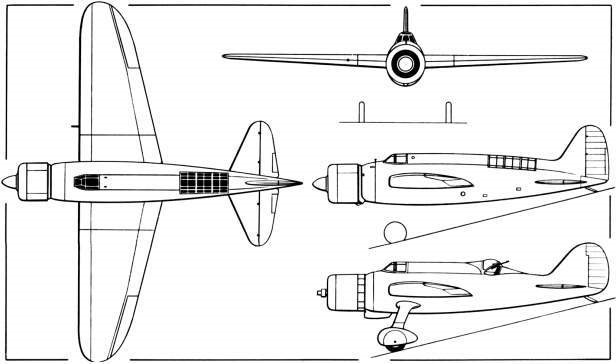
The manufacturer’s intention to achieve series production of the model at any cost led Kochierigin to make the decision to eliminate the retraction system and provide the model with a fixed gear, leading to the development of a new model that was renamed R -9 and that he ended up losing the contest with the Nieman R-10.
Variation: Kochierigin R -9
SR (TsKB-27)
Power plant: 1 x 780 hp M-85
Wingspan: 12.00 m
Wing area: 24.15 m²
Length: 9.90m
Height: 3.20m
Empty weight: 1862 kg
Normal takeoff weight: 2649 kg
Maximum speed: 460 km/h
Cruising speed: 380 km/h
Practical range: 840 km
ROC: 633 m/min
Practical ceiling: 9000 m
Armament: 3 x 7.62mm ShKAS machine guns
Bombload: 400 kg
Accommodation: 2 crew (pilot and gunner)
 All Aero