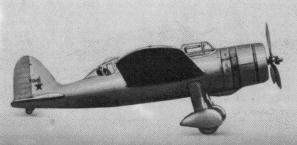
In developing a light ground attack aircraft based on the Kochierigin R-9 reconnaissance aircraft, Kochierigin developed, during 1938–1939, two two-seater models with fixed shrouded landing gear known as the Sh-1 (or LBSh, acronym for light armored attack aircraft; Russian Кочеригин ЛБШ or Ш) with Tumansky M-88 engine and Sh-2 with a Tumansky M-87A engine; both using the fast R-9M-85 (also known as the SR M-85 ) reconnaissance aircraft as a base.
On June 29, 1939, instruction KO 258 was received, which requested the NKAP of Kochierigin as director of Factory No.1 PA Voronin, to finish the aircraft and factory tests of a copy with an M-88 engine and present it to the state tests for July 1939. A second prototype was to be ready for August.
The specifications presented established a speed at sea level of no less than 430 km/h and at 6,000 – 7,000 m it should be between 500 and 530 km/h, with a climb time to 5,000 m of no more than 7 minutes. The required range had to exceed 800 km and the ceiling was established between 10 and 11 thousand meters.
As armament, the attack aircraft was to have two ShBAK heavy-caliber machine guns and two ShKAS or four ShKAS machine guns, all in the wings. The bomb capacity was set at 400 kg.
Compared to the R-9 reconnaissance aircraft, in the M-88- powered Sh-1 the navigator’s cockpit was moved forward. In the cockpit there was a widening of the cockpit. An MV-3 turret was installed in the rear position and the wingspan of the tailplane was increased. The tail skid was replaced by a wheel.
Experience accumulated in the development of the BSh-1 aircraft was used in the development of the wing of the Sh-1.
The report on the tests of the Sh-1 aircraft with the Tumansky M-88 engine at the NII VVS was confirmed on August 23, 1939. During the tests, a maximum speed of 360 km/h was obtained. At a height of 6,650 meters the speed rose to 437 km/h and at 7,650 it was 446 km/h. The flight weight was 3500 kg.
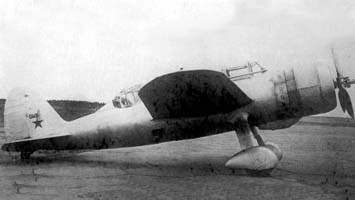
The Sh-1 ‘s armament consisted of two ShBAK cannons with 150 rounds each and two ShKAS machine gunners with 900 rounds. For the first time in an attack aircraft 20 mm aviation cannons were used. The normal load of bombs reached 200 kg, being able to reach up to 400 in overloaded version. Defensive armament included a 500-round ShKAS machine gun, housed in a low-height MV-3 turret.
The tests were unsuccessful due to problems with the M-88 engine and the appearance of metal shavings in the oil. In practice, the M-88 engine was unable to achieve the calculated power, which significantly affected the performance values obtained. Other factors such as the lack of surface finish and the poor selection of the propeller also affected the results.
Another result of the tests was of opinions in the NII VVS that the use of a retractable landing gear could bring a significant gain (20 – 25 km/h) in performance.
The second prototype, called Sh-2, was ready for the month of November. The Sh-2 featured a similar build to the R-9M-85. The fuselage, monocoque type with four spars and birch veneer covering. The NACA type cowl. Ring-type exhaust manifolds were located on both sides under the wing. Fuel was stored in four tanks, two in the fuselage and two in the wing consoles, with a total capacity of 840 litres.
The pilot was located in a cabin covered to the location of the navigator. Another notable feature was the dual control. The plane was equipped with an RSR radio station and a SPU-2 talk set.
The wings, with a double spar made of chrome tubes, had a pressed duraluminium rib cage covered with dural sheets. The centerplane also had two steel tube spars and was covered in duralumin. On this occasion, more attention had been paid to the finish. The entire coating featured smooth lines.
The tail unit had a wooden empennage in its lower part, while the upper part had a textile covering. The stabilizer was made of duralumin and the rudders with an aluminum structure and the surfaces covered with fabric.
The main undercarriage were of the cantilever type with 750×250 mm shrouded wheels. The legs had hydro-pneumatic suspension.
The armament consisted of four ShKAS machine guns with 4,000 shots in total. The Sh-2 could carry 200 kg of bombs (in overloaded version up to 400 kg). Four FAB-100 could be hung in the interior hold and another two outside.
The defensive armament was an ShKAS machine gun in an MV-3 turret with 500 shots.
In mid-November the tests of the Sh-2 were carried out and this time powered by an M-87A engine. The test approval document was signed by the head of the VVS AD Loktionov on November 19, 1939. Engineer 2nd Class Rastrigin was appointed as the main test engineer, Senior Lieutenant Varietin as test pilot, and Major Trietyakov as test navigator.
The overall results were quite acceptable. With a flying weight of 3,450 kg the Sh-2 could reach 350 km/h at sea level and 439 to 4,700 meters. The height of 5000 meters could be reached in 9.5 minutes. The motor group in this case did not present great difficulties.
Other results obtained were a range of 1,300 km and a flight ceiling of 9,800 m. The takeoff and landing run was 370 m. Visibility from the cabin forwards was considered poor, to the sides very good, and to the rear satisfactory. Landing and takeoff were rated as fairly easy.
Despite this, the test results were not acceptable. The requested benefits were not achieved and, on the other hand, there were problems of lack of completion in the pump system, lack of stability in the three axes and a large number of operating defects.
The piloting of the aircraft was considered unsatisfactory in all flight regimes because the pilot found it difficult to coordinate his actions. Due to design problems with the stabilizers the pilot was forced to pull the stick all the time.
The navigator’s cabin was quite cramped. The MV-3 turret presented problems and its replacement with an MV-5 was recommended. The OPB-1 aiming device could be used with a certain level of accuracy only at high altitudes. At low altitude bombardment was impossible.
As a result, neither version was approved for series production. It was recommended to resolve the indications made and present the device for other tests but in a version with a retractable gear.
LBSh (Sh-1)
Powerplant: 1 x 1100 hp Tumansky М-88
Wingspan: 12.00 m
Wing area: 24.15 m²
Length: 10.00m
Empty weight: 2806 kg
Normal takeoff weight: 3450 kg
Wing loading: 146 kg/m²
Power load: 3.2kg/hp
Maximum speed at sea level: 372 km/h
Maximum speed at 6650 m: 437 km/h
Cruising speed: 396 km/h
Projected practical range: 1300 km
ROC: 435 m/min
Practical ceiling: 9820 m
Accommodation: 2 (pilot and navigator)
Armament: 2 x 20mm ShBAK cannon, 150 rounds each / 2 x ShKAS mg, 900 rounds / 1 x 7.62mm ShKAs mg in MV-3 turret
Bombload: 200 – 400 kg
 All Aero