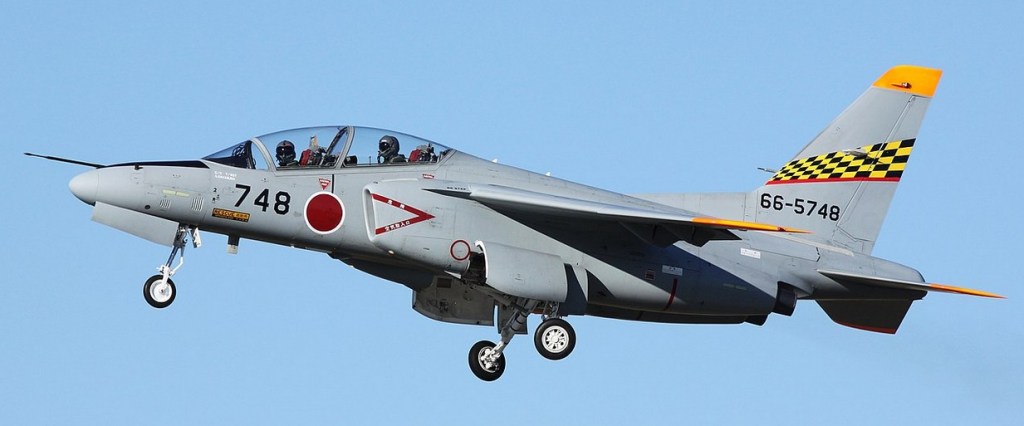
Based on Kawasaki’s KA-850 project, the T-4 was selected as the JASDF’s new advanced trainer in 1981 to replace the T-33 and Mitsubishi T-1. Kawasaki is the prime contractor, with Fuji and Mitsubishi each taking a 30 per cent share of the pro¬gramme. The aircraft is a mid-wing, twin-turbofan design which uses two indigenous IHI XF3-30 engines and is equipped with Stencel ejection seats, a headup display, an air data computer, and five hardpoints for auxiliary fuel and light weapons. Future developments may include a dedicated ground¬attack version.
Construction of 32 T.4 advanced trainers has been authorised to 1987, against an even¬tual JASDF requirement for more than 200 aircraft, and production of the first batch of 12 was under way, with initial deliveries due in 1988. Four XT-4 prototypes, the first of which flew on July 29, 1985, were engaged in an intensive test programme which was to be completed by March 1988.
The defence Agency awarded the T-4 a type certificate in July 1988.
XT-4
Engine: 2 x IHI XF3-30 turbofan.
Installed thrust: 32.6 kN.
Span: 10 m.
Length: 13 m.
Wing area: 21.6 sq.m
Empty wt: 3700 kg.
MTOW: 7500 kg.
Max speed: M0.9.
Initial ROC: 3000 m / min.
Ceiling: 15,240 m.
T/O run: 549 m.
Ldg run: 670 m.
Fuel internal: 2271 lt.
Range: 1300 km.
Hardpoints: 5.
 All Aero