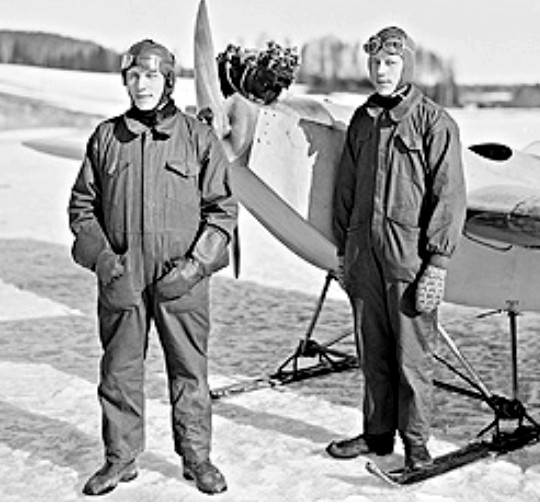
Niilo and Valto Karhumäki, also known as the Karhumäki brothers (Finnish: Veljekset Karhumäki), were Finnish aviation pioneers, aircraft manufacturers and airline founders.
Born in Multia, Niilo and Valto Karhumäki moved to Jyväskylä, where they founded a company called Veljekset Karhumäki in late 1924, which dealt with pilot training, public displays, aircraft maintenance and aerial photography during the 1930s. Niilo Karhumäki had completed in early Air Force reserve pilot course in Vyborg and received a pilot’s license.
Niilo and Valto Karhumäki started in autumn 1924 the construction of an airplane at their home. The work also involved Emil Kankaanpää and Hope Hovinen. The machine was given the name Bear 1. The brothers built in the 1920s of four aircraft: Bear 1 Bear 2 Bear 3 and Tern. Construction was initially something of a hobby, but soon expanded into a versatile aviation business.
In order to start a co-operation with the Finnish Air Force, the headquarters of Veljekset Karhumäki was moved to Kuorevesi. During World War II the company was merged into the Valtion lentokonetehdas company, manufacturer of a number of military aircraft. In the 1930s the Viri single-seat light monoplane was built, design by Finnish Club of Aeronautical Engineers. In 1939-1941 a new factory was built, near Halli airfield, where trainers for Finnish Air Force were built. The Karhumäki brothers designed the Karhumäki Karhu 48B light airplane, of which a small number was produced during the 1950s.
In 1950, Karhumäki Airways was founded by Veljekset Karhumäki, an airline initially offering scheduled passenger flights on mostly domestic routes. In 1963, Aero O/Y (today’s Finnair) acquired the majority of its stake, and in 1996 Karair (as it was known by then) was fully absorbed into Finnair.
Successful air transport and repair activities were discontinued due to tougher competition in 1963. Aerial Photography and the Ministry of Agriculture and Forestry flights continued. The brothers have been honoured with a monument called Lentäjäveljestenaukio (which translates as “Pilot Brothers Square”) in Halli.
 All Aero