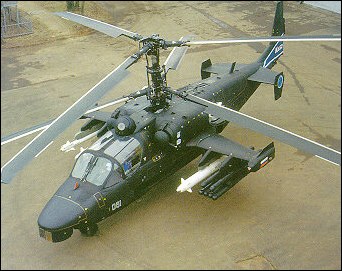
The Ka-50-2 designation applies to three different aircraft. The basic Ka-50-2 is a variant of the Ka-50 single-seater, though the designation is also applied to two twin-seat aircraft; first of these was a version of the Ka-52 Alligator. All Ka-50-2s differ from the baseline Ka-52 in retaining the attack and anti-tank role using 12 laser beam-riding AT-8 Vikhr ATGMs or 16 Rafael NT-D ATGMs. Number 024 was used as demonstrator.
The second variant of Ka-50-2 is another two-seater, intended to have a conventional stepped, tandem cockpits. A further subvariant of the tandem-seat Ka-50-2, the Erdogan (Turkish for Born Fighter) was proposed to Turkey jointly by Kamov and Israel Aircraft Industries. Powered by TV3- 117VMA-02 engines, this would have been fitted with longer-span wings and feature a NATO-compatible Giat 621 turret containing a single 20mm cannon which would fold down below the belly of the helicopter in flight, for a 360 degree arc of fire. It would fold to starboard for landing, and could be fired directly forward, even when folded. Ten Turkish pilots flew Alligator “061” at Antalya, Turkey, in early 1999 as part of evaluation process for a requirement for 145. Named as second choice when the Bell AH-1Z selected, negotiations reopened in mid-2002, following an impasse in negotiations with USA.
The multi-role all-weather combat Ka-52 “Alligator” coaxial-type helicopter differs from its predecessor by a wider nose part and twin-seat crew cockpit where the pilot ejection seats are arranged side-by-side. Both pilots have full controls of the helicopter without any limitations. The pilot cockpit is armored. Numerous weapons options for the helicopter are achieved by arranging a movable high-speed firing gun starboard of the helicopter, and by six external wing stores.
The avionics suite is comprised of a multiplexed, multi-level digital computer-based system having large storage capacity and high speed. Observation, search and targeting systems comprising head-mounted display are used for round-the-clock and all-weather detection of specified targets and their attack using optical, TV, laser, IR and radar equipment.
NATO reporting name Hokum-B, the Ka-52 was revealed at the 1995 Paris Air Show, rolled out in December 1996. The first flight was on 25 June 1997, but the first official flight was on 1 July 1997.
The Ka-52 is 85% similar to the single-seat Ka-50, but the front fuselage is redesigned to accommodate two crew, side by side. Access is by upward-hinged and bulged gull-wing type transparent canopy doors over each seat. The bottom of nose is recessed on the starboard side to improve the field of fire of the 2A42 gun. Some cockpit armour and a number of rounds for the cannon are omitted to compensate for the increased weight.
Power plant for the production models is two uprated 1,863kW Klimov TV3-117VMA-SB3 turboshafts. Two 1,633kW TV3-117VMA turboshafts powered the prototype.
The pilot and pupil or navigator/weapons operator have Zvezda K-37-800 ejection systems, for simultaneous emergency escape, similar to that of Ka-50. Full dual controls are standard including two colour and two monochrome SMD 66 multifunction displays.
AVIONICS: Integrated by Sextant Avionique, supplier of head-down displays, the Navigation and Attack System for Helicopters (NASH), Topowl helmet-mounted sight display, Nadir 10 navigation system.
Radar: Phazotron FH-01 Arbalet MMW radar installed in mast-mounted dome.
Flight: Nadir 10 nav system with Stratus laser gyro AHRS and Doppler radar.
Instrumentation: Arsenal Shchel-V helmet-mounted sight for weapons operator.
Mission: Samshit-E weapons control system above and behind the second cockpit, with TV, FLIR and laser range-finder and target designator. Thomson-CSF FLIR (or optional Russian Khod FLIR) integrated with Shkval electro-optical (TV) sighting system in ball above fuselage aft of canopy. Smaller ball for optical sight under fuselage. Windows for laser range-finder and IR camera in nose turret.
Self-defence: Active IR and electronic jamming units; UV-26 flare/chaff dispensers in wingtip fairings. Warning equipment includes Pastel (L150) RWR, Mak (L136) IR and Otklik (L140) laser system.
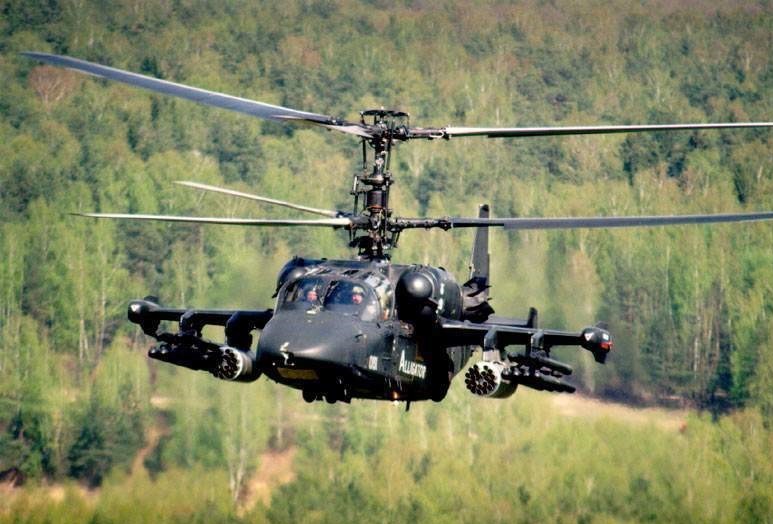
The Kamov Ka-52 entered series production on October 29, 2008. With deliveries of the first batch of 12 units for the Russian air forcé.
Powered by TV3-117VMA turboshafts of 2,195 unit shp from Kamov the Ka-52 reaches a maximum speed of 310 km/h and a cruise of 270 km/h, able to move backwards up to a maximum speed of 90 km/h or 80 km. /h to the sides. The normal takeoff is around 10,400 kg, the maximum 11,000 kg.
The Ka-52 Kamov cockpit chose the side-by-side seating. Both have a K-37-800 ejection seat which, prior to the exit of the seats, different explosive charges separate the rotor blades to allow both seats come out of the fuselage without inconvenience. The cabin is armored with the capacity to resist impacts of up to 20 mm while the windshields have a resistance to ammunition shots of up to 12.7 mm.

The instrument panel incorporates four multifunction polychrome LCD screens and another two monochrome to which is added an ILS-31 model Head Up Display. Both crew members have GEO-ONV-1 or ONV-1-01 night vision goggles, the entire instrument panel being compatible with them. Within the NAV/COM systems there is an inertial navigator with satellite assistance and digital communications equipment.
The integrated self-defense system known as Vitebsk includes:
L-150 Pastel radar warning system
L-140 OTKLIK laser warning system
Missile approach detector of unknown model
Double infrared jammer L-3705
Six UV-26 decoy dispersers

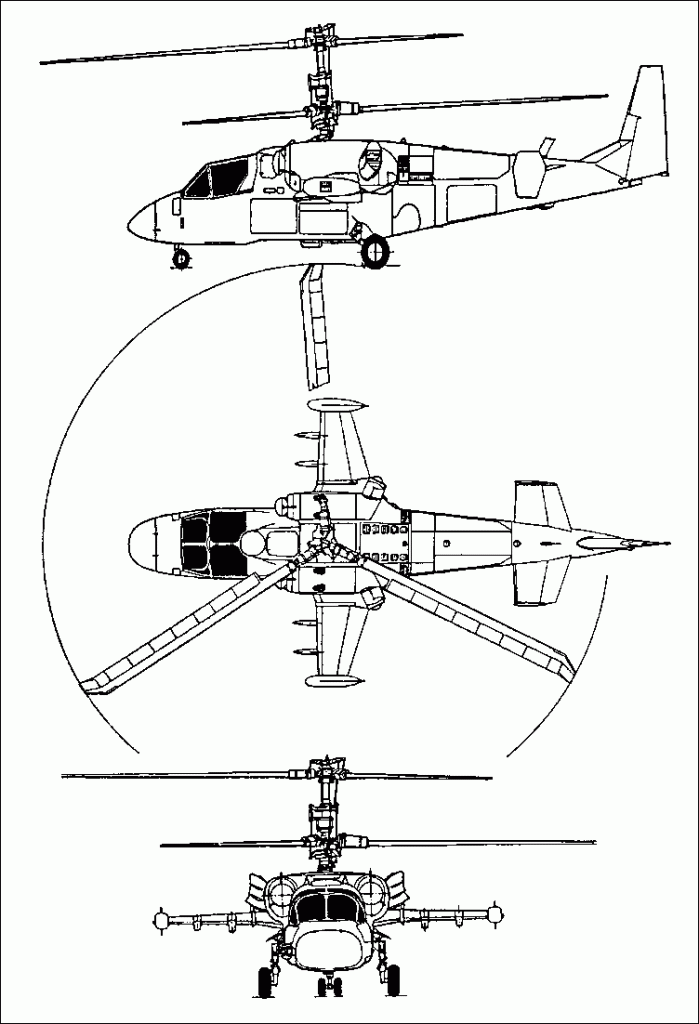
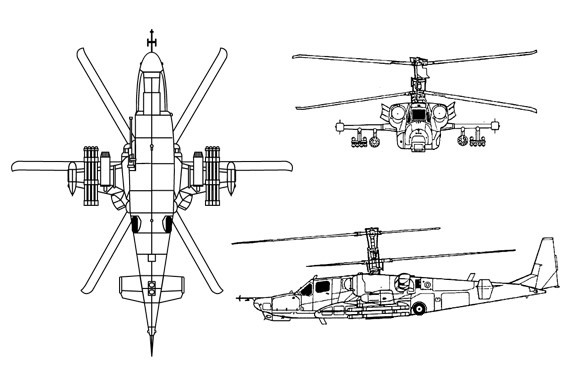
Ka-52
Engines: 1,863kW Klimov TV3-117VMA-SB3 turboshafts
Rotor diameter: 14.50m
Fuselage length: 13.53m
Height: 4.95m
Max take-off weight: 10800kg
Max speed: 300km/h
Hovering ceiling, OGE: 3600m
Normal range: 520km
Range with max fuel: 1200km
Armament: 1 x 30mm 2A42 cannon, 240 rounds
Hardpoints: 6
Crew: 2
 All Aero