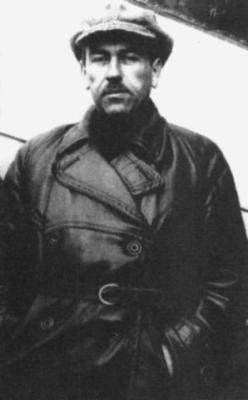
Konstantin Alexeyevich Kalinin (Russian: Константин Алексеевич Калинин) was born on December 29, 1899 in Warsaw. His father, a retired military man, died when he was only three years old. He completed his first studies at a local seminary.
During the 1905 disturbances in Russia, the young Kalinin was accused of distributing revolutionary bulletins, for which he was detained for four months. After being released he continued his teacher studies.
Between 1909 and 1912 Kalinin studied at the Odessa Higher Military Artillery School and after graduation was assigned to Vladivostok. A year later he would get married and have his first contact with aviation. Near the barracks where he was, was one of the first aviation units of the Russian Empire and these planes greatly impressed the young man, who requested to be transferred to a flight school, but was not allowed.
At the beginning of World War I Kalinin served as an artillery officer, but by February 1916 his dream of aviation came true when he was allowed to enter the Gatchina Military Flight School, graduating in December. The recently graduated pilot was assigned to the 26th Aviation Corps stationed on the Romanian front, where he flew reconnaissance missions in Farman and Voisin biplanes, receiving the Imperial Orders of Saint Stanislav, Saint Anne and Saint Vladimir.
After the October Revolution Kalinin joined the Red Army, serving as a pilot during the civil war and joining the ranks of the Communist Party in 1920. On June 1 of 1920, Kalinin entered the Moscow Aviation Technical School, created by Professor N. Ye. Zhukovski in 1919 and for the month of October, due to his excellent results, he validated the first year. By March 1921, Kalinin became head of the scientific-technical section of the school.
In 1922, his membership within the Communist Party was suspended on charges of sympathizing with the counterrevolutionary bands of the Ukrainian nationalist Petlyura and of party inactivity, but he was reinstated in June at the request of a member of the VS school party committee, Ilyushin, but in November he left the institution.
Kalinin moved to Kiev, where he started working at ” Remvozdux-6 ” aircraft repair factory as head of production. This factory, created in 1920, was dedicated to the repair of Red Army aircraft, mostly licensed model aircraft used during the First World War. Since his arrival, Kalinin grouped under his direction a design group made up of a technician (DL Tomashevich), two designers and two students linked to practical work: AT Rudenko and AN Gratsianski.
Determined to continue his studies at the end of 1922 Kalinin entered the Kiev Polytechnic Institute, where a year later he would be elected secretary of the Aviation Scientific Society. By 1923 he patented an elliptical wing of his own design, which would later be used on his civilian models. His graduation project in 1925 was the K-1 (RBZ-6) transport aircraft. Kalinin personally participated in the first flight of the K-1 and ended up graduating as a mechanical engineer. From that moment on he became one of the most renowned Soviet aircraft builders of the interwar period.
In 1926 Kalinin was transferred to Kharkov , where he was selected as chief designer of the UkrVozduxPut company, which was in charge of managing flights on local lines. Under his direction there were two designers, three specialists in wing configuration, fuselages and propellers, and two technicians.
The basis for his new KB was established in the aircraft repair shops of the UkrVozduxPut, which at that time was engaged in the repair of German Dornier aircraft used by Soviet-German airlines. This workshop had 25 workers and two German specialists on its payroll.
On September 17, 1926, these workshops, together with Kalinin’s team, would become the Kharkov Aviation Factory and would lay the foundations of the Kharkov Aviation Institute (JAI) , by creating classrooms for the preparation of workers. The Kharkiv Institute of Technology also created an aviation department for the preparation of engineers, which some time later would be transferred to the JHA.
Later, an aerodynamic laboratory was built where a 2-meter wind tunnel was installed in which Kalinin’s second model, the K-2, would be tested.
The work of the Soviet specialists in the UkrVozduxPut soon created problems with the Germans, which came to a head when the German model Dornier Mercur found a competitor in the domestic model K-2.
The leadership of the UkrVozduxPut was divided, with the supporters of the foreign model winning. As a result, Kalinin’s group was decremented, new specialists from Kiev were brought back, and development of the K-2 was halted.
In these circumstances, the Ukrainian government took action on the side of Kalinin. Soon the pro-German leadership of the UkrVozduxPut was removed from their posts, the Dornier Mercur was not bought and the K-2 was built and tested. Despite the fact that the K-2 did not show superiority in relation to the K-1 and was not produced, it served to prepare the mechanisms of the industry and was soon followed by more successful models such as the K-4 of 1928 (39 built) and the 1929 K-5(260 built), which managed to lay the foundations for national civil aviation, which meant the end of German dependence.
After some civilian models, Kalinin began the development of military models with the gigantic K-7 bomber, which would be destroyed during tests in 1933. Two improved models, one as a bomber and one as an airliner, began construction in Voronezh, but were abandoned in 1935. Later military aviation development was continued with the K-12 (VS-12) tailless bomber.
Kalinin ‘s KB was transferred to the Voronezh Aviation Factory (Factory No.18) where development of the K-12 continued. The new model had been ordered for production but the evaluation in the tests led to its configuration being considered as lacking in perspective and the development was abandoned (dragging with it other aircraft with a similar configuration such as the Moscaliov SAM-7).
In April 1938 he would be arrested on the charge of “enemy of the people” and shot in the Voronezh prison on October 22. His construction bureau was liquidated.
KA Kalinin’s career in aviation lasted only 13 years, in which he designed 16 models. Most of Kalinin’s designs were high-wing, elliptical-shaped, braced monoplanes with a tubular steel structure and wood and fabric covering, characteristic of his time.
 All Aero