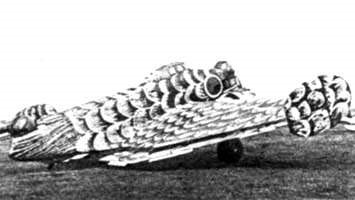
One of the more original KA Kalinin designs was the experimental K-12 or VS-2 (Russian: Калинин К-12 (ВС-2)) tailless aircraft, which had its origins in a request made on July 4, 1932 by the VVS RKKA to the Kharkov Experimental and Serial Aeronautical Construction Factory (JAZOSS) within the framework of the process of modernization which began in February.
It was necessary to replace the Polikarpov R-5. The technical requirements for the new model were dictated by the NII VVS as a multifunctional aircraft for military purposes under the name VS-2, an acronym for V oickovoi Samoliot -2 or Military Aircraft -2.
The K-12 was designed as a light bomber, reconnaissance aircraft, photographic reconnaissance and even light transport aircraft and ambulance. The required speed had to exceed 250 km/h at an altitude of 3,000 meters and the radius of action was 350 km.
By April 1933, the first conceptual drawings of the model were delivered in three versions with the use of three power plants: M-22, M-49 and M-52.
These versions included a traditionally designed aircraft, a twin tailcone structure aircraft, and a third that was close in outline to a flying wing, but featured a small-area horizontal tail surface, located close to the fuselage, thus which was known as the “short tail version”.
Kalinin convinced the head of the NII VVS VK Lavrov to choose the last variant. In his opinion, this variant should have the greatest maneuverability and the best defensive composition due to the absence of firing dead zones. The works began with the tests of some models in the wind tunnel of the Kharkiv Aviation Institute.
After an initial analysis at the NII VVS, the VS-2 project was not approved. It was argued that the project was incomplete and the aircraft overloaded. The use of the M-52 engine according to the data provided by the TsAGI would not be included in the experimental construction plan and the rupture of the crankcase during the tests required important modifications, so it was not feasible to project any aircraft on the basis of that power plant.
The only interesting thing according to the VVS leadership was the flying wing scheme. At that time, both in the USSR and abroad, this scheme attracted aircraft manufacturers, but only the most daring faced it. Too many technical aspects had to be taken into account and, despite the fact that the calculations showed that such a configuration would bring important advantages in terms of speed, manoeuvrability and defensive ease, the risk was too great.
In September 1933 JAZOSS submitted a second VS-2 variant for study. By then the project had already received the K-12 index in the KB. This project was also close to the concept of a flying wing, but kept the tail unit. The engines were located on the sides of the fuselage, inserted into the leading edge of the cantilever wings. The wings had a rectangular shape in the center plane, with trapezoidal consoles with arrows on the leading edge and the trailing edge straight, following the line of the center plane.
Single spar stabilizers were attached to either side of the fuselage, just aft of the wing trailing edge. To reduce the landing speed, Northrop – type surfaces were placed along the entire length of the wingspan. The wing leading edge featured two section slats, the outer ones featured automatic operation and the inner ones were pilot controlled. Aerodynamic surfaces were also located on the surface of the intrados, which were extended during landing, increasing the wing surface by 15-20%.
This version would lead to the definitive variant without a tail and with trapezoidal wing consoles, with vertical surfaces used as rudders located at the ends.
The civil version of the model was calculated for 11 passengers and a postal variant accommodated six. The plane could be disassembled to be transported in rail cars.
The novelty and complexity of the project forced a detailed analysis of the data presented. At that time in the USSR there was no experience in similar configurations or theoretical bases that would allow comparing the calculations presented. For these reasons, the analysis of the TsAGI and a group of renowned specialists who had to study the material presented were requested.
During the analysis of this proposal, a series of criteria were issued, which prevented an effective assessment of the calculations presented. The selection of the model geometry was considered to lack a theoretical basis. The selection of the shape and surface of the empennages and the aerodynamic characteristics of the machined surfaces of the wing had not been calculated. The static coefficients were not presented with the project, nor were wind tunnel tests carried out to confirm the correct selection of this composition. On the other hand, the performance calculations were presented without a specific definition of the propeller to be used, so it is impossible to verify them.
Problems were found in the calculation of the balance and weight of the aircraft, its payload capacity, fuel and oil and many other aspects, so it was considered that the results of the calculations presented did not correspond to reality. It was pointed out that the aerodynamic calculations for the M-22 and M-52 engines had been made on the basis of the same weight, which was not true.
As a result of the analysis, the report considered that the conceptual project presented by the JAZOSS with two M-22 engines was prospective for both military and civilian use, for which reason it was concluded that it could be approved in general, excluding the dimensions and position of the empennages and ailerons, which still needed to be tested in the wind tunnel. The installation of the M-22 engines in the VS-2 was considered temporary, until the M-52 engines were ready. The presentation of a landing gear on skis was also established as a condition for the state tests.
Another report, presented on October 29, 1933, clearly highlighted that this new project had too many little-studied aspects such as its general configuration, the wing without tail, the Northrop planes and the slats. There were no clear calculations of their independent behavior and even less of their work together. It was also written that according to the opinion of the specialists the new scheme would not bring any gain from the aerodynamic point of view. Answering concerns about stability and landing would still require a lot of testing in the wind tunnel. For all these reasons it was proposed to build only a model on a smaller scale with purely experimental objectives.
Lastly, the report presented by Ilyushin considered that the military scheme of the model should not be approved. It was still necessary to work with the loads, meet the requested technical requirements and demonstrate the feasibility of the installation selected for the flight control bodies.
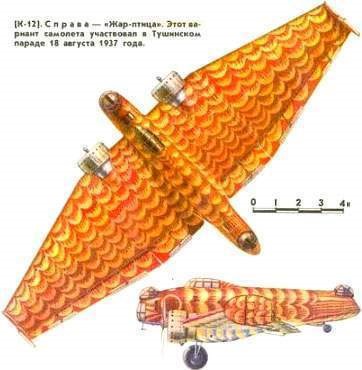
The Kalinin K-12 was conceived as a tailless aircraft in a flying wing configuration with wingtip empennages of mixed construction.
The oval section fuselage featured three sections that were bolted together. The structure was conceived of welded steel tubes covered in fabric. The navigator and gunner positions in the tail featured steel and duralumin cladding.
The midplane featured two spars made of chrome-molybdenum alloy steel tubes. The wing nerves were made of 10 х 8.5 mm steel tubes. The forward region of the midplane, between the leading edge and the spar and the rear, from the spar to the trailing edge, were constructed of duralumin and stainless steel. The central area, near the engines and the fuselage, were covered with fabric.
The wing consoles, with R-11 profile and trapezoidal shape, also had a double spar structure made of wood. The covering was plywood. The vertical and horizontal tail surfaces were made of fabric-coated steel tubes. The three-section ailerons were located along the entire length of the wingspan. The central section was used as elevons.
The power nacelles occupied the entire wing chord on the intrados and served as shelter for the main landers. The main landers on the prototype were fixed and used low-pressure wheels to allow them to operate over unprepared runways. These landers lacked depreciation. In winter operations the train had to be replaced by one of skis with hydraulic amortization.
The K-12 was powered by two M-22 engines produced at Factory No.19 with 2.8 meter diameter metal propellers. The starting of the engines was carried out by means of compressed air or with an external starting system. The use of Townend rings allowed proper cooling of the engines. During the tests, no abnormal heating was observed in the cylinder heads. The use of this hood, which could be easily removed, made it possible to facilitate technical intervention actions.
The fuel system consisted of 4 tanks located symmetrically in the wing, with a total capacity of 900 kg. The oil capacity was 90 kg.
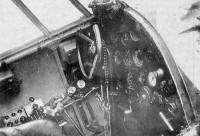
The Kalinin K-12 was designed for a crew of three. The pilot was located in the high cabin located in the central area of the fuselage. In the nose was the gunner navigator with a turret armed with machine guns. The navigator’s cabin had double control and at least conceptually it should allow flight operation, despite the fact that in practice the instrumentation there was very poor. At the end of the tail section was located a defensive turret operated by the gunner. The cockpit and fuel tanks could be covered with removable armor.
The aircraft in its bomber configuration was capable of carrying 500 kg of bombs inside the fuselage. Defensive armament consisted of two 7.62mm ShKAS machine guns operated by the navigator and tail gunner.
In order to check the theoretical calculations, Kalinin decided to build, in addition to the scale models for the aerodynamic tests, a 1:2 scale glider of the VS-2. This 9 meter wingspan glider was built in Kharkiv in 1934 and air tested by pilot VO Borisov.
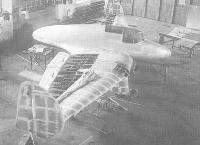
The first flight presented problems. After the glider broke free from the tug the pilot was unable to control the model and the glider inverted. The pilot launched (or was launched) from the glider, which once lightened, hovered smoothly and landed on the back. After the repairs, the causes of the problem were established and a new test was carried out, which this time passed without problems. The pilot VO Borisov successfully carried out about 100 flights, aimed at checking the real behavior in different flight regimes.
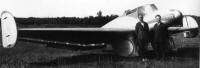
The transfer the new location in Voronezh also added to development delays. Only at the beginning of 1936 was the construction workshop able to begin work on the full-size aircraft.
In June 1936 the K-12 plane left the workshops for the factory test airfield and a month later the test pilot VO Borisov made the first flight. The factory tests requested were carried out without difficulties. This aircraft in the colors of the “Fire Bird” (Zhar Ptitsa) took part in the festivities for the day of the Soviet Air Forces on August 18, 1937 over Tushino. At that time, the state tests began at the NII VVS.
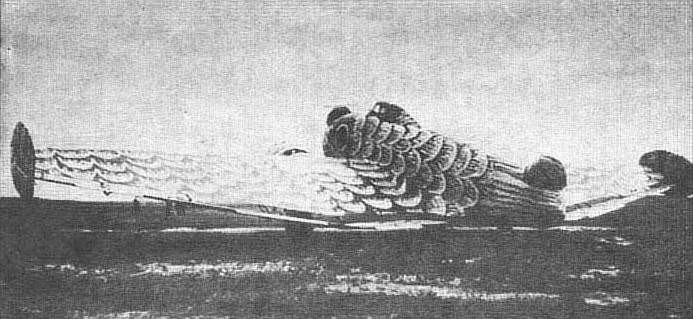
Third rank military engineer Samarin was selected as the person responsible for the tests. Borisov was chosen as the pilot by the factory. The engineer Nersisyan, the captain Shaurov and the technician Androsov also participated. The main objective of the tests was to define the flight properties of the VS-2 2M-22 aircraft and its performance, as well as to study the characteristics of the flying wing system in relation to its stability and flight control.
At the end of 1936 the aircraft was flown by PM Stefanovski , who issued a completely negative assessment of the model. The particular characteristics of the configuration brought as a consequence that the pilots during the tests were conducted with suspicion and it was considered that the VS-2 was a dangerous device. This played a not insignificant role in the future of the model.
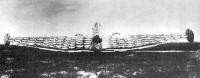
The VS-2 2M-22 accumulated 62 flights with a total of 33 flight hours, including 12 hours in 16 flights made at the NII VVS. In them it was shown that the model was stable in flight and responded favorably to the controls. Stability problems were noted during single-engine flights and during takeoff and landing operations due to ineffective wingtip empennages. Big problems were observed due to the lack of retracting of the landing gear. The tests could not be fully developed.
Problems prevented flights with overloads, combat manoeuvres, weapons tests, dynamic stability, and manoeuvrability.
In the conclusions it was noted that the VS-2 2M-22 aircraft with a flying wing scheme was considered purely experimental. For this reason, the objective of the tests had been directed to the definition of its stability and control properties of tailless aircraft, which at that time were considered the main questions in relation to this configuration.
The data obtained in the flights were not considered sufficient to be able to answer the questions, but they did give the possibility of obtaining some fundamental conclusions for the future development of aircraft in this configuration.
The VS-2 2M-22 aircraft showed good flight conditions. Horizontal flight could be maintained at speeds of 120 – 200 km/h and in this range stability was acceptable. The plane could glide at speeds between 115 and 120 km/h. It took off easily after a not very long run and at a fairly low speed, over 100 km/h. The takeoff trajectory had a tendency to be carried out in a circle. The landing speed was also low, close to 77 km/h. The airplane was considered statically stable under conditions of center of gravity location at 27% of length with rudders locked. With free rudders the plane was not stable.
The effectiveness of the vertical wingtip planes was considered poor, particularly in take off and landing operations and single-engine operations. It was proposed to eliminate these surfaces and replace them with a conventional empennage.
The effectiveness of the ailerons on landing was diminished due to their use as elevators, which was considered unnecessary. It was proposed to work on increasing the effectiveness of these surfaces.
The absence of suspension on the landers made landing difficult. The plane tended to jump after touchdown. Sometimes these jumps were so great that the pilot was forced to give up the throttle again and go up to make a new turn over the aerodrome. It was recommended to add oleo-pneumatic amortization systems. In the same way, it was decided to modify the tail skid to provide it with orientation in order to improve the operation on land.
Flying the plane from the navigator’s cockpit was impossible due to the lack of completeness of the navigation equipment.
The maximum speed obtained of 219 km/h was lower than that of the planes of the time. This was explained by the poor aerodynamic quality of the structure, which had many exposed surfaces and the already obsolete M-22 engines. The advantages of the tailless configuration were affected by the large size of the fuselage.
The defensive capability of the VS-2 was generally superior to that of any tailed aircraft. This model was characterized by the simplicity of the solution to the problem of defense of the rear and upper hemispheres. Despite this, the VS-2’s armament left a lot to be desired. The firing points did not guarantee the total defense of the aircraft and the defense of the aircraft against attacks from below was not guaranteed in any way. The protection of the firing positions was considered deficient.
The cockpit was valued very well. Visibility during the flight and take off was quite good. In the cabin in summer it was quite hot, even after lowering the glass on the left. The teams on the blackboard had a good distribution, with the exception of the variometer, which was very low and it was difficult to see the status.
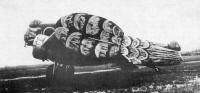
The overall assessment of the aircraft in the NII VVS report signed by Filin and Markov highlighted that the VS-2 2M-22 (K-12) aircraft was of great interest as an experiment in creating a flying wing configuration aircraft in a military configuration. It was considered that this scheme presented advantages in relation to the conventional system in terms of visibility, cleanliness for defence and take-off and landing operations at low speeds.
However, in the version presented, the VS-2 had very poor performance and poor weapons, so it was impossible to consider it a modern military aircraft. The model was considered experimental.
It was recommended to return the plane to its builders in order to improve all the problems. It was proposed to GUAP make these changes and begin factory tests for March 1, 1938. Then submit it for carrying out the full program of state tests.
On December 8, 1937, V. Smushkievich signed the NII VVS report and requested to insert into the experimental construction plan for 1938 the development of an experimental aircraft on the VS-2 scheme with technical requirements and armament in correspondence with a modern military aircraft. The possibility of serial production will be evaluated only after the completion of the state tests.
For two months the plane was overhauled, installing more powerful M-25 engines with variable-pitch metal propellers and electrically-operated retractable landing gear. The weapons were also modified. With these modifications the maximum speed increased to 420 km/h. After finishing the factory tests, the improved aircraft was delivered in April 1938 to the evaluation commission, which approved its serial production.
The K-12 “Zhar Ptitsa” demonstrated at the Tushino air parade was the only aircraft built. On April 1, 1938 K. A. Kalinin was arrested. According to the opinion of the Military Collegium of the Supreme Court of the USSR, he was accused of being an “enemy of the people” and shot. It has been speculated that the builder could have sold information to John Northrop about his studies on the subject of flying wings and also that he had relations with German espionage, but none of these theories have been proven.
The leadership of the aviation industry decided to cancel all the works of this builder, including the destruction of 10 copies that had started production at the Voronezh factory and were at different stages of completion. The lone K-12 was also destroyed after removing all useful equipment and constructive elements. An important part of the project documentation disappeared.

Kalinin K-12
Powerplant: 2 × Shvietsov М-22 480 hp
Wingspan: 20.90 m
Wing area: 72.70 m²
Length: 10.30m
Height: 3.65m
Empty weight: 3070 – 3210 kg
Normal take off weight: 4200 kg
Wing loading: 57.8 kg/m²
Power load: 4.38 kg/hp
Fuel capacity: 900 kg
Oil capacity: 90 kg
Speed at sea level: 211 km/h
Maximum speed at 3000 m: 228 km/h
Cruising speed: 189 km/h
Practical range: 1100 km
Practical ceiling: 7170 m
Landing run: 700 m
Take-off run: 700 m
Armament: two 7.62 mm ShKAS machine guns
Bomb load: 500 kg.
Accommodation: 3
 All Aero