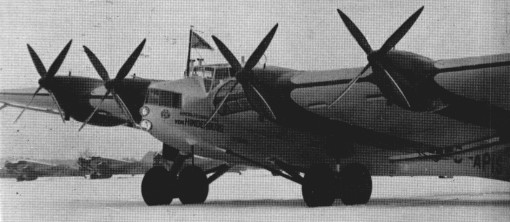
As early as 1909 Junkers had been projecting aircraft capable of carrying as many as 1000 people. Recognizing, that his flying wings were over-ambitious, he started work in 1928 on a machine which incorporated much of his flying wing technology, but had a conventional fuselage and empennage.
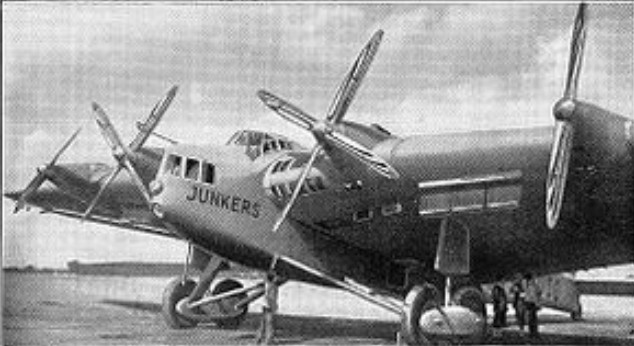
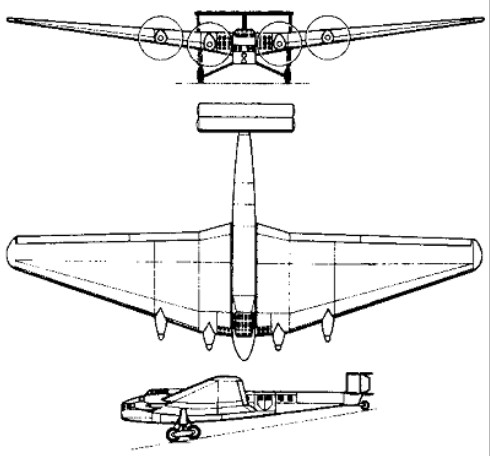
The Junkers G 38’s 44 m (144 ft) wing was 1.7 m (5 ft 7 in) thick at the root, enabling four passengers to be housed there, looking out through glazed leading edges, while the other 30 travellers sat in the fuselage. The thick wing also gave inflight access to the four engines, initially two each of 400 hp and 800 hp, but later changed to 800 hp Junkers L.88s, and finally to Jumo 204 diesel engines which left characteristic black trails.
The first flew on November 6, 1929. Production models carried 34 passengers (plus seven crew).
Two G 38s, named Deutschland and Generalfeldmarschall von Hindenburg, went into service with Deutsche Lufthansa in 1930 and 1931 on the important routes from Berlin to Copenhagen, Venice and Rome, bringing with them new standards of passenger comfort with two deck accommodation, smoking rooms and washrooms. One crashed in 1936; the second example was destroyed in a bombing raid.
From the G 38, Junkers developed the K 51 military variant. It was this that the Mitsubishi works built under licence, and in conditions of strict secrecy, with the collaboration of Junkers engineers. Six Ki 20s were produced as the Army Type 92 Super Heavy Bomber between 1931 35, and the first one flew in 1931. The first two were assembled from materials imported from Germany, the third included only a proportion of imported components, but the remaining aircraft were of all Japanese manufacture. As a measure of its size, the Ki 20 had a wing area double that of the Boeing B 29 Superfortress first flown a decade later.
The Ki 20 was festooned with defensive armament and bombs. In the nose was an open bow gunner’s cockpit. There were two underwing gun turrets, with other guns located in the rear of the inboard engine nacelles, and two dorsal gun positions. The total armament, formidable for the period, consisted of eight 7.7 mm (0.303 in) machine-guns and one 20 mm (0.79 in) cannon. Bombs were carried under the fuselage on external racks. The standard bombload was 2000 kg (4400 lb) with a claimed maximum of 5000 kg (11020 lb). The bombardier, one of the crew of ten, sat in a glassed in nose position. The first four Ki 20s were powered by four Junkers 800 hp L88 gasoline engines, and the last two by 720 hp Junkers Jumo 4 diesels. The aircraft was also used as a testbed for the Kawasaki Ha 9 engine.
The performance of the ungainly Ki 20 fell far short of the expectations that the army had for a long range strategic bomber capable of attacking targets as far away as the Philippines. In squadron service great difficulty was found in maintaining the engines. Although the aircraft were flown in both Japan and Manchuria, they never saw action. The Ki 20’s main use, it would seem, was for domestic propaganda. To this end, three joined the formation fly past during the January 1940 military review in Tokyo, while another was the subject of a public exhibition.
Junkers G 38
Engines: 4 x Jumo 204 diesel, 550kW
Max take-off weight: 24000 kg / 52911 lb
Empty weight: 14900 kg / 32849 lb
Wingspan: 44.0 m / 144 ft 4 in
Length: 23.2 m / 76 ft 1 in
Height: 7.2 m / 23 ft 7 in
Wing area: 305.0 sq.m / 3282.99 sq ft
Max. speed: 225 km/h / 140 mph
Cruise speed: 210 km/h / 130 mph
Ceiling: 6400 m / 21000 ft
Range w/max.fuel: 3500 km / 2175 miles
Range w/max.payload: 1000 km / 621 miles
Crew: 3-7
Passengers: 34
Ki 20
Engines: 4 x Jun¬kers 800 hp L88 gasoline
Wing span: 44m (144ft 4in)
Length: 23.2m(76ft 2in)
Gross weight: 25,448 kg (56 103 lb)
Speed: 200 km/h (124 mph).
Armament: eight 7.7 mm (0.303 in) machine¬guns and one 20 mm (0.79 in) cannon
Standard bombload: 2000 kg (4400 lb)
Claimed maximum: 5000 kg (11020 lb)
Crew: ten
Ki 20
Engines: 720 hp Junkers Jumo 4 diesels.
Wing span: 44m (144ft 4in)
Length: 23.2m(76ft 2in)
Gross weight: 25,448 kg (56 103 lb)
Speed: 200 km/h (124 mph).
Armament: eight 7.7 mm (0.303 in) machine¬guns and one 20 mm (0.79 in) cannon
Standard bombload: 2000 kg (4400 lb)
Claimed maximum: 5000 kg (11020 lb)
Crew: ten
 All Aero