
The Itoh Emi 16 Fuji-go (Fuji) designed by Tomotari Inagaki and built in 1920, was intended as a cheap and simple general purpose civil biplane but gained publicity with exhibition flights and successful speed and altitude contests against higher-powered fighter aircraft.
Though the Fuji-go was best known for its successes in speed contests, it was designed as a multi-purpose, economical civil aircraft, powered by a war-surplus Le Rhône rotary engine and with a cost kept low by structural simplicities such as wings without sweep or stagger.
It was a two-bay biplane with a wooden structure and fabric covering. Its wings had rectangular plans apart from blunted tips, braced together with pairs of parallel interplane struts. Behind the engine the fuselage was rectangular in section with two open cockpits, one under the upper wing and the other for the pilot under its trailing edge, which had a small cut-out to improve the upward field of view. The forward cockpit could carry a passenger or an extra fuel tank to increase the range.
The tail was conventional with a tailplane mounted on top of the fuselage carrying elevators with a cut-out for rudder movement. Both the small fin and generous balanced rudder had polyangular profiles.
The Fuji-go had fixed, conventional landing gear with wheels on an axle between pairs of V-struts mounted on the lower fuselage longerons and a long tailskid mounted below the fin leading edge.
Its first flight was on 22 July 1920.
The Fuji-go was soon into competitions, beginning with the First Prize-winning Flight Competition held in August. Flown by Yutichi Goto, it won first prize for altitude and came second in a speed race, covering a route between Funabashi and Chiba at 128 km/h (80 mph; 69 kn). It went on to perform publicity flights over Kyoto and Osaka. It also competed in the Imperial Flying Association’s Second Airmail Flying Contest which involved a race between Osaka and Kurume. Since several competitors had much more powerful engines it was decided to reduce drag by cropping the lower wings beyond the first bay, leaving a span of 7.04 m (23.1 ft). This increased the maximum speed by 21%. Goto and the Fuji-go came second, gaining an 8,000 yen prize and beaten only by a SPAD XIII fighter with a 220 hp (160 kW) engine.
After a period of further promotional flights the aircraft returned to competition in May in the 1921 Second Prize-winning Flight Competition. It was flown into third place by Komayoshi Yasuoka.
One Emi 18 was built in 1921 powered by a 120 hp (89 kW) Clerget nine-cylinder rotary engine. The wing area was greater and airframe was shorter than the original.
The 1921 Emi 19 was the same as the Emi 18 but powered by a 120 hp (89 kW) Turrin nine-cylinder rotary engine.
The 1921 Emi 20 had shorter span and length and was powered by an 80 hp (60 kW) Le Rhône rotary engine.
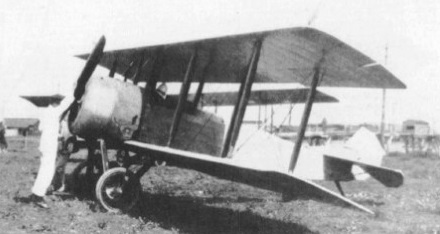
Emi 16 Fuji-go
Powerplant: 1 × Le Rhône, 89 kW (120 hp)
Propeller: 2-blade
Wingspan: 9.34 m (30 ft 8 in)
Wing area: 23.5 m2 (253 sq ft)
Length: 6.05 m (19 ft 10 in)
Height: 2.52 m (8 ft 3 in)
Gross weight: 740 kg (1,631 lb)
Maximum speed: 167 km/h (104 mph, 90 kn)
Time to 1,000 m (3,300 ft): 3 min 30 s
Crew: One
Capacity: one passenger
Emi 18
Engine: 120 hp (89 kW) Clerget
Span: 9.50 m (31.2 ft
Emi 19
Engine: 120 hp (89 kW) Turrin
Span: 9.34 m (30.6 ft)
Emi 20
Engine: 80 hp (60 kW) Le Rhône
Span: 9.0 m (29.5 ft)
 All Aero