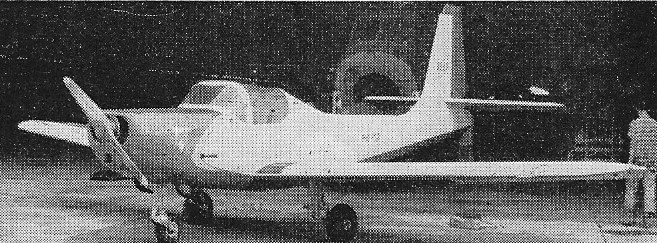
The XL-17 ” Musang” (Wildcat) is the fourth aircraft in the series designed and constructed by the Institute of Science and Technology of Manila in the Philippine Republic, and is part of a programme to test the application of local materials, such as home-grown woods, to aircraft structure. During their experiments the Institute developed a material which it called “Wobex”. “Wobex” consists of diagonally woven strips of thin bamboo glued together, made air tight and leakproof, and finished on the surface with a layer of fine sawdust and glue. Its main use is as a stressed skin covering.
In the mid-1950s the Philippine Institute of Science and Technology (I.S.T.) designed the single engine, tricycle undercarriage, low wing monoplane L-17 was one of them.
Designed by Antonio J. de Leon, its wing was a single-piece wooden structure with 5° of dihedral and a straight-tapered plan. It was plywood-covered and had split flaps inboard of the ailerons. The cantilever tail unit was similarly constructed with the straight-tapered horizontal surfaces on top of the extreme aft fuselage; the single-piece elevator carried an offset trim tab. The vertical tail was tall and straight-edged; the bottom of the horn balanced rudder was above the elevator and just aft of its hinge, with a small cut-out to allow for elevator deflection.
Fuselage is a one-piece semi-monocoque structure with wooden bulkheads and stringers covered by a “Wobex ” skin, which in turn is covered with fabric for final finishing and polishing. Fuel tanks are fitted aft of the seats and the rest of the fuselage space can be used as either a radio compartment or as baggage space. The engine mount is the standard truss-type with attachments at four points to the firewall bulkhead, which is reinforced for the attachment of the nose landing gear. The cantilever wing is trapezoid in form and of one-piece construction that tapers in chord and length. It is made up of one main and one auxiliary spar of box-type construction and reinforced diagonal spar. The leading edge is covered with a thick plywood covering to take torsional and chordwise shear loads. Overall wing covering is fabric. Slotted type ailerons are fitted and simple split flaps are located under the wings between the ailerons and the fuselage. The wing root upper section upper covering is reinforced to serve as a step and walkway to the cockpit. A tricycle undercarriage is fitted, the main gear to the main wing spars and the nose gear to the firewall bulkhead.
Cockpit seating two side by side under a single piece canopy. A 108 hp (80 kW) Lycoming O-235-C1 flat-four engine drove a two-blade propeller. The fixed tricycle undercarriage had rearward-sloping oleo legs mounted to the wings, giving a track of 2.40 m (7 ft 10 in).
The first flight of the L-17 was scheduled for May 1956.
Engine: 1 × Lycoming O-235-C1, 81 kW (108 hp)
Propeller: 2-bladed , fixed pitch, wooden
Wingspan: 9.60 m (31 ft 6 in)
Wing area: 13.40 m2 (144.2 sq ft)
Airfoil: US 35B at root, NACA 23012 tip
Length: 7.20 m (23 ft 7 in)
Height: 3.20 m (10 ft 6 in)
Empty weight: 510 kg (1,124 lb)
Gross weight: 735 kg (1,620 lb)
Fuel capacity: 68 L (15 Imp gal, 18 US gal)
Maximum speed: 210 km/h (130 mph, 110 kn)
Cruise speed: 175 km/h (109 mph, 94 kn)
Stall: 80 kph
Rate of climb: 3.8 m/s (750 ft/min)
Crew: 2
 All Aero