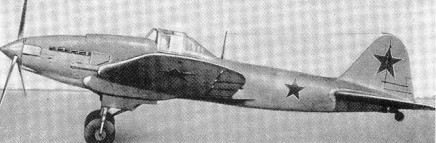
The Ilyushin Il-2 origin dates back to the mid-thirties, within the Soviet military criteria of having air support for the operations of the ground forces.
In 1935 a requirement was launched to obtain a ground attack aircraft that was protected, or more specifically a BSh (Bronirovanyi Shturmovik, armored attack aircraft). Finally Sergei Ilyushin’s team was the one that around 1938 developed the Il-2 that was going to be able to perform the functions required.
Two prototypes were developed a few months apart, the two-seater TsKB-55, also designated BSh-2 (from Bronirovanni Shturmovik, armoured attacker) by the air force that first flew on October 2, 1939, and the single-seater TsKB-57, which replaced the radio operator with an additional fuel tank. They were equipped with AM-35 and AM-38 engines respectively, with 1,350 and 1,600hp. of power, heavily armed with 20mm ShVAK cannons, machine guns, bombs and rockets and protected with more than 700 kg of armour.
On 12 October 1940 the TsKB-57 took to the air with the more powerful 967kW M-38 engine. This improved machine led to the IL-2 which was just getting into service when the Germans invaded in June 1941.
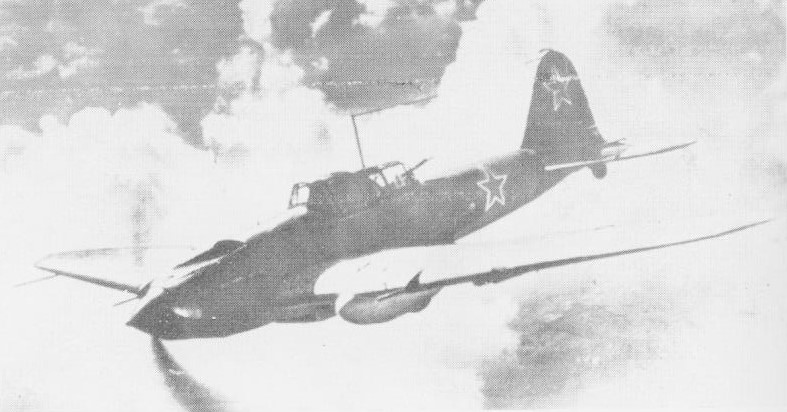
Serial production was prepared in factories in Moscow, Fili and Voronezh, but when only the first 250 examples had been delivered, the German invasion occurred on June 22, 1941.
The factories in Fili and Voronezh were moved to Kuybishyev, which became the center of production under pressing pressure from the Kremlin to make the model available in mass quantities.
Armament of the original IL-2 was two 20mm ShVAK and two 7.62mm ShKAS guns firing ahead, plus eight 82mm rockets and four 100kg bombs. The need for rear protection resulted in a second crew member being added to man a rear gun, usually a 12.7mm BS, and the forward guns were changed to the hard-hitting 20 or 37mm VYa, and sometimes two of each, in 1942. Bomb load went up to 600kg, including PTAB armour-piercing bombs. The Shturmovik’s weapons could pierce all German armoured vehicles, even the Tiger tank being vulnerable when attacked from the rear.
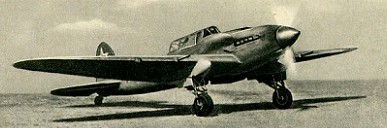
The aircraft was redesignated Il-2M with the new 1,750hp AM-38F engine, also increasing the armour up to 950 kgs. A new modification was also introduced, which consisted of converting the radio operator into a tail gunner, handling a 12.7mm UBT heavy machine gun, entering into action as of October 1942 under the designation Il-2M3, which was to be finally the main production version.
The Il-2m3 two seat version had a uniform armoured shell entire forward fuselage, with rear fuselage and wings of plywood and other light materials. They carry two 37mm cannon.
In 1943, the Poles were the first foreign operators of the Il-2, followed by the Czechs, Bulgarians, and Yugoslavs.
By the time the Ilyushin Il-10, an improved variant, went into production in August 1944, 36,163 Il-2 Shturmoviks had been delivered. In the postwar period, significant quantities were delivered to China, North Korea, and both Poland and Czechoslovakia produced improvements on the models, adapting them to their requirements. He received the nickname or code name “Bark” by NATO.
The IL-2 remained in operational service in the Soviet Union and with the Air Forces of Czechoslovakia and Poland into the 1950s.
Output averaged 1,200 per month during most of World War II, to give a total of approximately 36,000. When the IL-10 developed version is added the total is reported to amount to 42,330.
Variants:
- TsKB-55: two-seater prototype.
- BSh-2: designation of the TsKB-55 in the V-VS.
- TsKB-57: single-seat prototype.
- Il-2: production model of the TsKB-57 (1941).
- Il-2M: single-seat production model with improved armament and engine.
- Il-2M3: variant similar to the Il-2M but with a tail machine gunner.
- Il-2T: torpedo version for the Soviet Navy with the capacity to carry a 533mm torpedo.
- Il-2U or U-Il-2: trainer version with double control.
- Il-2I: prototype with M-38 radial engine.
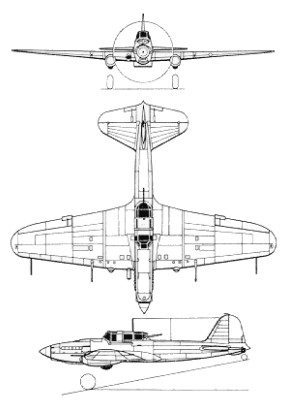
Engine: 1 x Mikulin AM-38F V-12, 1300kW / 1770 hp
Wingspan: 14.6 m / 47 ft 11 in
Length: 11.6 m / 38 ft 1 in
Wing area: 38.5 sq.m / 414.41 sq ft
Max take-off weight: 5360 kg / 11817 lb
Empty weight: 4200 kg / 9259 lb
Max. speed: 430 km/h / 267 mph at 6560 ft
Cruise speed: 320 km/h / 199 mph
Ceiling: 6000 m / 19700 ft
Range w/max.fuel: 800 km / 497 miles
Range w/max.payload: 600 km / 373 miles
Armament: 2 x 23mm machine-guns, 3 machine-guns, 400-600kg external
Crew: 1-2
l-2M3
Power plant: Mikulin AM-38F, 1,720hp
Wingspan: 14.60 m
Wing area: 38.50 sq.m
Length: 11.65 m
Height: 4.17m
Empty weight: 4,520 kg
Maximum takeoff weight: 6,360 kg
Maximum operating speed: 410 km/h (255 mph; 221 kt)
Service ceiling: 4,530 m (14,862 ft)
Service ceiling: 4,530 m
Range: 770 km
Wing loading: 160 kg/sq.m
Power/weight: 0.21 kW/kg
Crew: 2
Armament: 2 x VYa-23 23mm mg, 150 rounds per gun, 1 x Berezin UBT 12.7mm machine gun, 150 rounds, 2 x 7.62mm ShKAS machine guns, 750 rounds per gun
Bombload: 50 kg, 100 kg or 200 kg internal
Hard points: 4 / 600 kg total for 2 x Cannon or 2x RS-82 and RS-132 Rockets
 All Aero