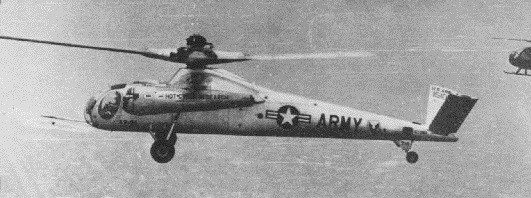
The Hughes XV-9 (company designation Hughes Model 385) was a 1960s American high-speed research helicopter built by Hughes Helicopters.
Convinced that the use of gas pressure to drive rotors, as used in the XH-17 and proposed for the XH-28, was superior to conventional methods as the elimination of the transmission drive system resulted in a lighter, less complex, and more easily maintained system, Hughes engineers sought ways to improve the propulsive efficiency of pressure-jet rotors. Eventually concluding that much improvement would result from ducting the hot efflux of gas generators directly to cascade vanes at each blade-tip instead of piping cold air to tip-burning nozzles, they succeeded in attracting the interest of the US Army.
Funded by the Army beginning in 1962, the multi-phase development programme for the Model 385 began with 60 hours of test running of a prototype hot-cycle rotor mounted on a ground rig. As results were encouraging, Hughes proceeded to the next phase, 15 hours of bench testing of the Model 385 propulsion module consisting of two General Electric YT64-GE-6 gas generators mounted at the tips of stub wings and driving a three-bladed rotor. Each blade was of two-spar construction with the hot efflux of the gas generators being taken to vanes at their tips by means of a Rene 41 high-temperature steel duct passing between the spars. Cooling air was forced through the leading and trailing edges of the constant-chord blades and was exhausted at the tip, fore and aft of the hot efflux. Results remaining promising, Hughes was authorized to proceed with the manufacture and testing of a research vehicle, the XV-9A (serial 64-15107), which was given a VTOL mission designator instead of the more traditional H helicopter designator.
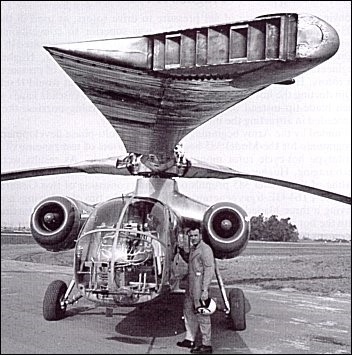
As the XV-9A was only intended as a demonstrator for the hot-cycle system, the Army requested that manufacturing costs be kept to a minimum by using components from other aircraft. Thus, the cockpit of a Hughes OH-6A (with side-by-side accommodation for a pilot and a co-pilot/flight test engineer) and the undercarriage of a Sikorsky H-34 were mated to a specially-built fuselage and V-tail. The hot efflux from two General Electric YT64-GE-6 gas generators, which were loaned by the Navy and mounted at the tips of a stub wing, drove the three-bladed rotor. Bleed air from these generators was ducted to a yaw control system at the tail.
The system was built around two pod-mounted General Electric YT64-GE-6 engines fitted to the ends of two high-set stub wings, one on either side of the fuselage directly below the main rotor hub. Each engine’s turbine section had been removed, and hot exhaust gases were ducted directly through the rotor hub to be expelled at near-sonic speeds through vaned cascades in each of the three blade tips. Smaller exhaust ports on either side of the tail boom just forward of the rudders provided some additional directional stability.
The version for the US Army was designated XV-9A and had a three-blade constant chord metal rotor. There was room for two pilots seated side by side in the cockpit.
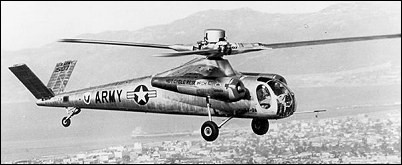
First flown by Robert G. Ferry at Culver City on 5 November, 1964, the XV-9A remained at the manufacturer’s facility until it had completed an initial 15-hour flight test programme. It was then transferred to Edwards AFB, where an additional 23 hours were flown.
The tests were satisfactory and the company was confident that the hot-cycle system would be widely used, although the XV-9A was noisy and had a high fuel consumption. The company was unable to mitigate the problems and the development by Hughes of pressure-jet systems did not proceed. The Army tests were completed in August 1965, with a total of 19.1 hours having been flown, and the helicopter was returned to Hughes.
From an engineering point of view, tests proved highly satisfactory and in 1965 Hughes confidently predicted that the hot-cycle system would be used for heavy-lift military helicopters and for compound civil helicopters.
From the environmental and economic points of view, however, the XV-9A was less successful as the exhaust of hot efflux through cascade vanes at the tips of the rotor was noisy and unacceptable in urban areas and as fuel consumption rate was high. To mitigate these deficiencies, Hughes proposed a refinement of the pressure-jet concept based on the use of turbofans in lieu of gas generators. This warm-cycle system was tested in a wind tunnel and on a whirling stand but improvements were insufficient to warrant the manufacture and testing of a flying prototype, thus bringing to an end the development by Hughes of pressure-jet systems successively based on the cold-cycle principle, as used for the XH-17 and XH-28, the hot-cycle principle, as featured by the XV-9A, and the warm-cycle principle, as evaluated during whirling stand tests.
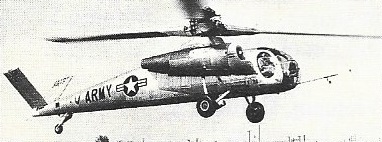
The aircraft was scheduled for delivery to the Smithsonian collection in May 1967 but actually arrived in August. It was shipped via railcar from Ft. Eustis and arrived as a wreck, which was not the Smithsonian’s understanding of the aircraft’s condition. The cockpit had been picked clean and there were multiple holes in the fuselage. Smithsonian correspondence does not make clear how much of this was due to improper handling and security by the railroad and how much was due to inadequate storage by the Army.
At some point in the early seventies, the aircraft was deemed beyond reasonable restoration and scrapped. The Smithsonian did retain most of one of the hot cycle blades and it is still in storage.
XV-9A
Powerplant: 2 × General Electric YT64-GE-6, 2,850 hp (2,126 kW) each
Main rotor diameter: 55 ft 0 in (16.76 m)
Main rotor area: 2,376 sq ft (220.6 m2)
Length: 45 ft 0 in (13.72 m)
Height: 12 ft 0 in (3.66 m)
Empty weight: 8,500 lb (3,864 kg)
Gross weight: 15,300 lb (6,955 kg)
Maximum speed: 173 mph (279 km/h, 150 kn)
Cruise speed: 150 mph (242 km/h, 130 kn)
Range: 165 mi (266 km, 143 nmi)
Service ceiling: 11,500 ft (3,505 m)
Crew: Two
 All Aero