At the Atlantic Aero FBO at Greensboro, North Carolina’s Piedmont Triad International Airport (KGSO), a team of engineers and technicians assembled a twin-engine very light business jet. This was the proof-of-concept (POC) prototype of what would become the HondaJet very light jet. The team’s work culminated on Dec. 3, 2003, when the POC took flight.
This was a relatively small team of engineers and technicians that had been working furiously for at least the last 10 months—and some much longer—in preparation for that day.
There were no electrical system drawings, only conceptual schematics, and they had to create them from scratch.
They had a very small group in the early days of the project in Greensboro and a larger team in Japan supporting them. Work hours during the design phase started early and extended into the evening, day after day. In three years, they accomplished a tremendous amount of work and overcame huge challenges with the limited staff getting the aircraft ready for its inaugural flight.
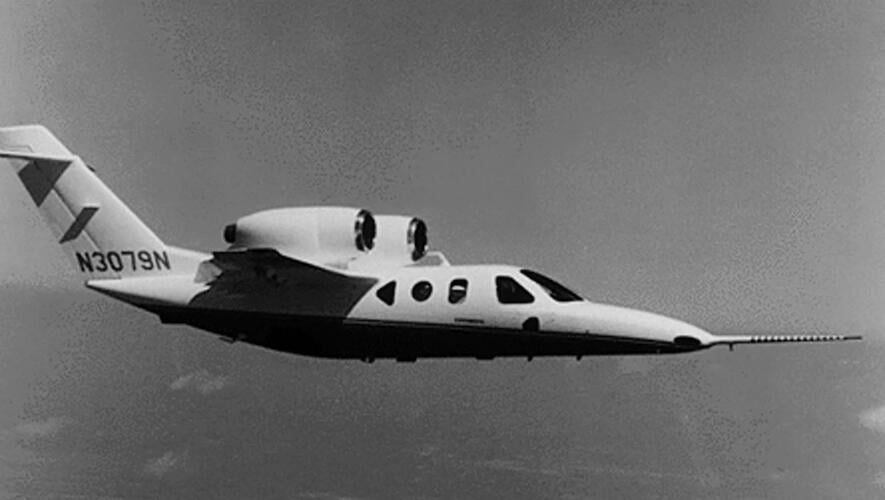
The second production jet to feature over-the-wing-mounted (OTWEM) turbofan engines, the HondaJet was the brainchild of Honda’s Michimasa Fujino. Fujino spent years exploring aircraft design, culminating in flight testing of the composite twin-engine MH02, which had two engines mounted directly on top of a wing attached to the top of the fuselage.
He eventually settled on the HondaJet OTWEM design because of its efficiency and the extra space it afforded in the aft cabin, but persuading the head office that this was the best configuration proved to be a huge challenge. It took more than two years to reach the point and finally the OTWEM configuration for HondaJet was fixed.
At midnight and, with the flight scheduled for 8 a.m., the aircraft was prepped and ready to go. However, back in at 5:30 a.m., firing up the aircraft to make sure everything was still okay before the preflight.
Michimasa Fujino’s first design was the MH02, which didn’t go into production.
 All Aero