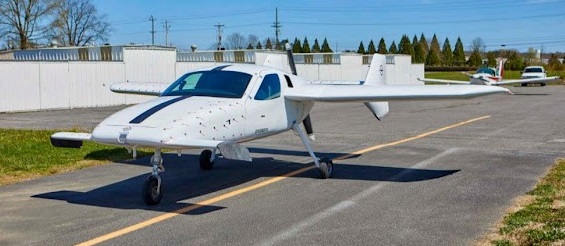
The composite construction Hogan Innovator was a two-place, twin-tailboom, rear-engine, pusher-propeller amateur built airplane, powered by a Continental Titan IOX-370-CLD1T4 engine.
Registered N257AR s/n 002, the Experimental (Special) Airplane had accrued about 12 hours on the Hobbs meter, of which about 0.3 hours was actual flight time.
In a written statement, the pilot who performed the initial test flight of the accident airplane provided a detailed description of what he observed and experienced on that flight. He said:
As soon as I came off the ground the plane went into a wild oscillation of both pitch and roll. I ran out of elevator up trim within the first few seconds of that flight and then had a lot of control pressure involved to keep it flying around the pattern. At that point I realized I needed altitude to sort out the control ability of the aircraft… During the flight I actually bumped off the elevator stop at least three times. I don’t know how many times during that flight the aircraft departed straight and level flight, all uncommanded, however I would guess it to be around a dozen times. At one point I considered bailing out of the plane but realized I had enough control to try to line up with the airport runway and attempt a controlled landing, or at least get it back to the airport where help could be given if the landing didn’t go well. As it turned out once I reduced the throttle for the final approach I was able to let off some of my control pressure for the elevator and make a very nice controlled descent… In my opinion: the aircraft demonstrated a static stability that was divergent and unstable. While dynamic stability was just barely on the stable side of neutral. These two factors obviously fought each other in the stability of the aircraft.
Video of the first half of the test flight, which was captured by an onboard camera mounted on the copilot’s window, provided a cross-cockpit view of the pilot and views outside his window and part of the windscreen. Audio of ambient noise in the cockpit as well as radio communications was heard throughout. The video viewed was consistent with the narrative description provided by the test pilot.
The camera’s battery lost its charge mid-flight and the video ended abruptly on the upwind leg over the runway.
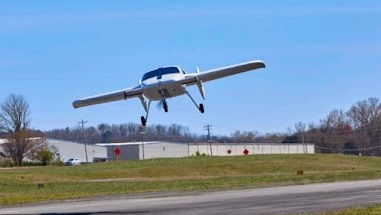
The airplane was the prototype for an airplane kit that was planned for mass production.
The airplane was disassembled, returned to the factory, modified at the accident pilot/builder’s direction based on captured data and test-pilot observations, and then brought back to CLZ, reassembled, and taxi-tested on 22 March 2019.
On March 23, 2019, at 1535 eastern daylight time, an experimental amateur-built Commuter Craft Innovator, N257AR, was destroyed by collision with terrain during an uncontrolled descent after takeoff from Thomas B. David Field (CZL), Calhoun, Georgia. The pilot/owner/designer/builder was fatally injured. Accident Number: ERA19FA134
On the day of the accident, the pilot asked his assistant to fly in a “chase plane” with a camera and photograph the airplane “in case it takes off.” The pilot said he did not intend to fly, would land if the airplane lifted off, and would only fly if “he had no other choice.” According to his assistant, she watched from the chase plane as the airplane departed “barely above the trees,” turned in the traffic pattern, and then descended from view.
According to the chase pilot, the accident pilot/owner instructed him to depart ahead of N257AR. The pilot/owner said he would takeoff, enter the downwind leg, “verify the plane was flying satisfactorily” and then climb the airplane to 3,000 ft. Once at altitude, the two planes would join up to capture footage of the prototype airplane in flight. Footage of the accident flight was not captured, but the chase pilot witnessed the accident flight from about 2,500 ft.
The chase pilot watched the accident airplane take off and turn to the crosswind and downwind legs of the traffic pattern. He estimated the airplane never climbed more than 200 feet above ground level (agl), and that the airplane struggled “to maintain airspeed or a nose-up attitude.” The chase pilot heard the accident pilot announce his intention to return to the airport, though a reason was not specified. He said the airplane was “porpoising” in flight before the nose “dipped down” and the airplane collided with trees and terrain.
Another pilot witnessed the accident flight from his car as he approached the airport. Immediately after takeoff, the airplane was “pitching and rolling and appeared unstable.” He estimated the pitch and roll excursions were about 20° left and right, and nose-up and nose-down. The witness described the crosswind turn as “steep” and estimated the bank angle at 45°. He also stated the airplane was “very low” and estimated it was about 150 ft agl in the turn when it disappeared behind trees due to “distance and low altitude.” The witness said he could not hear the engine sound from inside his car.
In a telephone interview, another witness said that he was inside his workshop when the airplane flew “low” overhead. He said the sound of the engine was loud, smooth, and continuous until the sounds of impact were heard. The witness left his shop to discover the airplane had crashed on his property.
The pilot held a private pilot certificate with a rating for airplane single engine land. His most recent FAA third-class medical certificate was issued December 6, 1999. Preliminary review of FAA records revealed the pilot did not hold a valid medical certificate nor had he completed a BasicMed course. A review of his logbook revealed the pilot had logged 334 total hours of flight experience. He logged 4.7 total hours of flight experience in 2018. His most recent flight was 1.1 hours in duration on April 27, 2018 in a Flight Design CTLS airplane. According to employees of Commuter Craft and the pilot’s logbook, the pilot had no experience in the Innovator airplane as either a pilot or passenger.
According to a Commuter Craft employee, the airplane had accrued about 12 hours on the hobbs meter, of which about .3 hours was actual flight time.
The wreckage was destroyed by impact and displayed no evidence of pre- or post-impact fire. Ground scars and fragmentation of the wreckage were consistent with ground contact in a steep, nose-down attitude at high speed. The wreckage path was about 90 feet long and oriented 132 degrees magnetic. The initial ground scar was in an open field and the main wreckage came to rest inside a narrow wood line between two fields. Flight control continuity could not be confirmed due to multiple cable breaks and fractures. All breaks and fractures exhibited signatures consistent with overload failure.
The engine was separated from its mounts but entangled with the main wreckage. Engine control continuity was established from the engine to its control quadrant, which remained attached to the engine. The two composite propeller blades of the constant-speed propeller were both uniformly fractured at their respective hubs and displayed chordwise scratching.
 All Aero