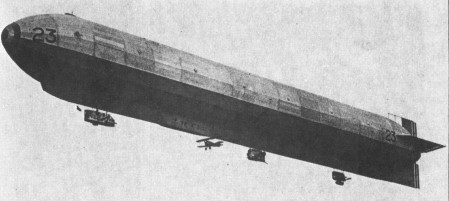
When His Majesty’s Airship No. 9 (HMA No.9) was delivered in the clos¬ing months of 1916 it was almost obso¬lete as a result of the lengthy political vicissitudes that had bedevilled its production. It served a useful purpose, however, it had become the basic pat¬tern on which the four rigid airships for the Admiralty were later to be based. The first of these ‘23’ class airships, HMA No. 23, was subsequently deli¬vered from Vickers Limited, Barrow¬-in-Furness, to Pulham on 15 Septem¬ber 1917. Design work had started in June of the previous year, the first flight being planned for that autumn, but consider¬able redesign had to be carried out when the original specification re¬sulted in a vessel that was something like 3493 kg (7,700 lb) too heavy, the greater part of this excess being attri¬butable to the choice of engines.
The first trial flight of No. 23, four days after delivery, turned out to be something of an anticlimax, for it was clear that she too was at least obsoles¬cent, as might be expected from the original design source, and her mod¬ern counterparts had a lifting capacity some nine times greater than that of which she was capable. It is hardly surprising, therefore, that the planned total of 10 airships of this type was final¬ly cut back to six, while No. 23 was relegated to training duties. The other units of the class were HMA No. 24 (Beardmore), HMA No. 25 (Armstrong Whitworth), HMA R26 (Vickers), HMA R27 (Beardmore) and HMA R29 (Arm¬strong Whitworth), the last pair being of the improved ‘23X’ class without an exterior keel. No. 26 was the first to receive the ‘R’ prefix for rigid airships.
Mindful that in the mid-months of 1918 there was a possibility of aerial confrontations between airships of the opposing nations, experiments were carried out with Sopwith Camel air¬craft suspended beneath the envelope of No. 23; the plan in the event of an attack was for the two fighters to be released to defend the mother vessel. There was no provision at the time for the aircraft to be reclaimed.
In the spring of 1919 No. 23 was strengthened for tests at a mooring mast, but before they could be carried out she was broken up in September.
HMA No. 23
Type: naval training airship.
Powerplant: four l86.4-kW (250-hp) Rolls-Royce Eagle III 12-cylinder water-cooled piston engines.
Maximum speed 84 kph (52 mph)
Service ceiling 914 m (3,000 ft)
Range 3219 km (2,000 miles)
Useful lift 6000 kg (13,228 lb) including four 45-kg (100-lb) bombs
Diameter 16.15 m (53 ft 0 in)
Length 163.07 m (535 ft 0 in)
Volume 26674.4 cu.m (942,000 cu ft)
Armament: provision for 7.7-mm (0.303-in) Lewis gun on free mounting above forward portion of hull, plus bombs.
 All Aero