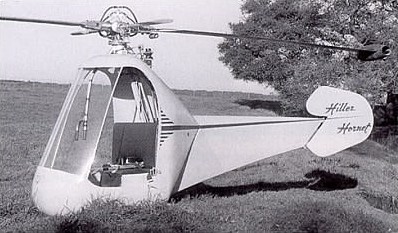
Originally intended for the civil market with a price as little as $5,000, the Hiller Hornet was a tiny helicopter powered by ramjet engines mounted on the rotor tips.
Although Hiller never realized the long-held dream of flying crane production for want of government sponsorship, this program did have conspicuous successes. The comprehensive body of research it generated has paved the way for such helicopters to be built in the future, eliminating every real or imagined obstacle to their construction. This program also fostered the development of two generations of the Hiller HJ-1 Hornet.
The first of these generations began with the construction of three HJ-1s in Palo Alto in 1950. Just 2.1m high, weighing 400kg fully loaded, and topped with 7m-diameter rotors, these machines were far less complex than conventional helicopters. Only their Rotormatic paddles revealed them to be Hiller machines. Frank Peterson flew the first Hiller HJ-1 “Hornet” in August day in 1950.
The two-place craft was of simple construction, consisting mainly of a reinforced steel tube framework overlaid with a skin of fiberglass and plastic laminate. The Hornet was powered by two Hiller 8RJ2B ramjets, one fixed to the end of each main rotor blade, with an auxiliary one horsepower gasoline engine being used to spin the rotor blades up to the 50 rpm required prior to ignition of the ramjets.
The HJ-1 “Hornet” generated substantial public interest when unveiled by Hiller in February 1951. At that time it was announced that the company might offer them for sale at less than $5,000 each. Its top speed was 130km/h, cruise was 110km/h, the service ceiling was 3350m, and the initial rate of climb was 5.6m/s. The only drawback was range, as a fully loaded HJ-1 could travel only a little under 65km.
The HJ-1 was stable for a small helicopter because of its Rotormatic paddles and high-inertia rotor. The docile manners ended at autorotation.
Whereas conventional helicopters autorotate at 9m/s or so, the Hiller “Hornet” plummeted at 15m/s, because the intakes of its ramjets retarded rotor windmilling. Hiller’s aeronautical engineers christened this aerodynamic braking “cold drag”. However slowly it turned during autorotation, the rotor – with the weight of ramjets at its tips – had plenty of accumulated kinetic energy left to trade for lift when the time came. One merely needed skill, nerve, and fast reflexes to know when to haul up on the collective lever.
Hiller Test Pilot Bruce Jones was the first person to autorotate a tip-powered helicopter. Ground observers stood aghast as he hurtled downward in the HJ-1, came to a radical flare in the nick of time, and settled to the ground. With a mix of relief and anger, Hiller’s non-pilot contracts manager ran up to the Hornet, shouting that the craft was not insured.
“Listen,” the pilot replied hotly, steadying himself on rubbery legs. “I’m lucky to be alive! The aircraft was falling at 15m/s and I was falling at 10, and I barely caught up with the controls to land the damn thing!”
Jones, a veteran World War II flier and a former Bell helicopter demonstration pilot, soon became the undisputed master of Hornet autorotations. An argument arose on the Hiller flight line one summer day in 1951 over what accuracy, if any, was possible during “deadstick” landings. Jones settled the issue once and for all by autorotating from 900m to land within 15m of dead center of the Hiller apron.
With no torque to counter, the “Hornet” dispensed with a tail rotor in favor of a simple airplane-style rudder canted to take advantage of rotor downwash. Pedals were likewise eliminated; side-to-side movement of the collective lever worked the rudder to provide yaw control. An overhead cyclic stick provided lateral and longitudinal control as in the early model 360. On the touchy subject of noise, Hiller publicity releases optimistically stated that “the Hornet’s sound range compares favorably with that of a conventional-powered helicopter.”
The “Hornet” had just two controls (cyclic and collective-cum-rudder) and tachometer, fuel flow gauge, airspeed indicator, altimeter, and starter button on its instrument panel.
The Korean War preempted plans to market the HJ-1. Viewing its rapidly expanding backlog of military helicopter orders, and an uncertain public demand for the HJ-1, Hiller Helicopters announced in September 1951 that plans for marketing a civil version of the Hornet had been indefinitely deferred.
 All Aero