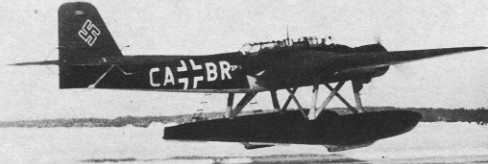
Design of this large seaplane started in 1935 as a faster and more manoeuvrable replacement for the He 59.
It was an all metal mid wing monoplane with single step metal floats. For its size it handled well and gave good performance.
The prototype He 115 V1 (D AEHF) was first flown in August 1937, powered by two 800 hp BMW 132K nine cylinder radials. After further flight trials its two machine-guns were then removed, their positions faired over, and on 20 March 1938 the aircraft set eight payload/speed records.
This aircraft was followed by three more prototypes of which the He 115 V3 (D ABZV) was the first aircraft to be given the extensively glazed nose of the final production version. The field of view for two of the three man crew was increased still further by extended glazing of the canopy from the cockpit back to the mid-¬fuselage position. The fourth prototype was the production prototype with float/ fuselage bracing wires replaced by struts.
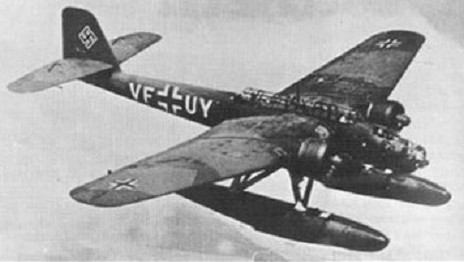
An evaluation batch of ten, designated He 115A 0, also produced in 1937-38, were followed in 1939 by 34 He 115A 1s, powered by uprated 960 hp BMW 132K engines. The He 115A 0s were armed with a single 7.9 mm (0.311 in) machine gun in the extreme nose while A 1 models were fitted with an extra MG 15 gun and were used as torpedo attack aircraft. Some A 1s were built for export and designated A 2: Norway bought six and Sweden 10.
The first large scale production version for the Luftwaffe derived from the V5 (itself modified from an A 0) which developed into the He 115B series. These aircraft had structural improvements to accommodate the heavier payload, an increased fuel capacity, and provision for up to five 250 kg (550 lb) bombs. Alternatively, two 250 kg (550 lb) bombs and an 800 kg (1760 lb) or 920 kg (2030 lb) torpedo or mine could typically be carried. Manufacture continued until 1944, by which time production totalled 138 air¬craft, excluding prototypes.
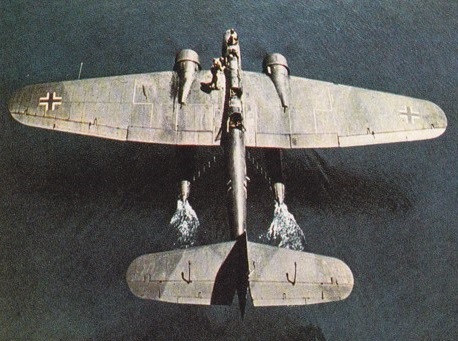
The B series was followed by the He 115C series, begun in 1940 and entering Luftwaffe service the following year. The C 1 had an additional under nose MG 151 cannon and two rearward firing MG 17 machine guns mounted in the rear of the engine nacelles. Subsequent C variants were generally similar, the C 2 having reinforced floats; the C 3s were fitted with mine-laying equipment; and the C 4s were used as torpedo bombers, armed with only three rearward firing machine guns.
A one off He 115A 1, converted to become the He 115D, was armed with one cannon and five machine guns, carried a fourth crew member, and was powered by two 1600 hp BMW 801MA radial engines. It was used operationally but did not go into series production.
The He 115 stayed in useful service until 1944, and was used mainly in Scandinavia, the North Sea and English Channel, the north of Germany, and to a lesser extent in the North African and Mediterranean theatres. Two of the Norwegian He 115A 2s escaped to the UK in 1940 and, together with an ex-Luftwaffe B-1, were used by the RAF to carry agents between Malta and North Africa. During their service lives, the He 115B and C models were fitted with a variety of Rustsatze (field conversion kits) comprising variations in the nature of the operational payload carried. The particular kit was indicated in a suffix to the main designation: thus, for example, the He 115B-1/R1 was a standard B-1 carrying a photo reconnaissance twin camera installation (R1), whereas the He 115B 1/R3 was equipped with one 920 kg (2030 lb) or two 500 kg (1100 lb) aerial mines and their release gear.
He 115C-1
Engines: 2 x BMW 132K, 960 hp / 872 kW
Span: 22.3 m (73 ft 2 in)
Length: 17.3 m (56 ft 9 in)
Height: 21 ft 7.25 in / 6.59 m
Wing area: 933.23 sq.ft / 86.70 sq.m
Empty weight: 15,146 lb / 6870 kg
Gross weight: 10680 kg (23550 lb)
Maximum speed: 300 km/h (186 mph) at 3280 ft / 1000m
Climb to 3280ft/1000m: 5 min 6 sec
Service ceiling: 18,040 ft / 5500m
Range: 1740 mi / 2800 km
Seats: 3
Armament: 1 x 15mm cannon / 4 x 7.92mm mg
Bombload: 2756 / 1250 kg or 1 x 1102 lb / 500 kg torpedo

 All Aero