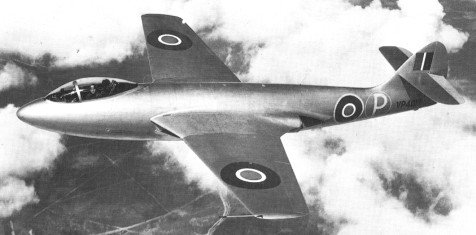
Hawker produced their first jet fighter, the P1040, to the specifications of the Air Ministry, designed by the team headed by Sir Sydney Camm. In certain respects the P1040 was an unorthodox aircraft. Although fitted with a single Rolls Royce Nene engine with twin intakes at the wing roots, it had a split jet pipe with two exhausts at the wing root trailing edge on either side of the fuselage; it also had straight wings, a straight tail and a normal fin. It was a beautiful aircraft to fly with spring tab ailerons, and it attracted the attention of the Admiralty. The Royal Navy took it over, converted it for deck landings with the addition of a hook, and gave it folding wings and other nautical refinements. This version of the P1040 became known as the N7/46, and was later produced as the Seahawk for the Fleet Air Arm. After the P1040 came the P1052, with a number of important changes in design.
Hawker P.1040 Sea Hawk Article
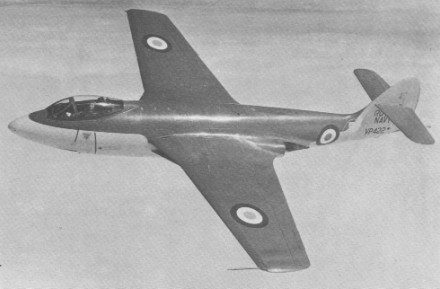
Arising from the P.1040 single-seat land-based interceptor prototype, the Hawker Sea Hawk first flew in prototype form on 2 September 1947. A novel feature was the tail jet pipe which divided and exhausted in the wing roots. This made it exceptionally manoeuvrable and allowed a large internal fuel capacity giving the fighter a relatively long range. In addition to the fuselage mounted guns, bombs and rockets could be carried under the wings.

A tricycle undercarriage had single wheels on each unit. The main wheels retract inward into the fuselage. The nose wheel retracts forward. The wings fold upward and inward.
It was eventually followed by the Rolls-Royce Nene 101-powered Sea Hawk F.I, 35 of which were built for the Royal Navy by Hawker and 60 by Armstrong Whitworth.

This being a pure fighter variant. It was not until 1953 that it began to enter service with the Fleet Air Arm. Used operationally from the carriers Albion, Bulwark and Eagle in 1956, in support of Anglo French landings in Egypt, the type remained in service until 1960.
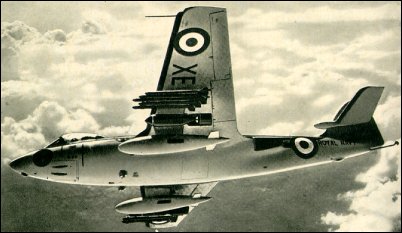
Sea Hawk production being entrusted to Armstrong Whitworth Aircraft from the Sea Hawk F.Mk 2 version onwards from 1953. The Mk 2 version was similar to the F.I but had powered ailerons. It was first flown in February 1954 and 40 were delivered. Progressive development of the basic design led to the appearance of rather more versatile variants, the first of these being the 116 Armstrong-Whitworth built Sea Hawk FB.Mk 3, which featured a strengthened wing structure, enabling it to carry bombs, rockets or auxiliary fuel tanks, and plain ailerons without tabs.
These were followed by 97 Sea Hawk FGA.Mk 4 with attachments for underwing stores, in addition to four 20mm built-in guns. The FGA.4 has power assisted ailerons.
In 1955 a Sea Hawk was flying at Britteswell equipped with vortex generators on the tailplane to ascertain the longitudinal stability characteristics at high Mach numbers. The research was aimed at increasing the maximum speed from the 630 mph.

Adoption of the more powerful Nene 103 turbojet engine in 1956 led to the Sea Hawk FB.Mk 5 (about 50 converted from Mk 3) and 86 new (plus some converted) Sea Hawk FGA.Mk 6 derivatives, these basically being re-engined Sea Hawk FB.Mk 3s and Sea Hawk FGA.Mk 4s, although some Sea Hawk FGA.Mk Gs were built as such.
In addition to production for the Fleet Air Arm, the Sea Hawk also operated with the naval air arms of India. Two squadrons of F(GA).6 were acquired by the Indian Navy for service on the aircraft carrier Vikrant; this service subsequently also received 22 ex-RN F(GA).4/6 and 28 ex-German aircraft.
22 Sea Hawk Mk 50 for the Royal Netherlands Navy were similar to Mk 6 but with American radio equipment; modified in 1959 to carry Sidewinder missiles.
34 Sea Hawk Mk 100 close-support strike fighters were produced for the Federal German Navy, and 34 Sea Hawk Mk 101 long-range radar reconnaissance fighters for the Federal German Navy.
German Hawker Sea Hawk Article April 1959
By 1960 the Sea Hawk retired from the Fleet Air Arm.
Of the 434 Sea Hawks produced for the Royal Navy, plus those for foreign service, only about 30 aircraft, serving on the Vikrant, remained in 1980.
Sea Hawk F.Mk 1
Engine: 1 x Rolls-Royce Nene 101 tur¬bojet, 2268-kg (5,000-lb) thrust.
Wing span: 39 ft 0 in (11.89 m).
Length: 39 ft 8 in (12.09m).
Height: 8 ft 8 in (2.64 m).
Max TO wt: 16,200 lb (7347 kg).
Max level speed: 560 mph (901 kph).
Sea Hawk FGA.4
Engine: RR Nene
Wingspan: 39 ft
Length: 40 ft
Sea Hawk FGA.Mk 6
Engine: one 2359-kg (5,200-lb) thrust Rolls-Royce Nene 103 turbojet.
Wingspan: 11.89 m (39 ft 0 in)
Length: 12.09 m (39 ft 8 in)
Height 2.64 m (8 ft 8 in)
Wing area 25.83 sq.m (278 sq ft)
Wheel track: 8 ft 6 in
Maximum speed 945 km/h (587 mph) at 6095 m (20,000 ft)
Service ceiling 13565 m (44,500 ft)
ROC: 5700 fpm
Range 1287 km (800 miles) with auxiliary fuel.
Empty weight: 4672 kg (10,300 lb)
Maximum take-off weight: 6895 kg (15,200 lb)
Armament: four MK Hispano Mk V 20-mm cannon, plus two 227-kg (500-lb) bombs or 2076-mm (3-in) rockets.
Crew: 1

 All Aero