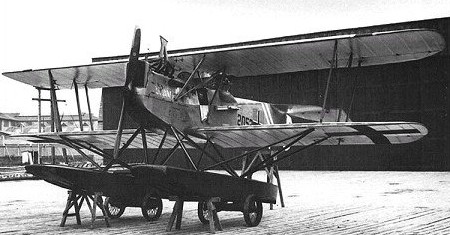
Designed and built in late 1916, the Branden¬burg W.12, first of several highly successful floatplane fighters evolved by Ernst Heinkel, had its prototype completed and flown for the first time in January 1917 with a 160hp Mercedes D III six-cylinder water-cooled engine.
Hansa-Brandenburg W.12 Article
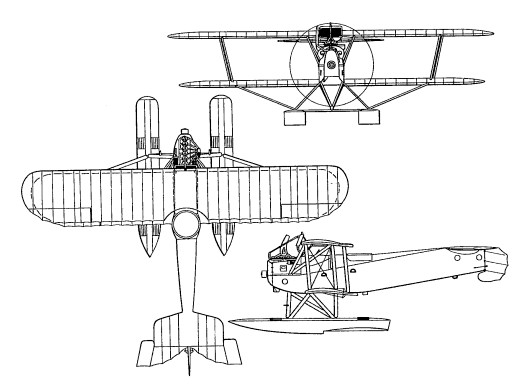
A single-bay twin-float two-seat fighter biplane, of wooden construction with plywood fuselage skinning, the W12 was produced for the German Navy with both the 160hp Mercedes D IIIa engine and the 150hp Benz Bz III. Its first operations were conducted from the seaplane station at Zeebrugge.
Standard armament comprised one forward-firing synchronised 7.92mm LMG 08/15 machine gun and a Parabellum of similar calibre on a flexible mount in the rear cockpit, but of the 146 W.12s that had been built when production terminated in June 1918. One batch of 30 Benz-engined fighters had been delivered with a forward-firing armament of two LMGs.
The W.12 remained in first line service until the Armistice.
W.12
Engine: 1 x 160hp Mercedes D.III or 150 hp Benz Bz.III
Max take-off weight: 1454 kg / 3206 lb
Empty weight: 997 kg / 2198 lb
Wingspan: 11.20 m
Length: 9.60 m
Height: 3.30 m / 11 ft 10 in
Wing area: 36.20 sq.m / 389.65 sq ft
Max. speed: 161 km/h / 100 mph
Cruise speed: 146 km/h / 91 mph
Ceiling: 5000 m / 16400 ft
Armament: 3 x 7.92mm
Crew: 2
 All Aero