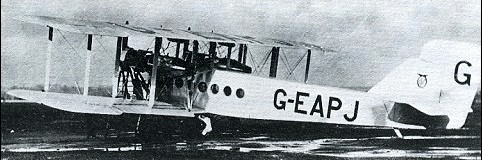
Following its initial services into Europe with modified O/400 bombers shortly after the first World War, Handley Page Transport operated a series of two and three-engined developments of the bomber, designated W8, W9 and W10.
First flown on 2 December 1919 the W.8 had twelve passenger seats in two rows in a glazed cabin, while the pilot and co-pilot sat in an open cockpit in the nose of the fuselage.
Powered was 335kW Napier Lion IB engines.
The Handley Page W.8B (three of which were originally operated by Handley Page Transport and then from 1924 by Imperial Airways on its London-Paris service) was a refinement of the original W.8. The W.8Bs each had two 268kW Rolls-Royce Eagle VIII engines. The last W.8B was retired in 1932.
A trio of W8bs named Princes Mary, Prince George and Prince Henry, started a London Paris service in May 1922.
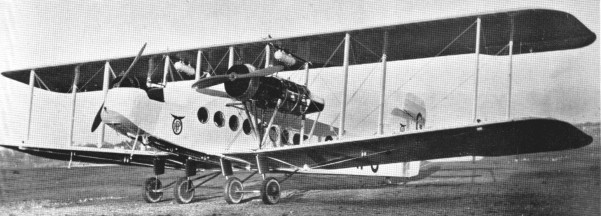
In addition to the British-operated W.8Bs, one was built and exported to Belgium, where SABCA licence-built three more for Sabena. Handley Page also delivered a single example of the W.8E, with two 171kW Siddeley Puma and one nose-mounted 268kW Rolls-Royce Eagle IX engines. Eight were subsequently licence-built in Belgium.
The final new W.8 version, the W.8F Hamilton, was similar to the W.8E and had been designed to be used in the Belgian Congo. Practically a standard W.8B, the nose of the fuselage ahead of the cabin was considerably modified. One of these machines in 1925 completed a flight from Brussels to the Belgian Congo, a distance of 11,000km, piloted by Lt Thieffry, of the Belgian Army, accompanied by Mecanicien De Bruycker.
Imperial Airways received only one W.8F
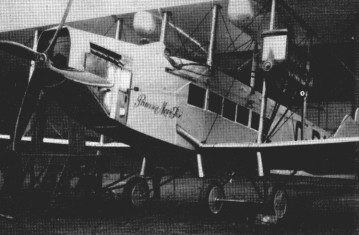
The HP.24 Hyderabad was a military derivative.
Following its initial services into Europe with modified O/400 bombers shortly after the first World War, Handley Page Transport operated a series of two and three-engined developments of the bomber, designated W8, W9 and W10.
Imperial Airways received one W.9A Hampstead and four W.10s (the last retired in 1933). The Hampstead was powered by three 287kW Siddeley Jaguar and then 335kW Bristol Jupiter VI engines and had a 5.31m long, 1.35m wide and 1.78m high passenger cabin for 14 persons.
The W.10s each had two 335 kW Napier Lion IIB engines and featured a new type of rudder, fitted with a balance of the inset-hinge type, instead of the earlier horn-balance arrangement. The W.10 featured an entirely metallic structure for the engine mountings, replacing the usual wooden bearers.
Imperial Airways received W.10s (the last retired in 1933).
W8b
Engines: 2 x Rolls Royce Eagle VIII, 360 hp
Props: 10 ft 6 in (3.20 m) 4 blade.
Wing span: 75 ft. (22.86 m).
Length: 60 ft.1 in (18.31 m).
Wing area: 1456 sq ft (135.26sq.m).
Gross wt: 12500 lb (5,670 kg).
Max speed: 104 mph (167 km/h).
Range: approx 500 miles (800 km).
Crew: 2.
Pax cap: 12.
W.9a Hampstead
Engine: 3 x Siddeley Jaguar, 287kW
Max take-off weight: 6577 kg / 14500 lb
Empty weight: 3794 kg / 8364 lb
Wingspan: 24.08 m / 79 ft 0 in
Length: 18.39 m / 60 ft 4 in
Wing area: 145.30 sq.m / 1563.99 sq ft
Max. speed: 183 km/h / 114 mph
Ceiling: 4115 m / 13500 ft
Range: 644 km / 400 miles
 All Aero