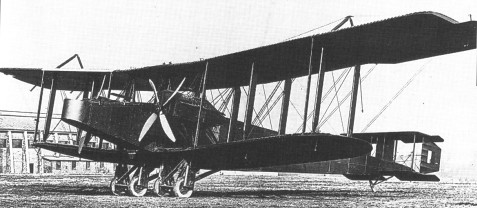
In December, 1914, Capt. Murray Sueter had asked Handley Page to produce for the RNAS an aircraft which, with naval forthrightness, he described as “a bloody paralyzer”, a development of the O/100.
Operational experience with the O/100 showed that certain changes were desirable, especially to the fuel system. In the original layout each engine had its own armoured fuel tank contained within the armoured nacelle which housed the engine, restricting the amount of fuel which could be carried. The modified fuel system consisted of two fuselage tanks and two gravity-fed tanks installed in the leading edge of the upper wing’s centre-section. Wind-driven pumps supplied fuel direct to the engines, as well as to the gravity-fed tanks. Removal of the fuel tanks from the nacelles allowed them to be shortened and a new inter-plane strut to be fitted immediately aft of each nacelle.
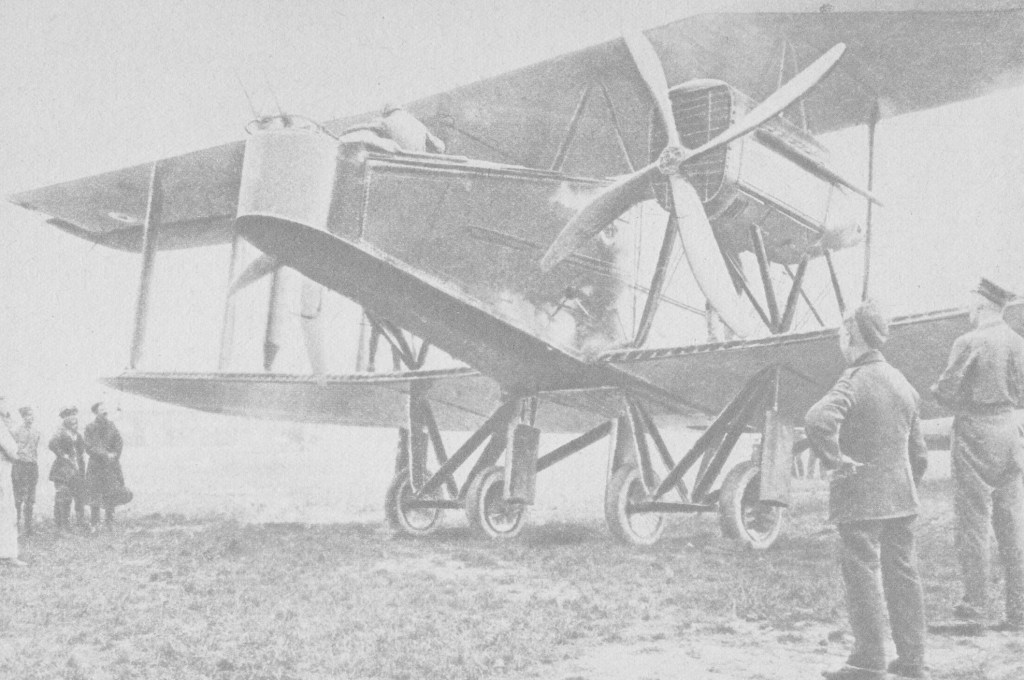
Other improvements included the provision of a compressed-air engine-starting system, with a crank handle for manual start in the event of pressure loss, and changes to the rear gun position and central fin. In this new configuration this variant of the O/100 was redesignated O/400. An initial contract for 100 of these aircraft was awarded to Handley Page in August 1917.
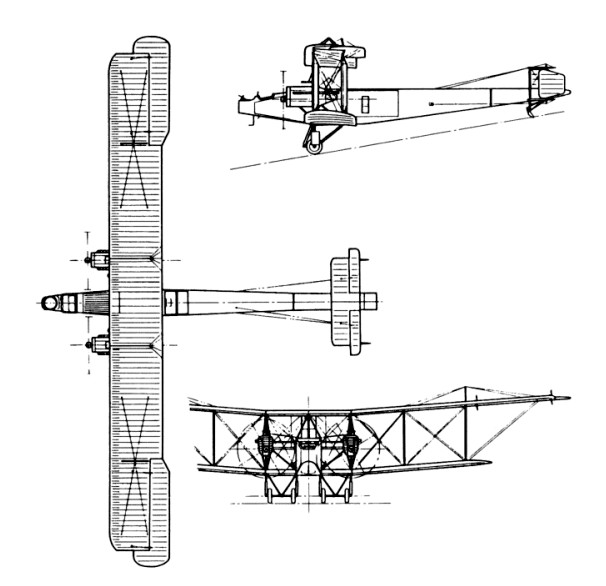
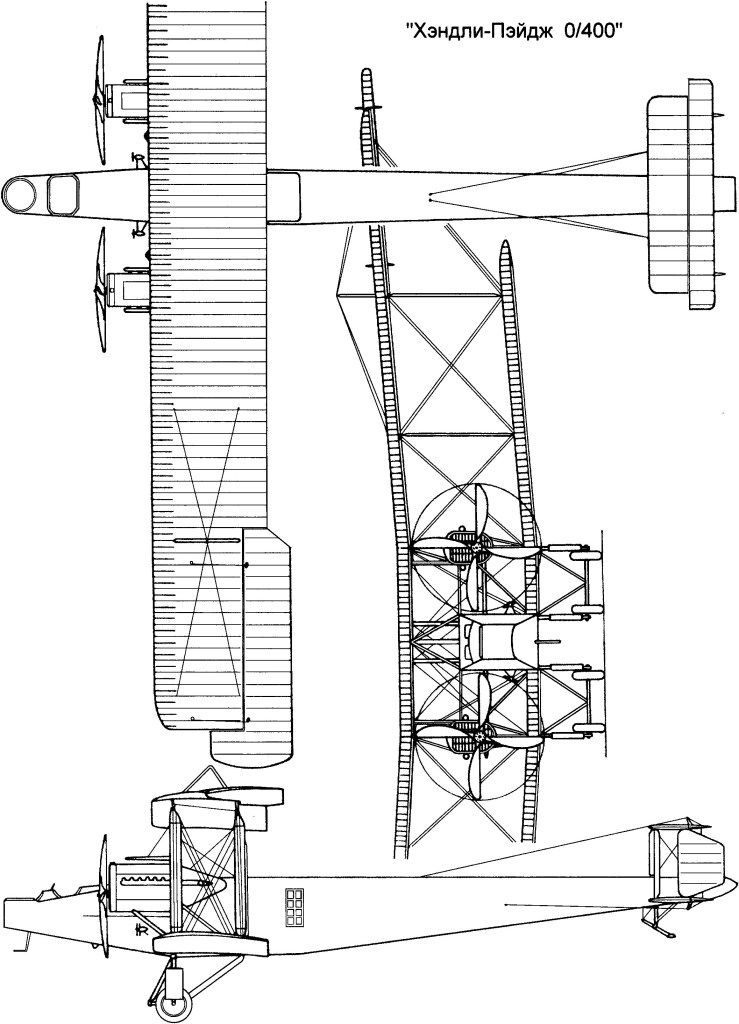
The O/400 was a two-place biplane with two-spar wooden wings, with fabric covering. The wings could be folded for storage. The fabric covered fuselage has a biplane tail-unit, with elevators on the top and bottom tailplanes, a central fixed fin and two outboard rudders. Ailerons were on the top wings only. Twin wheels were on each undercarriage unit.
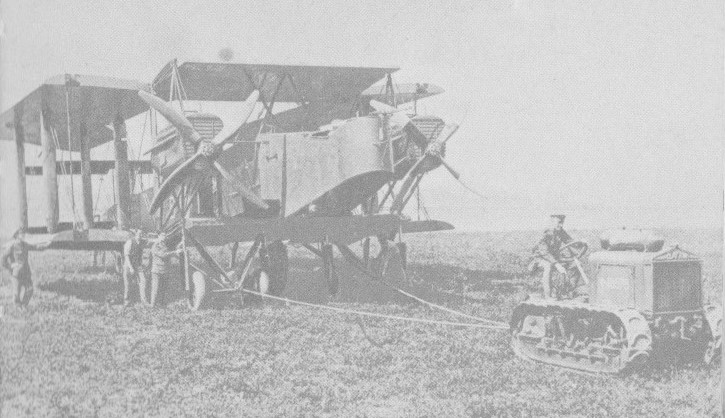
A total of 284 Imp.Gal of fuel was in two tanks in the fuselage and two in the upper centre-section. Defensive armament consisted of one or two Lewis machine guns in the nose cockpit, one or two in the cockpit aft of the wings, and one firing rearward and downward through a trapdoor in the fuselage. An internal bomb-bay for one 1650-lb bomb or equivalent weight of smaller bombs. A typical load was sixteen 112-lb bombs.
First flying in September 1917, production deliveries of O/400 began in the spring of 1918, but it was not until 9 August 1918 that No 97 Squadron, which was equipped with these aircraft, joined the Independent Force and began operations. As numbers built up it became possible to launch heavier and more frequent raids: on the night of 14-15 September 1918 an attack by 40 Handley Pages was launched against enemy targets. It was also during September that O/400 began to use newly developed 750kg bombs for the first time.
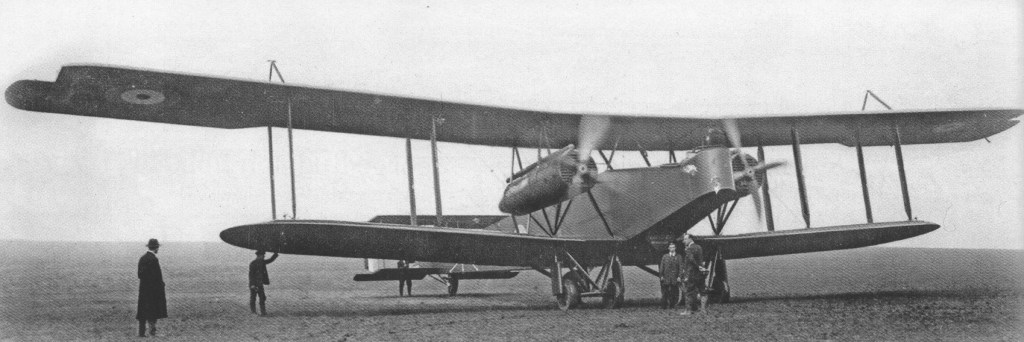
This weapon came into service in 1917 in the form of the O/400 twin engined, heavy bomber. Carrying a bombload of 1800 lbs, and powered by two Rolls Royce Eagle engines, it was the world’s first really effective night bomber.
The Handley Page O/400 of 1918 was Britain’s standard heavy bomber of the first World War. A large biplane, with a span of 100 ft (30.5 m) on the upper wing, it was powered by two Rolls Royce Eagles or alternative engines of 250 350 hp each. A crew of three was usually carried, there being an open cockpit seating two side by-side and open gunners’ cockpits in the extreme nose and in the fuselage behind the wings. The guns were mounted on Scarff rings which allowed them to be swivelled through a 360 degree arc, and another gun was mounted in the underside of the fuselage to fire downwards and aft.
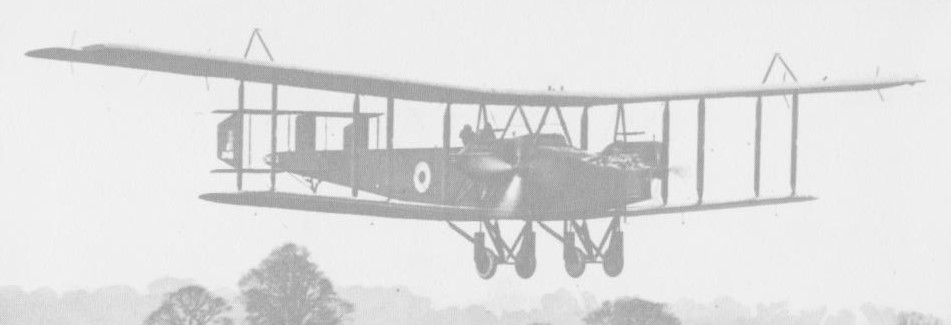
The O/400 could carry sixteen 112 1b bombs inside the fuselage, the bomb bay being covered by spring loaded doors which opened under the weight of the bombs as they were released. Other combinations of larger bombs could be carried, up to a single example of the 1,650 1b (750kg) bomb which was the largest used by the RAF in that war. Two more bombs could be carried on external racks under the fuselage. With a gross weight of about 13,500 lb (6,125 kg), the O/400 could reach a speed, flat out, of nearly 100 mph (160 km/h) and had a range of about 600 miles (965 km). Construction was of wood, with fabric covering.
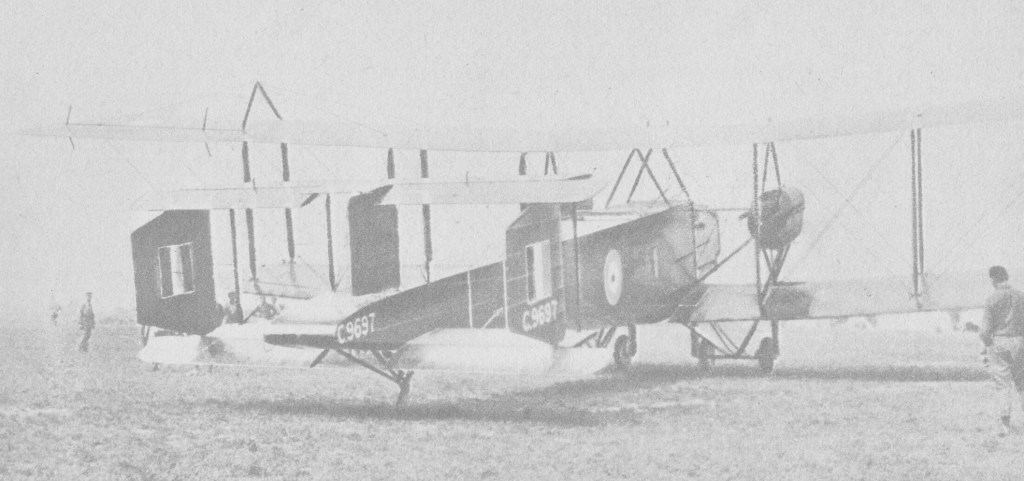
On the Western Front an O/400 was the only aircraft to bomb Essen.
By comparison with the 0/100 the type had more power, detail improvements and the fuel relocated from the two engine nacelles to the fuselage, from where it was pumped to an upper-wing centre section tank for gravity feed to the two inline engines. The type was in service with seven Independent Air Force squadrons (Nos 58, 97, 15, 207, 214, 215 and 216) just before the end of the war, and remained in limited service in the period immediately after the war, until replaced by the de Havilland (Airco) DH10 Amiens and the Vickers Vimy. The O/400 had a slightly longer post-war career in Egypt, where it served with Nos 70 and 216 Squadrons up to 1920.
A total of 700 O/400 were ordered, and about 400 were delivered before the Armistice. In the US 1,500 of these aircraft were ordered from Standard Aircraft Corporation, with power plant comprising two 50hp / 261kW Liberty 12-N engines. Built as components from 1917, of this total only 107 were delivered to Great Britain in 1918 mainly for use as spare parts. Eight were assembled for the the US Army Air Service (AS62445 to 62451, and one other) before signature of the Armistice brought contract cancellation.
A number of British-built O/400 were delivered post-war to China.
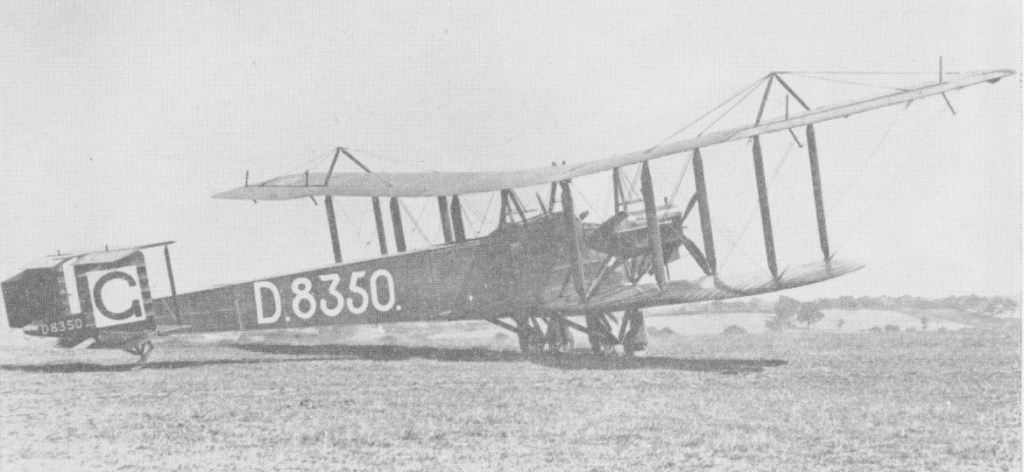
Soon after the armistice with Turkey, Major-General Geoffrey Salmond, with Brig.-General A.E. Borton as chief pilot, flew from Palestine to India in an O/400, the first aircraft to make the journey.
On September 2, 1919, Handley Page Transport Ltd, operating from Cricklewood, began flights between London and Paris, and to Brussels and Amsterdam.
Handley Page used converted O/400 bombers on the London-Paris, London-Brussels routes, and converted de Havilland 9s on the London-Amsterdam. The converted DH9s were designated DH.16s. The fuselage of the aircraft was rebuilt as a cabin with room for four passengers. Converted in the same way, the O/400 has room for 12 passengers.
The O/400 led to the W8 airliner of 1920.
O/400
Engines:
2 x Rolls-Royce Eagle IV, 250hp.
O/400
Engines: 2 x Rolls-Royce Eagle VII, 268kW (360hp).
Span: 30.48m (l00ft).
Length: 19.16m (62 ft 10.25 in).
MTOW: 6360 kg (14,022 lb).
Max speed: 97.5 mph at sea level.
Height: 22 ft.
Operational endurance: 8 hrs.
Wing chord: 10 ft.
Wing area: 1,648 sq. ft.
Weight empty: 8,502 lb
Loaded weight: 13,360 lb.
Ceiling: 8,500 ft.
Armament: 3 to 5 x 7.7-mm (0.303-mg plus up to 907kg (2,000lb) of bombs internally.
Engines: 2 x Rolls-Royce Eagle VIII, 265kW
Wingspan: 30.5 m / 100 ft 1 in
Wing area: 153.0 sq.m / 1646.88 sq ft
Length: 19.6 m / 64 ft 4 in
Height: 6.7 m / 21 ft 12 in
Max take-off weight: 5466 kg / 12051 lb
Empty weight: 3776 kg / 8325 lb
Fuel capacity: 284 Imp.Gal
Max. Speed: 157 km/h / 98 mph
Ceiling: 2600 m / 8550 ft
Range w/max.fuel: 1000 km / 621 miles
Crew: 2
Passengers: 10-14
Standard Aircraft Corp-Handley-Page O/400
Engines: two 350hp Liberty 12-N
Wingspan: 100’0″
Length: 62’10”
Useful load: 3704 lb
Speed: 96 mph
 All Aero