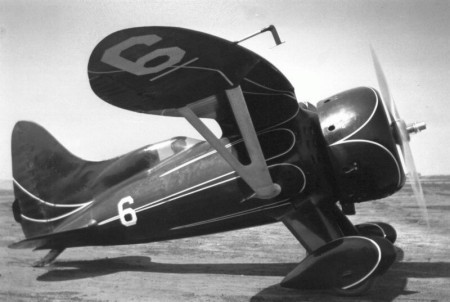
With two firm orders in his hand, Bob Hall had leased a corner of the main hangar at Bowles Agawam Field where work began early in 1932 on the two never to be forgotten Hall racers.
Work began almost simultaneously on the two speed planes. The first was built on order for Flank Lynch, a wealthy sportsman. Lynch expected to fly this high wing plane around the world in a record attempt. It was considerably the larger of the two Hall designs and seated two people in a staggered side-by-side arrangement.
As work progressed, Bob Hall turned his attention to the International Air Races at Niagara Falls New York which were to begin June 24, 1932. At 8:40 p.m. the evening before the big races were to begin at Niagara Falls, the two place aircraft took to the air for the first time with Bob Hall at the controls.
This second race plane designed and built by Bob Hall was a beautiful gull wing design. It was a single place speedster which was expected to be the equal of any other ship entered in the Cleveland National Air Races. This, of course, meant that an exciting rivalry was shaping up in Springfield between the Granvilles and the new Hall group.
The new gull winged racer was built under contract for Marion Price Guggenheim of the New York family, well known for their support of all types of aeronautical activities. The contract stipulated that only Russell Thaw or a pilot designated by him, would be permitted to fly the new race plane. Young Thaw was known as the playboy of east coast society circles and worked as chief pilot for the Guggenheim family, flying a Lockheed Air Express and a Vega. Mrs. Guggenheim would later christen this new race plane the “Bulldog”, in honour of the famed Yale University mascot.
After sitting out the 1932 Cleveland races, Frank Lynch flew his racer back to Bowles-Agawam airport where it was to be gone over in preparation for future competition. A short time later after some minor reworking, Frank Lynch climbed into the cockpit for a routine test flight. But as it turned out, this would be the last flight for both Frank Lynch and the “Cicada”. For as the “Cicada” roared down the runway and became airborne, it suddenly veered from its line of flight and clipped a corner of a hangar top, crashed and burned as horrified spectators watched in disbelief.
Hall chose the gull wing design because he thought it would produce longitudinal stability. He also designed a rather intricate exhaust system with pipes exiting at right angles to the air stream and flush with outer contours of the engine cowling . . . the theory being to create a low pressure area in the exhaust ports to better scavenge exhaust gases, thus increasing the volumetric efficiency of the supercharger. The engine was the same as mounted in the “Cicada”, a P&W Wasp Jr., which developed 535 hp. Hamilton Standard made available to Hall one of their first handmade controllable pitch propellers for use on the “Bulldog”. The wing span was 26 feet with a fuselage length of 19 feet. The racer was painted red and black with a white separator stripe and was assigned race No. 6 for the Cleveland races.
As July slipped into August, feverish preparations were carried on by the Hall group to ready the “Bulldog” for the Cleveland Nationals. The schedule called for an early August test program before the racer would be turned over to Russell Thaw, the chosen race pilot.
Hall held to his schedule and began the testing of the “Bulldog” early in August 1932. His speedy gull wing racer almost came to grief on its very first test flight. As he roared down the runway on his first take-off, the “Bulldog” started to roll to the left at about 10 feet of altitude. Hall cut the engine and got the wing up enough to clear the ground as it fell back to earth on its left wheel. Skillfully he brought the other wheel down and the airplane rolled to a stop. The excess shock caused the left tire to blow out with resulting damage to the wheel pants, which was easily repaired. The “Bulldog’s” fin was then modified three times and the rudder four times, before Hall was satisfied with the ship’s flight characteristics. This was because the gull wing was directionally destabilizing to a degree that Hall had not foreseen. While this was going on, the ejector exhaust system was removed because insufficient time remained to iron out various unforeseen details of heat expansion and contraction of various parts.
Russell Thaw, the chosen race pilot, then got the chance to fly the “Bulldog”. At the last minute Thaw expressed dissatisfaction with the airplane. He indicated that he probably would not fly the plane during the National Air Races after all. There was no indication of whether he would choose a substitute pilot or if Hall himself might fly the plane. Hall’s associates were very disappointed over this sudden turn of events and it was hoped that money could be raised to repurchase the plane from Mrs. Guggenheim. The plane had been officially delivered to Thaw only a few hours before his decision to withdraw it from the races.
Russell Thaw was quoted by newsmen as saying. “The ship is not my idea of a racer”. He declined to elaborate on the statement and things were pretty much up in the air. Hall meanwhile flew the plane to Roosevelt Field to confer with Mrs. Guggenheim. He reportedly had managed to dig up enough money for the ship’s repurchase. This did not transpire but at least he came away from the conference with permission to fly the plane himself in the Cleveland races. At least Hall would not be denied the chance to test his design against that of the Granville group in the famous Thompson Trophy Race. He had missed his chance to enter the Bendix race because of his lengthy conference with Mrs. Guggenheim.
Meanwhile, Frank Lynch had just completed the installation of the new Wasp Jr. engine in his “Cicada” as Bob Hall arrived back at Bowles-Agawam Field with permission to fly the “Bulldog” at Cleveland. They had both missed the Bendix race, so with all due speed they climbed into their airplanes and headed for Cleveland and hopefully some good pylon racing.
At Cleveland preparations were getting underway for the Shell speed dashes, qualifying event for the famous Thompson Trophy Race. Much to everyone’s delight, the Hall “Bulldog” and the Hall “Cicada” came in over the canvas-covered Brookpark Road fence, (the north boundary of the Cleveland Airport), and taxied up to the hangar line. Once in Cleveland the new engine on the “Cicada” began to act up and Lynch and his airplane were forced to sit out the entire Cleveland races. Bob Hall and the “Bulldog” fared much better as Hall qualified his racer at 243.717 mph in the Shell speed dash, which meant he would be a competitor in the Thompson race.
The 1932 Thompson Trophy race would be 10 laps around a 10-mile course. It was flown on Monday afternoon, September 5th. The “Big Daddy” of closed-course air racing events drew eight contestants: Jimmy Doolittle in the Gee Bee R-1, Lee Gehlbach flying the Gee Bee R-2 Jimmy Wedell, Roscoe Turner and James Haizlip in their Wedell Williams Specials, Bob Hall in his red, black and white “Bulldog”, Bill Ong in Howard’s “Ike” and Ray Moore in the “San Francisco I”. With a quick chop of the starter’s flag and the boom of a mortar, the racers were off in a race-horse start.
Hall was first off the ground and around the scatter pylon, but Doolittle in the Gee Bee R-1 passed him almost at once and began pulling away. In the second lap, Ray Moore dropped out with engine trouble and Hall fell back into sixth place. Jimmy Wedell moved up to second place, Turner third, Haizlip fourth, Gehlbach fifth and Ong brought up the rear. The race ended in that order. Jimmy Doolittle lapped the entire field at least once and roared over the finish line trailing smoke and pulling farther ahead with each revolution of the Gee Bee’s eight foot prop. Doolittle’s average speed, a new closed-course record, was 252.7 mph. Wedell in second place had 242.5 mph. Bob Hall placed sixth at 215.57 mph. Needless to say, he was a very disappointed young man. Once again the Granville brothers had proved their ideas for fast aircraft were correct.
There was some conjecture, after the race, that the basic pitch settings on the experimental Hamilton Standard controllable pitch propeller on Hall’s “Bulldog” did not permit the Wasp Jr. to develop peak power during the closed course Thompson event. Hamilton Standard, as well as Pratt and Whitney engineers, analyzing the “Bulldog’s” sluggish performance were anxious to correct the horsepower shortage, but this never did come about.
A short time after the 1932 Cleveland Air Races a disappointed, disillusioned and disgusted Bob Hall dismantled the “Bulldog” so that it would never race again. Cleveland Model Supply, a well known Cleveland model airplane kit manufacturer acquired the cowling, wheel pants and cockpit canopy, the only large pieces remaining after the aircraft was torn apart. These last remaining parts of the “Bulldog” were eventually donated to a scrap metal collection in Cleveland during World War II. The “Cicada” on the other hand met a different fate.
 All Aero