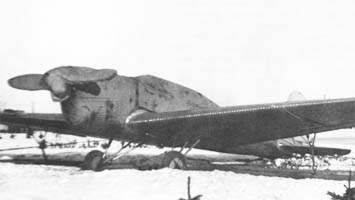
The idea for the creation of the MAI/Grushin Stal-MAI (Russian МАИ/Грушин Сталь-МАИ) arose in 1931, when the TsAGI decided to develop record-setting aircraft to achieve long-range flights. In August 1931, the Military Revolutionary Committee (Revboyensoviet) organized a commission for the development of a long-range aircraft and in December 1931 the decision was made to finance the development of the RD (ANT-25) designed by Sukhoi in the OKB of AN Tupolev and designed to reach 13,000 km. In parallel, it was requested to create an aircraft with a range of about 5000 km.
At the end of 1931, the head of the chair of construction and aeronautical projection of the MAI, DP Grigorovich organized a group of students for the design of the airplane. Such students as P. Grushin, M. Pasinnin, L. Kurbala, V. Fiedulov and A. Shelkin were included in this group.
The strength calculation was developed by VP Yarovitski and the construction was directed by the deputy director of UPM SM Belyaikin. The head of the production workshop was AS Orlov, the engineer-technologist for welding processes L. Pasiechnik. The new aircraft, named Stal-MAI (Steel-MAI) was built by A. Bajariev, V. Novikov, A. Ivanov and others in the MAI.
During the course of the construction process, the technical direction passed to PD Grushin, who in 1933 went on to lead the recently created OKB-1, built on the basis of the KB of the aeronautical construction faculty of the MAI.
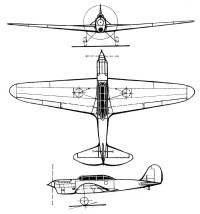
The Stal-MAI was a low-wing monoplane with a straight trapezoidal wing. The relatively short fuselage with monoplane tail of conventional type. The engine was a water-cooled M-34R with 830 horsepower. The engine used in the Stal-MAI was the one used in exhibitions and for this reason it was characterized by a special finish, reflected in the polishing of the outer surface, the chrome finish of the nuts and piston heads, and the painting of the block. The M-34R used a gearbox to drive a variable-pitch metal propeller.
The Stal-MAI was one of the first aircraft in the world made entirely of steel (hence its name). The construction was entirely in Enerzh-6 stainless steel, with fabric covering on the control surfaces. The fuselage was a welded semi-monocoque structure covered with light plates.
The wing featured a double spar. The front spar was located at the thickest point of the profile (28% of the chord) and was built on the basis of shaped strips. The rear spar was made of chrome molybdenum steel tubes. The wings had a wingspan of 18 meters and an area of 40 m², allowing a calculated speed of 320 km/h, with a landing speed close to 100 km/h.
Virtually all construction of the fuselage, wing and tail was made using electric spot welding. The wing and fuselage skin was made with thin 0.3 – 0.5 mm steel sheets. At some key points the shell was reinforced with internally welded corrugated steel. All the ribbing was also made with shaped steel parts.
The landing gear was of the conventional type with retractable main landing gear with air shocks and a tailwheel. The main units retracted into the wing with the help of a hand crank mechanism.
The cabin was two-seater, closed by a single cover.
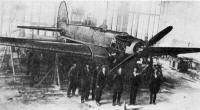
The Stal-MAI was built at the UPM MAI and was delivered for testing in the summer of 1934. The tests took place at the Jodinka airfield and the test pilots were IF Kozlov and Yu. I. Pyontkovsky.
On September 19, 1934, Yu . I. Piontkovski made the first flight of the model. During the fifth flight an accident occurred due to an overheating of the engine. Yu. I. Piontkovski and PD Grushin were able to land successfully, but during touchdown the power bank and the wing fixing base deformed. The repair process was extremely long, extending practically throughout 1935, without actually finishing it, so the plane never took flight again.
Powerplant: 1 x 830 hp M-34R
Wingspan: 18.00 m
Wing area: 40.00 m²
Length: 11.30m
(Calculated)
Maximum speed: 320 km/h
Cruise speed: 280 km/h
Landing speed: 100 km/h
Range: 5000km
Accommodation: 2
 All Aero