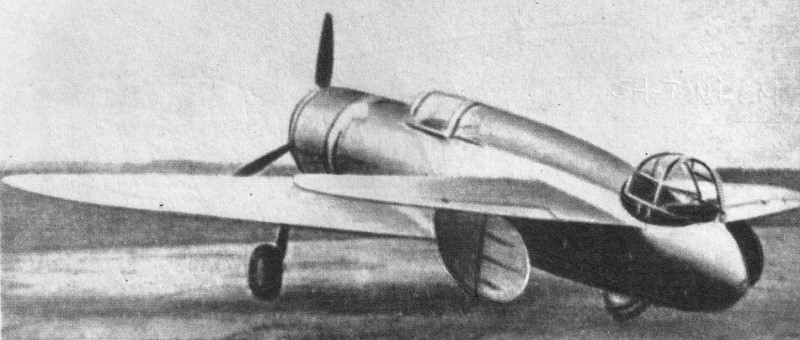
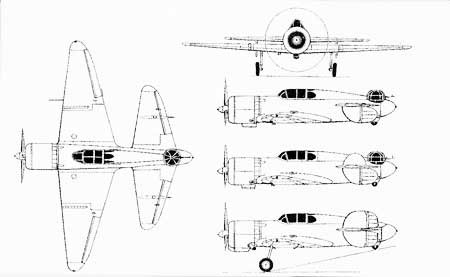
A development of the KB MAI under the direction of PD Grushin, known as Sh-MAI, MAI-3, Sh-Tandem or Tandem-MAI (Russian МАИ/Грушин Ш-Тандем), designed as a two-seater with an unconventional structure of tandem wings. This configuration was selected taking into account that the distribution of mass along the entire length of the cantral axis of the aircraft would allow excellent longitudinal stability. Another success of this configuration was the possibility of locating the gunner’s turret directly in the tail section, which together with the use of a double empennage structure, allowed excellent defensive coverage. The tandem scheme also facilitated armor plating and the location of the weapons bay.
Originally the Sh-Tandem was designed to use an M-88 air-cooled radial engine, but when it was not available an M-87 and later an M-87A were used.
The main wing was set low and housed the main landing gear lugs. The tail wheel was not retracted in flight.
The rear wing was located high on the fuselage and its area represented 45% of the main one, also working as a tailplane. Ailerons were arranged on both wings, behaving at the rear also as elevators.
The vertical empennages were located on the rear wing, roughly in the center of the console’s wingspan.Five different configurations of these vertical fins were tested, ending up with large area washer-like structures, located above and below the wing. Each fin was integrated into the wing structure and contained the rudders. This configuration affected the gunner’s firing coverage area, which led to the need to move him towards the wing.
The Sh-Tandem was built entirely in wood, mainly bakelite plywood. The wing featured a double spar with crafted covering panels.
The Sh-Tandem’s armament was standard for a light attack aircraft and consisted of 4 x 7.62mm ShKAS machine guns in the wings with 2,400 rounds total, one ShKAS machine gun in the turret with 700 rounds and capacity for 200kg bombs externally.
The Sh-Tandem prototype was built in the MAI workshops and the fuselage, the centerplane and the main consoles were built by a group of 18 workers from the institute’s workshops in just 45 days.
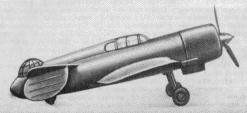
On January 8, 1939, the plane in a single-seat configuration and without weapons carried out the first flight tests with the M-87 engine. In these flights, a high speed was achieved, the performance corresponding to the calculated data. The speed at sea level reached 406 km/h and at an altitude of 4,250 meters it was 488 km/h.
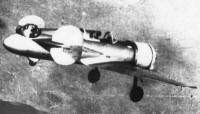
Based on the results obtained in the tests, Grushin was recommended to move the gunner’s cabin a little more to the stern and equip it with an MV-5 turret.
Between September and October 1939, the two-seater version of the Sh-Tandem with a new M-87A power plant with a nominal power of 950 hp and a BISh-3 variable pitch propeller carried out joint factory and state tests. This example featured a rearward gunner’s cabin and MV-3 turret. During the tests, 51 flights were carried out with a total time of 18 hours and 38 minutes. With a flying weight of 2,800 kg, the speed at sea level reached 361 km/h and at 5,600 meters it was 444 km/h. Landing speed without air brakes was 140 – 145 km/h. The takeoff run was 400 meters and the landing run was 480 meters.
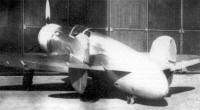
The test report was signed on October 10, reflecting the aircraft’s ease of handling, but in general it was considered that the Sh-Tandem failed the tests because it failed to achieve the results requested by the military, in addition of presenting a tendency to destabilize with increasing speed and other problems such as discomfort in the gunner’s cabin, ineffective design of the landing gear and lack of rigidity in the front wing.
The takeoff was rated as difficult and the upper position of the rear wing was considered not the most appropriate. The armament was also not considered finished. The MV-3 turret “swallowed” 34 km/h speed, so it was decided to redesign the gunner’s position to a version similar to the one used by the Fokker G.1. However, it was considered that the Sh-Tandem scheme represented military interest, so it was recommended to deliver the prototype to the TsAGI, make the improvements and present it again for testing.
The construction of a second prototype characterized by the negative dihedral in the rear wing began. This example included a retractable tricycle landing gear and an M-63 engine capable of developing 800 hp at 4,500 meters. The little formality of the design and the low power of the weapon conditioned the decision of the NKAP to abandon development in May 1939. The second prototype was 70% complete when work was definitively suspended.
The results obtained during the tests were used in the projection of the next model of the KB MAI, a light bomber that was called BB-MAI.
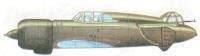
Sh-Tandem
Engine: 1 x 930 hp М-87
Wingspan: 11.00 m
Length: 8.50m
Wing area: 30.40 m²
Normal takeoff weight: 2560 kg
Wing loading: 84kg/m²
Power load: 3.3kg/hp
Maximum speed at sea level: 406 km/h
Maximum speed at altitude: 488 km/h
Landing speed: 145 km/h
Accommodation: 2
Armament: Five 7.62mm ShKAS machine guns
Bombload: 200kg
 All Aero