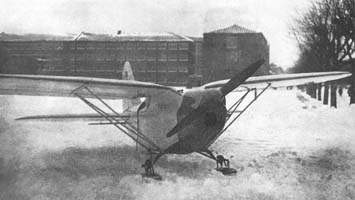
In the mid-30s at the OKB-1 of the Moscow Aviation Institute (MAI), led by PD Grushin, developed a small light aircraft with a monoplane tandem wing named Ortyabrionok (Russian: МАИ/Грушин Октябренок). This project was developed in 1935 to participate in the contest for light aircraft with low engine power, called by the management of Osoaviajim and Aviavnito. The main requirements of this contest were: totally safe flight, wide tolerance in piloting, ability to be used for the preparation of novice pilots and, above all, low manufacturing and operating cost.
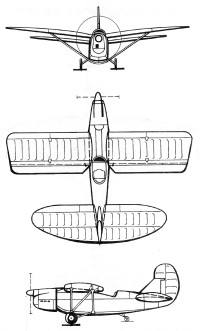
The work on the Oktyabrionok included the development of a scale model for wind tunnel tests, and the development of various configurations. As a result, an airplane with tandem monoplane wings was designed.
On the Oktyabrionok the front and rear wings were fixed. Elevons were located on the forward wing along the entire wingspan of the trailing edge. These elevons that performed functions of elevators, flaps for takeoff and landing operations, and ailerons for turns. The rear wing was embedded in the airframe and lacked control surfaces. The presence of the elevators in the forward wing allowed to obtain a great efficiency in the takeoff and landing operations.
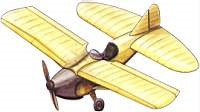
Unlike the French ” Pou du Ciel “, in the Oktyabrionok the front wing was fixed to the fuselage by means of horizontal joints linked to the control stick, which allowed a variation of the incidence of the wing in relation to the longitudinal axis. With this modification, the elevators managed to maintain their effectiveness in all flight regimes, including diving, which managed to solve one of the main deficiencies of the French model, which also caused a few accidents. This configuration was the result of wind tunnel tests and was later confirmed during flight tests. It was flown by pilots with very little experience.
The control of the flight in the basic piloting configuration was executed only by means of the flight stick. In this case the pedals only served to direct the tail wheel on the ground. Modifying the center of gravity of the airplane towards 50 – 60% of the longitudinal axis, it was possible to reduce the stability of the airplane in flight to an acceptable level for pilots with medium qualifications. In this case the pedals were connected to the rudder.
Originally in order folding wings were designed. The front ones were collected upwards and the rear ones back to the sides of the fuselage. In the model development process this option was eliminated.
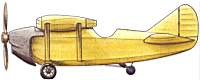
In the initial conception, a power plant that was developed as a project by the OKB-2 of MAI. This model was not yet ready at the time of the competition, so the initial power plant was a 27 hp Obré-Dunné, which was later changed to a 30 hp Bristol Cherub. The plane turned out to be somewhat heavier than the calculations, instead of 230 kg its weight was close to 400 kg. For this reason, after several modifications, a more powerful 45 hp Salmsom engine was installed.
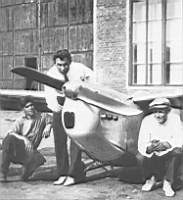
AI Grinchik, PI Blandov, PV Semionov and AA Lebiedinski took a very active part in the construction of the Oktyabrionok. In the process of developing the model, the wing spars were reinforced, shock absorbers were added to the wheels, and the rudder area was increased.
The first flight of the Oktyabrionok took place on October 23, 1936. Test pilot AI Zhukov, chief pilot of the Aviajim Factory, reached 1000 meters. After several turns over the airfield, Zhukov executed an eight, demonstrating the excellent stability of the plane. For takeoff only 50 – 60 meters were enough. For the landing only 15 meters.
On October 30, taking off from the airfield of the MAI aeroclub in Khimki, AI Zhukov flew over the institute and made several figures over the Tushino airfield.
The instructors of the MAI Flying Club, AA Lebiedinski and S. Jolobtsov, flew at Oktyabrionok and PD Grushin himself received his training as a pilot on this plane.
The Oktyabrionok flew well, but the tandem wing configuration did not allow for great aerodynamic advantages relative to the conventional monoplane layout.
After tests at the NII VVS, developed by PM Stefanovski , the Oktyabrionok was delivered to the VVS , being registered as a staff liaison aircraft. It flew successfully for a few years.
In 1938 the Oktyabrionok participated in the air show held in Tushino.
Engine: 1 x 45 hp Salmson
Forward wing span: 6.00 m
Rear wing span: 4.4 m
Total wing area: 12.80 m²
Front wing area: 7 m²
Length: 4.12 m
Empty weight: 295 kg
Maximum takeoff weight: 400 kg
Fuel capacity: 25 kg
Payload capacity: 105 kg
Wing loading: 23 kg/m²
Power load: 8.9 kg/hp
Maximum speed: 115 km/h
Cruising speed: 95 km/h
Landing speed: 55 km/h
Accommodation: 1
 All Aero