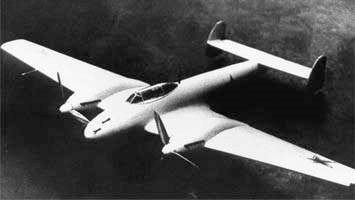
In 1940 PD Grushin was given the task of creating a long-range escort fighter within the experimental aviation development program. Developed by Grushin during his period as the OKB ‘s chief builder at Kharkiv Aviation Plant No.135, the IDS heavy escort fighter name corresponds to the initials Long-Range Fighter (in Russian: Истребитель Дальнего Сопровождения), but it was also known as Gr-1 (Grushin No.1).
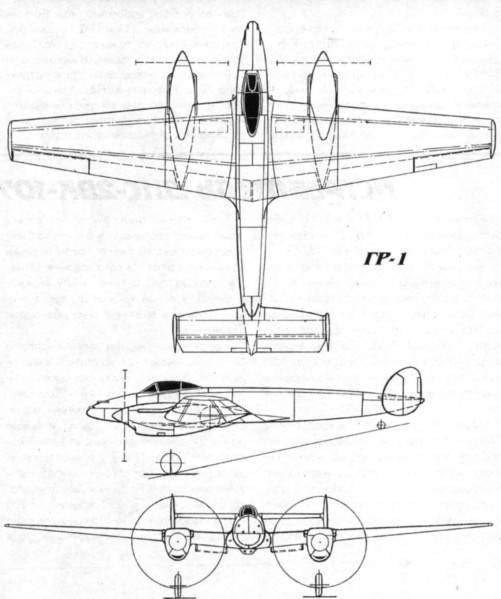
The Gr-1 was designed as a twin-engine monoplane of conventional structure with a twin-empennage tail and was powered by two water-cooled Mikulin AM-37s rated at 1,200 hp. The structure of the Gr-1 was metal. The wings featured spars of square section and the rib of shaped and welded pieces of steel forming a closed contour.
The Gr-1 cockpit featured armor plating using a steel slatted trunk and this was the primary cause for the single-seat configuration selection. During development Grushin asked his specialists to assess between a two-seater configuration with pilot and gunner and an armored single-seater configuration capable of fully defending the pilot. The results showed that the second configuration was 18 kg lighter than the first and from this analysis the Gr-1 emerged as a single-seater.
AM-37 engines featured exhaust manifolds located above the wing and the radiators were located in the lower part of the wing center and had a retractable configuration to reduce the probability of impacts during dogfights.
The IDS had in the nose two 7.62 mm ShKAS machine guns and two 20 mm ShBAK cannons. Two other ShKAS machine guns were located in the wings. All the machine guns had 1,250 rounds, while the cannons had 300 rounds per unit. It was also planned to install a station with a pair of 37 mm guns in the lower part of the fuselage with 200 rounds each.
In the wing, 4 supports capable of carrying eight 100 kg aviation bombs or four RS-82 or RS-132 unguided rockets could be located. Instead of installing guns, up to 500 kg of bombs could be hung under the fuselage.
The Gr-1 was designed and built in just 9 months. The static resistance tests took several days and in the spring of 1941 the plane was ready to fly. After a period of fine-tuning and fixing details, someone objected that the plane had not been tested in the TsAGI wind tunnel. Without this proof, flying was too risky, so the plane was disassembled and sent to Moscow.
After the tests, the plane was again disassembled and sent to Factory No.135 to correct the indications, but the war began.
The Factory was evacuated to the west and the plane was repacked. During the transfer the convoy was bombed. The Gr-1 suffered extensive damage and all the documentation was burned. Work on the fighter was never continued. Grushin was sent to Factory No.21, where he held the post of chief engineer and later replacement for builder Semyon Lavochkin.
Gr-1
Powerplant: 2 x 1,250 hp Mikulin АМ-37
Wingspan: 16.80 m
Wing area: 42.00 m²
Length: 11.60m
Height: 3.88m
Empty weight: 5420 kg
Normal takeoff weight: 7650 kg
Fuel capacity: 1860/2550 kg
Wing loading: 182kg/m²
Power load: 2.73 kg/hp
Calculated
Maximum speed at sea level: 448 km/h
Maximum speed at 7200 m: 595 km/h
Landing speed: 120 km/h
Ascent time to 5000 m: 9.8 min.
Range: 1890 km
Practical range: 1380 km
Practical ceiling: 11700 m
Accommodation: 1
Armament: Four 7.62 mm ShKAS machine guns and two 20 mm ShKAS cannon
Bombload: 500 kg or eight RS-82 and RS-132 rockets
 All Aero