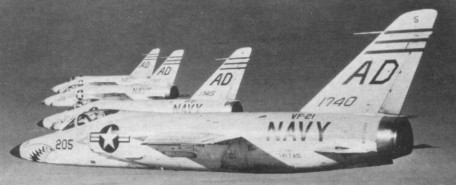
The US Navy’s first transonic shipboard warplane, development of the G-98 was ordered on 27 April 1953 as a revised and improved F9F-6. In the event, there was no commonality with the earlier fighter, but nevertheless, when the first example was flown on 30 July 1954, it was designated YF9F-9, this being changed to F11F-1 in April 1955.
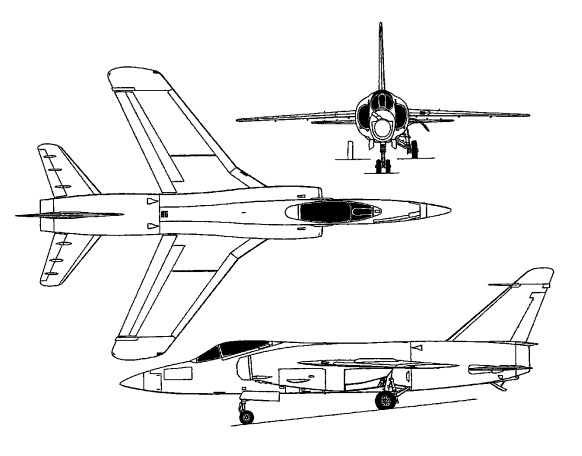
The airframe had mid-set wings sweptback at 30 degrees. There are swept-back tail surfaces, with an all-moving tailplane mid-set on the fuselage. No ailerons are fitted. Lateral control being by spoilers. Leading edge slats are fitted. Trailing-edge flaps are over the full span except for the folding tip portions. Finger type air-brakes are under the fuselage. Two underwing jettisonable fuel tanks may be fitted.
The tricycle under-carriage has a single wheel on each main unit and twin-wheel nose unit. The main wheels retract forward and into the fuselage, and the nose wheels retract rearward.
Able to fly supersonic in level flight, the F11F-9 Tiger was in production for the U.S. Navy in 1955. Six prototypes and 39 F9F-9 were ordered initially. Difficulties with the intended afterburning Wright J65-W-6 engine dictated installation of the derated J65-W-18 in the production F11F-1 with a maximum military thrust of 7,450 lb (3379 kg) and 10,500 lb (4 763 kg) with full reheat. In consequence, the F11F-1 failed to meet contractual performance guarantees.
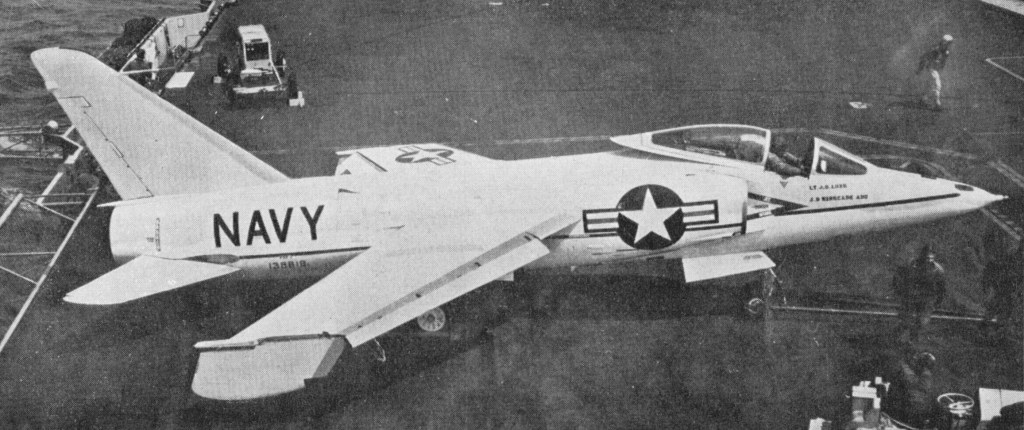
A small number of pre-production aircraft, each with a Wright J65-W-6 turbojet engine with afterburner, were followed by 39 production aircraft (ordered with J65-W-4 afterburning engines).
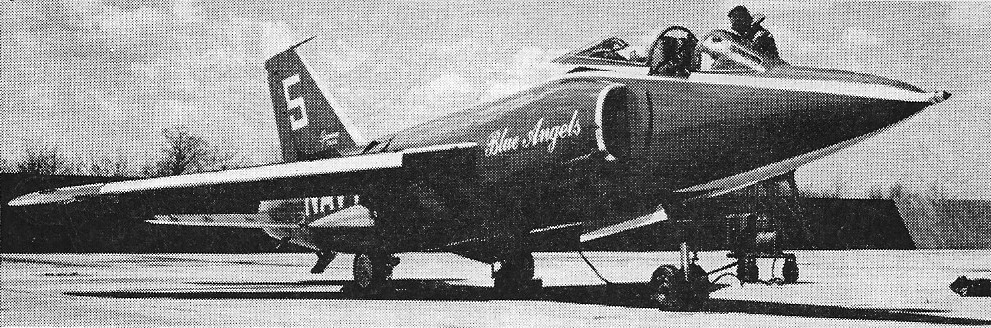
The last two Tigers of the initial production batch were fitted with the General Electric YJ79-GE-7 turbojet rated at 9,600 lb (4 355 kg) military thrust and 15,000 lb (6 804 kg) with reheat as F11F-1Fs.
One of the F11F-1Fs attained a speed of 1,963km/h and set a short-lived height record on 18 April 1958 of 23,449m.

A further contract for J65-W-18-engined Tigers placed for the US Navy brought the total number of F11F-1s built to 201, but these were gradually phased out of first-line service from 1959. Those which remained in second-line service when the tri-service designations became rationalised in 1962 were redesignated F-11A.

Production was limited to 201 aeroplanes, the last being delivered in March 1957, service phase-out commencing in 1959.
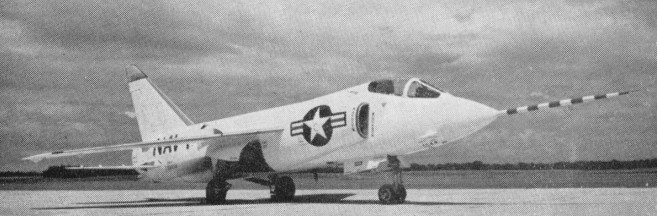
F11F-1
Engine: 1 x Wright J-65-W-6, 33.8kN
Max speed, 753 mph (1212 km/h) at sea level.
Initial climb, 16,300 ft/min (82,8 m/sec).
Range, 1,108 mls (1783 km).
Service ceiling: 16700 m / 54800 ft
Empty weight, 13,307 lb (6 036 kg).
Max loaded weight, 23,459 lb (10 641 kg).
Span, 31 ft 8 in (9,65 m).
Length, 44 ft 10.75 in (13,68 m).
Height, 13 ft 2.75 in (4,03 m).
Wing area, 250 sq ft (23,22 sq.m).
Armament: four 20-mm cannon.
Crew: 1
F11F-1
Engine: 1 x Wright J-65-W-18, 10,500 lb
Span, 31 ft 8 in (9,65 m).
Wing area, 250 sq ft (23,22 sq.m).
Length, 44 ft 10.75 in (13,68 m).
Height, 13 ft 2.75 in (4,03 m).
Empty weight, 13,307 lb (6 036 kg).
Max loaded weight, 24,078 lb
Max speed, 740 mph / M1.12 at 35,000 ft
Service ceiling: 50,500 ft
Range, 600 mls
Armament: four 20-mm cannon.
Hardpoints: 4
Crew: 1
F11F-9 Tiger
Naval fighter
Crew: 1
Engine: Wright J65-W-7 Sapphire turbojet, with afterburner, 7500 lb. thrust.
Wingspan: 31 ft. 5 in
Length: 39 ft.
Loaded weight: approx. 14,000 lb.
 All Aero