
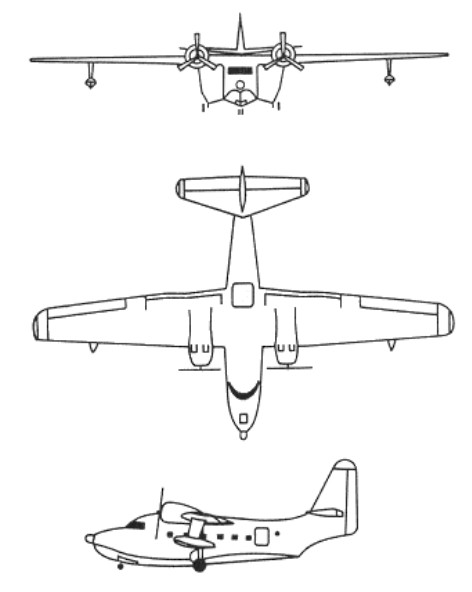
In 1944 Grumman initiated design of its Grumman G-64 aircraft, which was to be named Albatross, and which saw service with the US Air Force, US Coast Guard and US Navy. The Albatross was first ordered as the XJR2F 1 utility transport for the US Navy and the prototype was flown first on 24 October 1947, and was of generally similar configuration to its predecessor. Fixed underwing floats were retained, but these and the entire structure had been considerably refined to reduce drag. Other changes included the provision of a cantilever, instead of strut-braced, tailplane; tricycle type retractable landing gear; and pylons beneath the wing, outboard of the engines, which could carry weapons, or drop-tanks to increase range. The wings and tailplane are unswept, the tailplane with dihedral. The controls are conventional and flaps are split trailing edge type. Additional fuel could also be carried in the underwing, non-retractable, floats. Accommodation was provided for a crew of four and the cabin could accommodate 10 passengers, stretchers, or cargo, according to requirements.
Grumman G-64 / HU-16 Albatross Article
Initial production was of the UF-1 model, and a modified version introduced in 1955 was the UF-2. This latter aircraft had a 16 ft 6 in increased span, a cambered wing leading edge, ailerons and tail surfaces of increased area, and more effective de-icing boots for all aerofoil leading edges.
Many SA-16A were modified to SA-16B standard.
In the tri-service rationalisation of designations in 1962, these aircraft became HU-16C and HU-16D respectively.
Winterised aircraft for Antarctic service were designated UF-1L (later LU-16C), and five UF-1T dual-control trainers were re-designated TU-16C.
The US Navy’s UF-2 general duties amphibian and Coast Guard’s UF-2G were similar to the SA-16B. In 1965 the Coast Guard operated 71 UF-2Gs.
Also operated by the US Navy as the UF-1F and UF-1L. The UF-2S was a modification of the UF-2 for anti-submarine hunter-killer duties. It utilizes much of the equipment developed for the S2F Tracker. Norway ordered 16 examples of the UF-2S. More than 450 Albatross were built.
The USAF found the G-64 attractive for rescue operations, the majority of the 305 ordered serving with the MATS Air Rescue Service under the designation SA-16A. Most of which were converted to SA 16B form with extended wings and tail for operation at greater weight. An improved version, equivalent to the US Navy’s UF-2, entered service in 1957 as the SA-16B; in 1962 these became HU-16A and HU-16B respectively. HU-16E was the designation (originally UF-1F) of Albatross aircraft operated by the US Coast Guard, and 10 supplied to Canada were designated CSR-110.
In service in 1955 with air-sea rescue units of the U.S.A.F. (SA-16A) and with the U.S.N. (UF-1) and U.S.C.G. (UF-1G) for general utility duties. One version has a sprung ski under the hull and small skis under the wing-tip floats, to permit operation from land, water or ice without modification.
An anti-submarine version with nose radome, retractable MAD gear, ECM radome and searchlight was introduced in 1961, and was equipped to carry a small number of depth charges. The versatile Albatross continues in service with a few air forces and navies, but its powerful and fuel-hungry engines have meant that surplus aircraft which became available for use were not a particularly attractive proposition to airline operators, and in consequence few were adapted for such a role.
Several nations used the Albatross, including Argentina, Brazil, Canada, Chile, Greece, Indonesia, Italy, Japan, Norway, Philippines, Portugal and Spain. Many still in service are of the anti-submarine type first flown in 1961, with nose radome, tail MAD boom, underwing searchlight, ECM installations and provision for carrying antisubmarine depth charges, torpedoes or other stores. Full all weather electronics and anti icing equipment are standard.
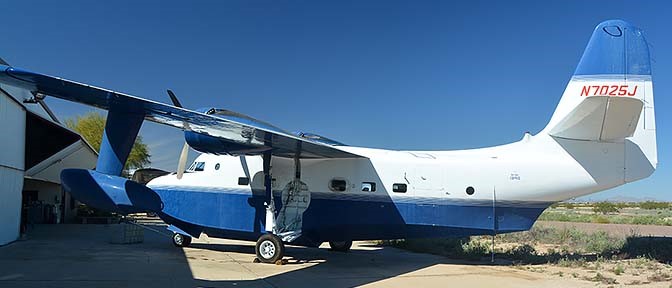
The unique capabilities of the big amphib have caused numerous attempts to modernize the basic hull. In the 1970s, Grumman reconfigured the military design to make room for 28 passengers, and added a galley for food and room for a fight attendant. The new airplane was designated the G111 and awarded FAA certification in 1980. Other Albatrosses have been converted to turbine power.
The Grumman G-111, civilianised version of the HU-16 Albatross, entered service on 1 July 1981 with Chalks International Airline to operate scheduled service between Fort Lauderdale and Paradise Island, Nassau. Chalks is a subsidiary of Resorts International, which has arranged the programme to convert U-16 to G-111 standard. Sub-contracted to Grumman, Chalks took two of the initial batch of five G-111. Up to 50 more were available for conversion.
Transland Aircraft modified HU-16B for civilian use with ATC A2GL.
Principal versions – UH-16A (short-span navy model), UH-16B (long-span navy model), UH-16C (short- span air force model), UH-16D (long-span air force model), and UH-16F (coast guard model).
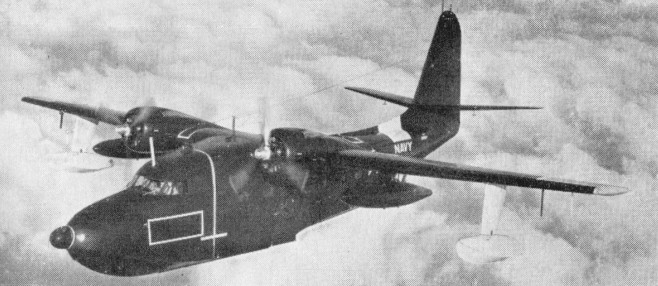
UF-1
Air-sea rescue amphibian.
Engines: 2x 1,425 h.p. Wright R1820-76B
Wingspan: 80 ft
Length: 62 ft. 2 in.
Loaded weight: 27,025 lb.
Max. speed: 247 mph
Typical range: 2,700 miles at 225 mph with 2×300 USG external tanks.
Armament: None.
Crew: 4-6
Capacity: 10 passengers or 12 stretchers.
UF-2S
Engines: 2 x Wright R-1820-76A, 1425 hp
Props: 3 blade
Wing span: 96 ft 8 in
Length: 62 ft 10 in
Height: 25 ft 10 in
Wing area: 1035 sq.ft
MTOW: 37,500 lb
Fuel capacity centre section: 562 Gal
Float fuel capacity: 2 x 166 Gal
Underwing fuel capacity: 2 x 250 Gal
Service ceiling: 21,500 ft
Range: 2850 mi at 124 mph
Wing Hardpoints: 4
HU-16C Albatross
Engines: 2 x 1,425-hp (l,063-kW) Wright R-l820-76A Cyclone
Max range: 2200 nm.
Crew: 4-6
HU-16D Albatross
Engines: 2 x 1,425-hp (l,063-kW) Wright R-l820-76 Cyclone
Maximum speed 236 mph (205 kts / 380 km/h)
Cruise speed: 360 km/h / 224 mph
Service ceiling 21,500 ft (6,555 m)
Range 2,850 nm (4,587 km)
Empty wt.: 22,883 lb (10,380 kg)
MTOW: 35,700 lb (16,193 kg)
Wing span: 96 ft 8 in (29.46 m)
Length 61 ft 3 in (18.67 m)
Height 25 ft 10 in (7.87 m)
Wing area 1,035.0 sq ft (96.15 sq.m).
Crew: 4-6
 All Aero