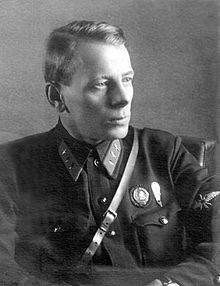
Pavel Ignatievich Grokhovski (in Russian: Павел Игнатьевич Гроховский) was born in March 6, 1899 in Viasma, Smolensk.
His childhood was spent in Tver, where he completed the first four grades of primary education, later entering the Royal College of this city. At the age of 15 Grokhovsky left his studies and his home, traveling to Moscow, where he worked as a messenger for a pharmacy. In those years he frequently visited the Jodynka airfield where Russian aviation pioneers Dokuchayev, Gaber-Vlynski, Lerche held exhibitions, falling in love with aviation.
In 1917 he voluntarily joined a group of revolutionary sailors in Revel (Tallinn), participating in the October uprising. He participated in the Civil War as a sailor on the battle ship “Petropavlovsk”, in the Baltic Fleet. He participated in ground operations under the leadership of IKKoshinov and PEDybenko. Later he fought against the Germans in Ukraine; against Kolchak, Denikin and the White Forces and against the English intervening forces.
In 1919 he joined the Communist Party of the USSR and two years later he was appointed Commissioner of the Black and Azov Seas.
In 1922 he entered flight courses. He studied initially at the Yegorevsk Theoretical School and then at the Borisoglevsk Flight School. In 1925 he finished the Kacha Military Aviation School, becoming a pilot.
His first inventions related to aviation were developed by Grokhovsky in 1927, when he served as a military pilot in the 44th squadron at Novocherkass. In those years bomber training was done with concrete bombs.
Grokhovsky proposed to replace them with clay bombs filled with chalk of different colors. This not only made the teaching process cheaper, but it was very easy to analyze the results of the training since each crew was assigned a color that was scattered at the site of the fall of the artifact.
From 1929 he began to work as a test pilot at the VVS Scientific-Research Institute (NII VVS). In those years, the idea of parachute landing was beginning to develop.
In 1929 Grokhovsky made his first parachute jump.
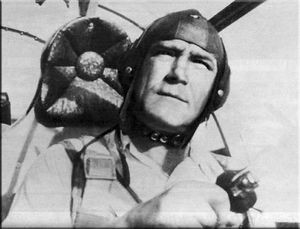
The first Soviet parachutists used the American Irvin system. Each parachute cost about 1,000 gold rubles. Grokhovsky proposed to sew the domes using cheap calico. To demonstrate the possibility of use, Grokhovsky himself and his collaborators performed demonstration jumps.
To study the possibilities of the new idea, the Oskonbyuró (Special Construction Bureau) of the VVS RKKA was created in 1932, dedicated to the development of skydiving and air landing techniques. Grokhovsky was appointed chief and chief builder.
Grokhovsky dreamed of a plane specialized in the transport of paratroopers. His conception would be embodied in the G-37, an aircraft built in the form of a structure with a high fixed landing gear to which a ventral container with landing troops could be attached. This cockpit could be released in flight and fell to the ground with a large parachute 40 meters in diameter.
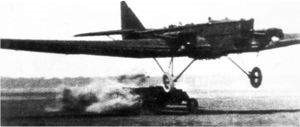
One of Grokhovsky’s novel inventions was his “Aviabus”, a system for launching charges and people from the air without using a parachute. The “Aviabus” was in the form of a flat container in the shape of a short, thick wing, which featured a two-wheel train with rubber cushioning on its bow and a skid on the tail. After launching from a height of 12 – 15 meters above the ground, the “Aviabus” performed a slight glide and when it touched the ground it kept rolling until it lost inertia. With this invention, Grokhovsky was able to considerably reduce the length of stay of the transporter aircraft in the landing area and the problems associated with take-off.
“Aviabus” projects were designed with different capacities and with wheel or ski landing gear. “Aviabus” were developed for land and water landings and even more innovative projects such as a motorized sled, which once launched from the mother plane could start its engine and fulfill its military task as an artillery troop transport. One of the variants was also the “avio-tanqueta”, an armored “Aviabus” with a train of mats and its own engine.
In 1932 the G-63 glider made its appearance. For the first time a glider of such dimensions was built, capable of lifting and transporting 16 soldiers, who travelled lying inside the thick wing. There was also a capacity to transport 500 kg of cargo.
When his organization became an Institute, Grokhovsky had the opportunity to expand his work to the design and construction of airplanes. Between 1934 and 1936, the institute designed and built 5 experimental aircraft models. Grokhovsky generally designed the schematic of the new plane and its development was entrusted to one of his subordinates.
PI Grokhovsky was transferred to a bureaucratic assignment at the Central Council of the Union of Defense Assistance Societies and Aviation-Chemical Construction of the USSR (OSOVIAJIM). The 5 of November 1942 was finally arrested by infundades accusations and ended up dying in prison. The “official” records this death on 2 October 1946 due to tuberculosis.
In 1957, Grokhovsky’s case was presented to the court of the Moscow military region, which completely cleared him due to the lack of evidence that showed involvement in the accusations.
Pavel Ignatievich Grokhovsky was responsible for more than 100 innovations and experimental creations, generally very advanced for his time. He proposed dive bombing long before they began to be used in a massive way, refuelling in the air, the use of the swept wing, the ekranoplanes. Many of these ideas were widely disseminated in later years. Grokhovsky was an exceptional man. His meager education was supplemented by a rare innate instuction. His acquaintances valued him as reckless and audacious, and at times he was irresponsible. Piloting a plane, he performed the acrobatic figures almost at ground level, he always drove the vehicles at high speed, personally tested his most dangerous creations.
Order of Lenin (1933)
Master of the Sport of Skydiving (1934)
Productions related to aeronautics
G-26
Experimental interceptor fighter developed between 1935 and 1936. It was unleashed by the use of a bicycle-type undercarriage with skids under the wings. The prototype was destroyed before its completion.
G-31
Glider from 1933 with capacity for 16 equipped soldiers obtained as an improvement of the previous G-63. Two were produced which were also tested in a motorized version with different powerplants.
G-37
Troop transport plane conceived in 1934 and characterized by its double fuselage and a large light from the ground to be able to transport a launchable container with landing troops under the belly. The container was launched from the air, descending with the help of a parachute.
G-38
Multifunctional combat aircraft known as “Light Cruiser” or LK-2. Developed in parallel with the G-26, the prototype would also be destroyed, when its construction had not yet been completed.
G-39 “Cucaracha”
1939 experimental fighter with arrow wings and tailless configuration.
G-52
“Flying battery” conceived on the basis of a heavily armed Túpolev TB-3 bomber with 76 mm field guns.
G-61
Modification of a Polikarpov R-5 reconnaissance aircraft with cassettes for landing troops located under the wings. Several prototypes were developed, which were successfully tested in 1936. In 1937 two of the civilian version Polikarpov P-5 would be used in an attempt to save Levanevski’s crew
G-63
Initial prototype of the G-31 landing glider. It was destroyed during testing.
Inflatable gliders
The Grokhovsky Institute developed three models of inflatable gliders that were successfully tested between 1934 and 1935.
 All Aero