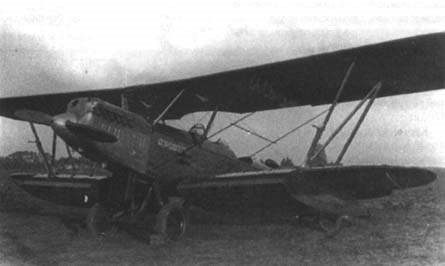
Starting in 1931, Grokhovsky worked on systems for air landing. One of the systems, the Grokhovsky G-61 (Russian: Гроховский Г-61), was to take advantage of all the payload capacity of the aircraft models without affecting their structure. It allowed a stock Polikarpov R-5 reconnaissance biplane to lift 16 people.
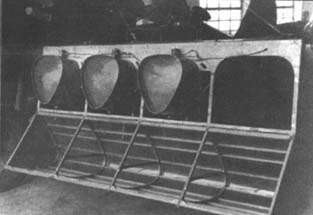
Grokhovsky decided to save resources in construction of specialized aircraft by installing two specially designed cassettes under the underwing of a stock R-5. Each had several compartments designed to carry one soldier.
The first model of the G-61 container had capacity for two paratroopers and could be opened downwards to allow jumping.
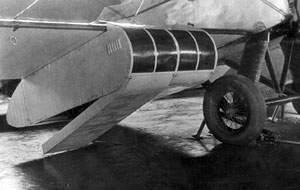
To reduce aerodynamic resistance, the cassettes were designed as a thick wing profile and by protruding from the wing plane in the front and rear area, they increased the wing area by about 7 sq.m. According to the opinion of the institute’s specialists, this should constitute an increase in the lift force and therefore increase the payload capacity of the model. The new leading edge was formed by transparent curved surfaces of Plexiglas, covering the entire width of the cassette and reinforced with a plywood structure.
In addition to transporting soldiers, these cassettes could be used to evacuate the wounded, transport supplies and cargo. Outside the military sphere, the cassettes were used to transport expeditions to remote places, carry out rescue missions, among others.
Cassettes with different capacities were designed, depending on the mission. One of the first versions of the G-61 had only 4 compartments, each calculated to transport a person weighing about 80 kg. The bottom of the compartments could be opened in flight. In this way the pilot could release loads with a parachute or launch the paratroopers into the air.
By 1935 this G-61 system passed factory tests and was delivered to state tests, but Grokhovsky kept working on higher capacity versions.
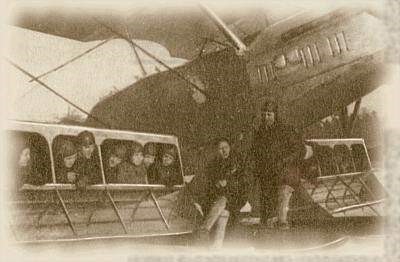
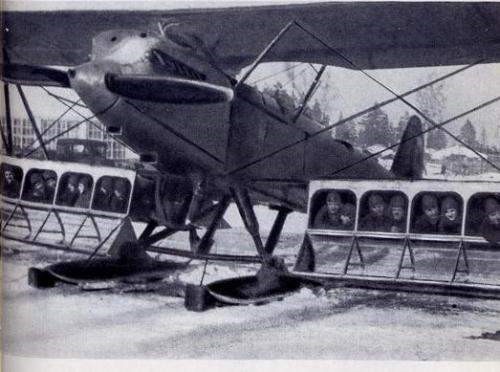
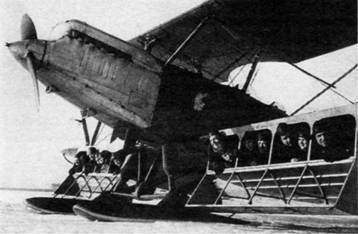
In 1936 a new version was designed. Each cassette held 7 soldiers, bringing the R-5 ‘s capacity to 15 soldiers (including one in the aircraft’s second seat). The construction turned out to be quite light, only about 200 kg. The entire structure of the R-5 was reinforced.
Yakov Alksnis and NN Polikarpov openly expressed their skepticism about the success of the new version. However, by that time Grojovski had a well-earned reputation, so he was given permission to fly his creation. The most difficult thing was finding a test pilot who wanted to test it. Three would refuse, so Grojovski finally decided to take the risk.
On December 8, 1936 at the NKTP Central Airfield in Podlipki an R-5 plane took off with the two new cassettes. The flight had been planned with sandbags until the expected takeoff weight was achieved. These sacks were jokingly known as “Iván Peskov” because this surname means “Son of the Sand”. When Alksnis and Polikarpov arrived to supervise the flight, the plane had already been loaded and the cassettes closed.
The plane with its ski undercarriage traveled around the runway for about 350 meters and took off. At the controls was Pavel Grojovski. The plane made a low-altitude circle flight and took to the runway. The surprise was tremendous when the cassettes were opened and it was found that instead of bags there were 14 Grojovski collaborators. The “official” explanation was that the Iván Peshkov sacks had not arrived on time for the tests and the collaborators had volunteered to take on the weight. In reality, this fact constitutes a sign of the confidence that the workers of the institute had in their boss.
The take-off weight on this flight, including the pilot, a passenger and an auxiliary 250-liter fuel tank, reached 1,650 kg (tests were carried out with weights up to 2,000 kg). Top speed was set at 180 km/h and cruising at about 160 km/h.
Despite Grokhovsky ‘s successes at that time, he began to move away from issues related to the landing to concentrate on aeronautical production. In 1937 the institute would be reorganized and all these works abandoned.
On 12 August 1937, during an attempted flight to the United States via the North Pole, the crew of the Bolkhovitinov DB-A (“Н-209”) would go missing with the crew led by polar pilot SA Levanevski.
On August 25, 1937 Grokhovsky wrote a letter to Stalin in which he reaffirmed that the capacity of the R-5 with the G-61 could be raised from 1,650 to 2000 kg. This would make it possible to locate auxiliary fuel tanks with a pump transfer system to the main tanks and increase the range of the P-5 (civilian version of the R-5) to 3,000 km. In 7 – 10 days Grokhovsky promised to have the cassettes ready. In addition to fuel, these capacities could take food for several months, a tent, an inflatable boat, and all the necessary instruments for a prolonged search.
Grokhovsky further enunciated the advantages of the R-5 for the task due to its ability to land and take off on relatively short runways, the presence of dual flight control, and the possibility of transporting the entire return crew in a single aircraft. The letter ended with a request to allow to equip a P-5 with cassettes and allow it to participate in the search for the crew of “Н-209”.
Grojovski ‘s request was approved. Two P-5 airliners were loaned from the GVF’s northern direction. The first, with factory number 8458, had been delivered in 1934, receiving registration СССР-Л1565 in August. The second example, with factory number 9627, would enter service in June 1935 with registration СССР-Л1937. Both examples received the designation PG-61.
The cassettes were installed in Factories No.89 and 241. The engineers Gubanov (Factory No.241), Mladkovski (GVF Main Directorate), Vorozhtsov (NII GVF) and instrumentalist Lomtiev played a vital role in the modifications.
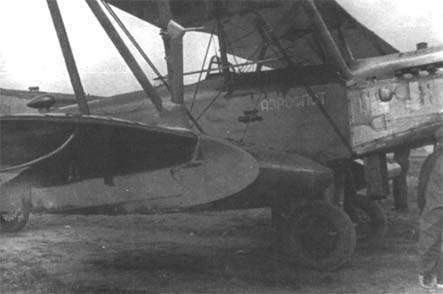
The modifications made made it possible to increase the takeoff weight of the P-5 to 4050 kg. The cassettes were designed in such a way that all the weight was concentrated near the center of gravity of the model.
On September 12, 1937, the aircraft, registered СССР-Л1565, took off from Moscow to Arkhangelsk with the pilot of the experimental institute Boris Bitski. In two days it reached its destination, where the plane was disassembled for transport aboard the steamer “Roshal”, which was traveling to Rudolf Island in the Franz Josef Land archipelago .
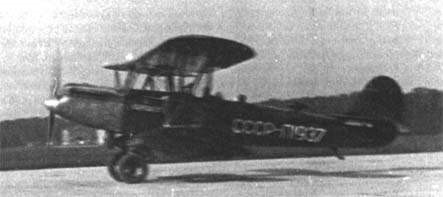
The second example СССР-Л1937 was kept in Moscow for a set of tests. Auxiliary fuel tanks with a total capacity of 840 liters were installed in six of the 8 cassette compartments. The takeoff weight with fuel rose to 3350 kg. In the rest of the compartments there was a reserve radio station, food for two months, weapons, sleeping bags, and additional parts for minor repairs to the plane. The takeoff weight grew to 3780 kg. Instruments for blind flights, a radio-compass and powerful radio equipment were installed in the piloting cabins.
On September 16, 1937, pilot IS Kotov and the radio operator Degtiev began the tests of the aircraft at the Bykovsky airfield. Only four flights were carried out in which it was possible to determine that the aircraft behaved quite well in flight and could be controlled without difficulty, despite its great weight. Takeoffs and landings and horizontal flight of maximum and minimum speeds were tested. The plane behaved well and not unlike the normal P-5.
During the takeoff run, no tendency to deviate to one side was recorded. Takeoff occurred at a speed of 90-95 km/h and the run lasted about 18 seconds.
Horizontal flight was tested at speeds between 135 and 185 km/h. Gliding was tested at speeds of 135 – 140 km/h, demonstrating good stability.
The landing was not unlike normal P-5 aircraft. The auxiliary tank system also passed the tests.
After the culmination of the tests, the СССР-Л1937 plane flew to Moscow, from where it departed for Arkhangelsk, taking on board the same crew that participated in the tests. In Arkhangelsk the plane was disarmed and its crew joined that of the other plane, which had not yet boarded.
The Roshal steamer arrived in Arkhangelsk on October 1. The loading of the ship took 5 days. At the end of October, it would arrive at the island of Rudolf, where a group of Tupolev G-2 planes (civilian transport version of the Tupolev TB-3 bomber) were already present. Despite the number of aircraft and crews, constant weather problems did not allow the pilots of these aircraft to conduct an active search for Levanevski’s aircraft.
Unlike these large aircraft, which arrived flying under their own power, the P-5s, after unloading, had to be fuelled and transferred to the improvised runway. During final preparation on December 2, the ice under Bitski’s aircraft gave way and the СССР-Л1565 aircraft plunged about a meter, damaging its propeller. Next to the plane, Chuxnovski, who was helping in the preparation, fell into the water.
On December 8 both planes were prepared for flights. Both pilots calculated that the weather would improve and in about four days they could take off. In one of the planes the navigator LM Rubinshtein would travel. Inclement weather thwarted this plan.
The weather situation improved only on the 20th and the P-5s, together with Chuxnovski’s G-2, were ready. Bitski and Kotov tried twice to take off, but a broken tail skid prevented them from taking off. It is unknown if the PG-61 took part in the rescue flights or not.
It is known that СССР-Л1937 survived this adventure and was still flying at the beginning of 1941. The fate of the P-5 СССР-1565 is unknown.
Grokhovsky G-61
Powerplant: One M-17B, 680 hp takeoff / 500 hp rated power
Wingspan:15.5/12.6 m
Wing area: 50.2 m²
Length:10.56m
Loaded weight: 3800kg
Wing loading: :75.7 kg/sq.m
Power load: 7.6 kg/hp
Payload capacity: 15 soldiers
Cargo volume :4.3 cu.m
Top speed: 201km/h
Cruising speed: 130 km/h
Take-off run max load: 400 m (30 sec)
Ceiling: 2800m
Accommodation: 1-2
 All Aero